The Evolution of Road Highway Signs for ADAS and Autonomous Driving
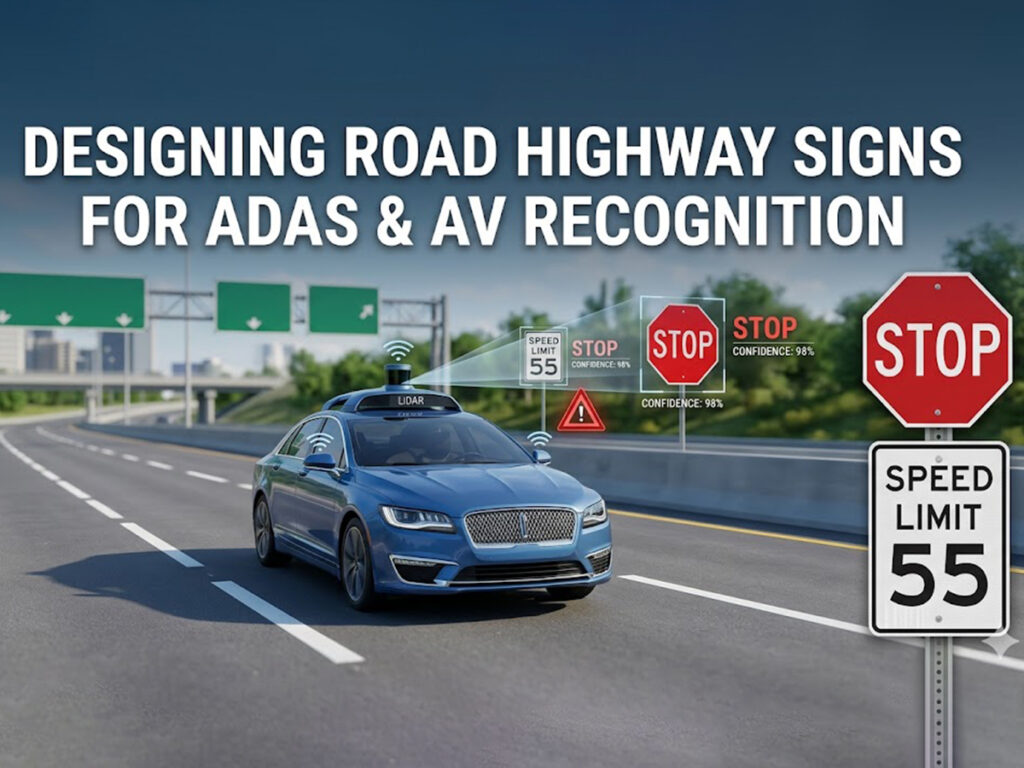
As advanced driver-assistance systems (Адас) and autonomous vehicles scale globally, традиционный road highway signs must serve a dual purpose. They no longer function solely for human interpretation. Вместо, these markers act as critical machine-readable infrastructure. They enable accurate, real-time recognition for onboard vehicle sensors and AI algorithms.
For government highway planners, this shift introduces a sophisticated design paradigm. Modern highway safety signs must integrate high-level visibility with technical standardization. These signs must deliver consistent detection across diverse environmental conditions. Failure to optimize for both human and machine perception can lead to catastrophic navigation errors.
Success in this transition depends on precision engineering. Planners must evaluate how custom highway sign materials and manufacturing influence digital legibility. Strategic material selection ensures the highway traffic sign remains visible to infrared cameras and LiDAR. This approach aligns physical assets with the emerging requirements of intelligent transportation systems.
The Role of Highway Traffic Signs in Computer Vision Road Sign Detection
How ADAS Systems Interpret Highway Safety Signs
ADAS platforms utilize high-resolution cameras and neural networks to perform computer vision road sign detection. These systems analyze pixel data to identify geometric shapes and chromatic frequencies. Once a highway safety sign is detected, the software matches it against a pre-installed library of regulatory symbols. This process enables the vehicle to execute speed adjustments or lane-centering maneuvers automatically.
Machine vision systems require extreme visual consistency to maintain high confidence levels. Unlike humans, algorithms struggle with subtle variations in highway traffic sign appearance. Faded pigments or non-standard fonts can cause “classification errors,” where the AI misidentifies a critical warning. Поэтому, manufacturers must prioritize high-contrast designs and precise color calibration. This uniformity ensures that every road highway sign installation provides a predictable data point for the vehicle’s CPU.
Key Limitations in Current Computer Vision Road Sign Detection
Current detection systems face technical bottlenecks that threaten road safety. Overcoming these limitations requires a shift toward “machine-optimal” инфраструктура.
- Pixel-Level Degradation: Environmental factors like heavy rain or salt spray can distort the visual signature of a highway traffic sign.
- Edge Case Failures: Low-sun angles often cause “blooming” effects on camera sensors. This glare washes out the symbols on standard highway safety signs.
- Inconsistent Retroreflectivity: Many older road highway signs lack the uniform brightness necessary for nighttime infrared detection.
- Geometric Occlusion: Dirt accumulation or physical damage can alter the recognizable silhouette of a sign.
Addressing these pain points involves deploying signs with enhanced optical properties. By using materials that mitigate glare and resist weathering, planners significantly improve computer vision road sign detection reliability. High-performance signage acts as a redundant safety layer, ensuring the vehicle receives clear instructions even in sub-optimal driving conditions.
Core Design Principles for Highway Signs for ADAS Recognition
Standardized Marker Geometry for AI Readability
Geometric consistency serves as the primary anchor for highway signs for ADAS recognition. AI models utilize “template matching” to identify predefined shapes within a camera’s field of view. Any deviation from these geometric standards leads to misclassification or catastrophic detection failure.
Implementing standardized marker geometry for AI provides several technical advantages:
🛑Октагоны (Стоп знаки): Unique eight-sided silhouettes allow for identification even when the sign face is partially obscured.
⚠Треугольники (Yield/Warnings): Acute angles create distinct feature points for edge-detection algorithms.
🔶Бриллианты (Строительство): Consistent corner-to-corner ratios allow sensors to calculate the vehicle’s relative distance and angle.
🪧Vertical Rectangles (Регулирующий): Strict height-to-width proportions ensure predictable bounding boxes for object detection software.
For highway planners, enforcing these standards across all highway traffic sign deployments is vital. While specific regions may have subtle differences, as detailed in the, maintaining geometric purity remains the universal requirement for system reliability. For more information about the shapes of road traffic signs, read about our 8 basic shapes of road signs.
Optimizing Contrast, Цвет, and Symbol Simplicity
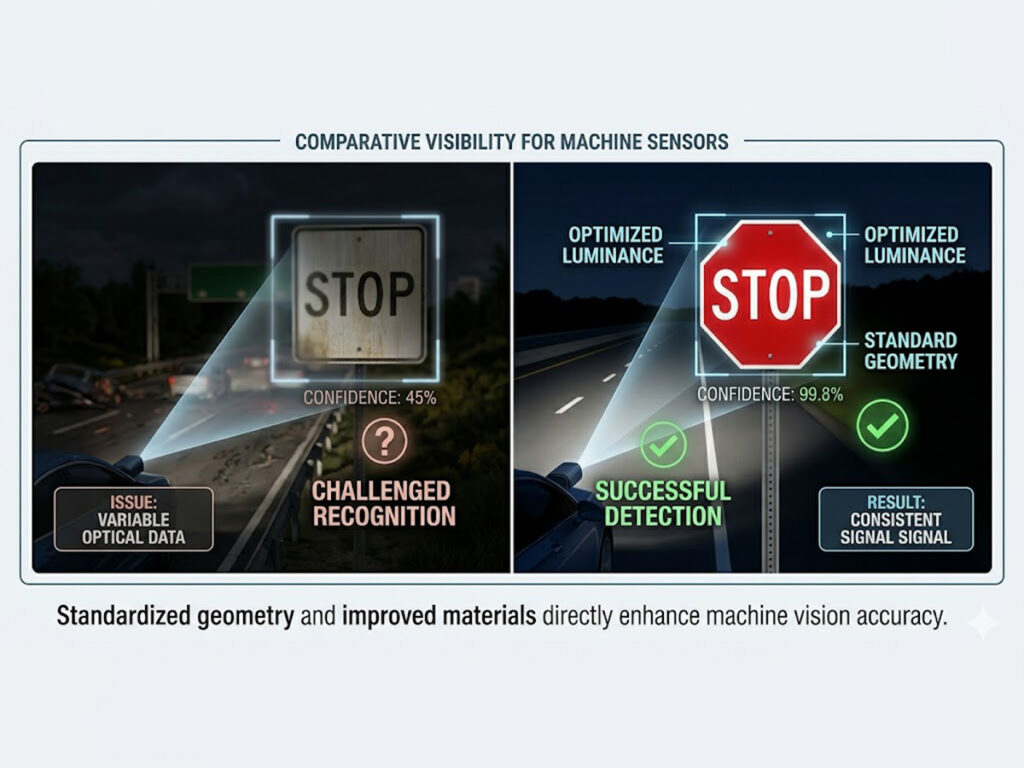
High chromatic contrast and luminance ratios are the primary drivers of computer vision road sign detection reliability. Unlike the human eye, which can compensate for lighting shifts, AI sensors rely on stable “Signal-to-Noise” ratios to isolate a highway traffic sign from the background environment. Standardized color palettes—such as high-intensity fluorescent yellow for warnings—provide a specific spectral signature for AI classification.
Key design considerations for road highway signs включать:
- Luminance Contrast Ratio: Engineers must maintain a minimum contrast ratio (обычно 12:1 или выше) between the legend and the background. This ensures the sign remains legible to sensors during “high-flare” условия, such as direct sunrise or sunset.
- Symbolic Primacy and Feature Points: Relying on universally recognized pictograms allows AI to use “feature point extraction” instead of complex text-recognition (Пост). Simple symbols reduce the computational latency required to process a highway traffic sign.
- Edge Definition and Chromaticity: Sharp, clean edges on symbols prevent “pixel bleeding” in digital captures. Professional manufacturing ensures that road highway signs maintain strict chromaticity coordinates within the CIE color space, preventing AI from misidentifying a red stop sign as a brown tourist marker.
- Minimalist Layouts: Avoiding text-heavy designs eliminates “signal clutter.” This simplification prevents the “over-segmentation” of images, where the AI struggles to distinguish between primary instructions and secondary information.
Optimized, высококонтрастный road highway signs accelerate the decision-making process for vehicle CPUs. By prioritizing these optical principles, highway signs for ADAS recognition ensure consistent performance across the full spectrum of autonomous infrastructure.
Material Innovation: Infrared Reflective Sheeting and Machine Visibility
Why Infrared Reflective Sheeting Improves Detection Accuracy
Traditional materials primarily serve human vision within the visible spectrum. Однако, advanced ADAS sensors often utilize the near-infrared (NIR) spectrum to “видеть” through darkness and atmospheric haze. Integrating infrared reflective sheeting into highway signs for ADAS recognition creates a high-contrast signal invisible to humans but brilliant to sensors.
This specialized material provides several technical advantages for machine vision:
- Spectral Optimization: These layers reflect light in wavelengths specifically tuned to CMOS and LiDAR sensor sensitivities.
- Enhanced Nighttime Fidelity: NIR reflection reduces the reliance on active vehicle lighting, allowing for earlier computer vision road sign detection.
- Illumination Consistency: The material mitigates the “размыв” effect caused by high-intensity LED headlights, maintaining symbol legibility.
Durability and Performance of Modern Highway Safety Signs Materials
Material longevity directly dictates the reliability of autonomous navigation systems. Physical degradation, such as micro-cracking or pigment fading, significantly degrades the accuracy of computer vision road sign detection. When a sign loses its optical properties, the AI may fail to identify a critical safety warning.
Modern engineering focuses on sustained performance through several defensive layers:
- UV-Resistant Overlays: These coatings block harmful radiation to maintain the chromaticity and contrast of road highway signs.
- Hydrophobic and Anti-Soiling Surfaces: Specialized films repel water and dirt, предотвращения “signal occlusion” that confuses machine learning algorithms.
- Long-Life Retroreflective Microprisms: Advanced prisms maintain high-angle reflectivity even after years of environmental exposure.
Для планировщиков инфраструктуры, lifecycle performance is as vital as initial compliance. Understanding how material selection impacts sign longevity helps agencies reduce long-term maintenance costs. Specifying high-durability highway safety signs ensures that the physical road network remains compatible with evolving AI technology for decades.
MUTCD 11th Edition AV Standards and Their Impact on Highway Sign Design
Key Updates in MUTCD 11th Edition AV Standards
The MUTCD 11th Edition AV standards establish the first comprehensive federal framework for automated vehicle support. Конкретно, Section 5A.04 mandates higher minimum retroreflectivity levels for highway safety signs. This ensures that sensors can distinguish markers from environmental clutter. Unlike older versions, the 11th Edition emphasizes consistent highway marker design to reduce algorithmic confusion during complex navigation.
Более того, Раздел 2А.07 requires specific legend and border contrast ratios. This rule improves the ability of computer vision systems to isolate critical symbols. The updated standards also address the “Uniformity of Meaning” principle. This ensures that a highway traffic sign conveys the same digital signature across all state lines. These shifts move infrastructure toward a hybrid model that prioritizes both human perception and machine readability.
Aligning Highway Traffic Sign Infrastructure with Future Regulations
Government agencies must proactively align their road highway signs with these evolving federal standards. Compliance is no longer just about human safety. It now involves optimizing the physical road network for digital interoperability. Proactive alignment helps agencies avoid the massive costs of emergency retrofitting as autonomous vehicle penetration increases.
To achieve long-term highway marker compliance, planners should focus on three strategic areas:
- Systematic Legacy Audits: Identify and replace aged highway safety signs that fail to meet the new Section 5A retroreflectivity thresholds.
- Geospatial Consistency: Standardize the placement and height of every highway traffic sign. This reduces the “search area” for onboard vehicle cameras.
- Material Precision: Use high-performance films that meet the chromaticity requirements defined in the latest MUTCD 11th Edition AV standards.
Early adoption of these regulations improves overall road safety and project longevity. By integrating these technical specifications now, planners create a robust foundation for future autonomous corridors. This strategic foresight ensures that road highway signs remain functional assets in an increasingly automated world.
Designing Highway Signs for ADAS Recognition in Real-World Environments
Размещение, Высота, and Angle Optimization
Strategic positioning is critical for highway signs for ADAS recognition. Machine vision sensors have fixed “cones of vision” and limited dynamic ranges. If a highway safety sign sits at an irregular height, the AI may fail to trigger the correct detection bounding box. Consistent mounting ensures that onboard cameras can predict exactly where the sign will appear.
Тематическое исследование: The Michigan I-94 Connected Corridor
A real-world implementation of this logic is the Michigan I-94 Connected Corridor project led by Cavnue and the Michigan Department of Transportation (MDOT). This project creates a dedicated lane for automated vehicles using “digital twin” технология. By standardizing the placement, высота, and orientation of every highway traffic sign, the project reduces the “search space” for vehicle sensors, significantly lowering computational latency. (Источник: https://www.michigan.gov/mdot/projects-studies/studies/traffic-and-environmental-linkages-studies/cav-corridor-project)
Planners must also manage the “incidence angle” to maximize retroreflectivity. Improperly angled signs cause “specular reflection,” which blinds camera sensors with localized glare. Proper orientation ensures that light returns efficiently to both human drivers and vehicle sensors.
The following table compares placement requirements across different environments:
| Среда | Placement Challenge | Optimization Strategy |
| High-Speed Rural | Long-range detection lag | Increased mounting height and larger highway traffic sign scale. |
| Dense Urban | Visual clutter and shadows | Frequent placement and high-contrast backgrounds for better segmentation. |
| Mountainous/Curved | Limited line-of-sight | Angled bracket adjustments to maintain perpendicularity to the sensor. |
Redundancy and Digital Integration in Smart Road Systems
Reliability in autonomous navigation requires redundant infrastructure layers. Planners increasingly deploy multiple road highway signs to provide “failsafe” confirmation for AI decision-making. If a single sign is obscured by a large vehicle, a secondary marker ensures the system receives the necessary data.
Modern smart systems integrate these physical assets with digital technology:
- Sequential Signage: Placing duplicate highway safety signs at 500-foot intervals allows the AI to verify information through multiple data captures.
- Hybrid VMS Integration: Combining static road highway signs с Переменные знаки сообщения (Виртуальные машины) provides real-time updates for dynamic traffic conditions.
- Digital-Physical Synchronization: Smart infrastructure ensures that the physical highway traffic sign matches the digital map data sent to the vehicle via V2I.
Such redundancy supports safe operation in both human-driven and autonomous scenarios. By ensuring multiple points of detection, government planners mitigate the risks of sensor occlusion and environmental interference.
Implementation Strategies for Government Highway Planners
Auditing Existing Highway Safety Signs for ADAS Compatibility
A systematic audit serves as the foundational step toward infrastructure modernization. Agencies must transition from simple visual inspections to data-driven assessments of machine readability. В рамках MUTCD 11-го издания (Section 5A.01), maintaining specific minimum retroreflectivity levels is now a critical safety mandate for supporting automated vehicle operations.
During the audit process, planners should evaluate these technical dimensions:
Specifying Next-Generation Highway Signs in Procurement
Procurement specifications must evolve to reflect the requirements of the 2026-2030 Strategic Highway Safety Plans (SHSP). Modern contracts should move beyond ASTM D4956 Type I (Инженерный класс) and mandate high-performance prismatic films. These materials provide the wide-angle reflectivity necessary for both LiDAR and human drivers.
Effective procurement documentation should include the following technical requirements:
- Infrared Reflective Sheeting Integration: Mandating coatings that reflect light within the 700nm to 1100nm range for enhanced night vision recognition.
- Enhanced Contrast Ratios: Specifying a minimum 3:1 contrast ratio between the sign legend and background to optimize computer vision road sign detection.
- Regulatory Alignment: Requiring full compliance with the latest MUTCD 11th Edition AV standards regarding font stroke and border width.
Vendor selection should prioritize manufacturers with proven expertise in smart infrastructure. Choosing a provider that understands the intersection of highway traffic sign design and AI perception ensures long-term regulatory compliance. This strategy future-proofs the highway network against the rapid scaling of autonomous technology.
- Luminance Thresholds for CMOS Sensors: Engineers must ensure that road highway signs maintain a luminance intensity within the dynamic range of CMOS sensors. For reliable detection at night, the retroreflectivity coefficient (R_A) should typically exceed 15 к 25 cd/lx/m^2 for white backgrounds. If the luminance falls below 7 cd/lx/m^2, sensors struggle to distinguish the sign from ambient “pixel noise,” leading to detection failure.
- Geometric Fidelity: Identifying non-standard or aged road highway signs that deviate from the standardized marker geometry for AI training sets.
- Environmental Obstruction Analysis: Assessing if vegetation or urban clutter causes “pixel occlusion.” This prevents AI algorithms from locking onto the sign silhouette and identifying its purpose.
Заключение: Building Future-Ready Highway Traffic Sign Systems for Autonomous Mobility
The transition toward autonomous mobility requires a fundamental redesign of highway safety signs. These assets no longer function as passive markers. Вместо, road highway signs now serve as critical, real-time data inputs for intelligent vehicle navigation systems. Ensuring these physical markers remain machine-readable is essential for the safe scaling of self-driving technology.
By adopting standardized marker geometry for AI and advanced infrared reflective sheeting, government planners can future-proof their infrastructure. These technical upgrades allow sensors to maintain high confidence levels in complex driving environments. Более того, aligning local projects with MUTCD 11th Edition AV standards ensures cross-jurisdictional consistency for all automated systems.
Strategic investment in highway signs for ADAS recognition enhances overall road safety. This approach ensures compatibility with a transportation landscape where humans and machines share the roadway. By prioritizing high-performance highway traffic sign design today, agencies build a resilient foundation for the smart infrastructure of tomorrow.
Часто задаваемые вопросы: Optimizing Highway Infrastructure for ADAS & АВ
вопрос: How does the MUTCD 11th Edition AV standards specifically impact retroreflectivity requirements for government planners?
The MUTCD 11th Edition AV standards (specifically Section 5A.04) elevate the compliance threshold to support machine vision. Unlike traditional standards focused on human photopic vision, these regulations prioritize consistent highway traffic sign яркость. Planners must now maintain higher minimum retroreflectivity levels to ensure that CMOS sensors can distinguish critical symbols from background “pixel noise” in low-light environments.
вопрос: Why is standardized marker geometry for AI more critical than traditional sign shapes?
While humans can infer meaning from a damaged sign, AI models rely on “template matching” и “feature point extraction.” Adopting standardized marker geometry for AI—such as precise octagons and triangles—provides predictable bounding boxes for detection algorithms. This geometric consistency reduces computational latency and prevents misclassification errors in Advanced Driver Assistance Systems (Адас), especially at high speeds where processing time is limited.
вопрос: What are the technical benefits of using infrared reflective sheeting for autonomous vehicle recognition?
Infrared reflective sheeting addresses the spectral sensitivity of LiDAR and NIR (Near-Infrared) камеры. Traditional materials may wash out under high-intensity LED headlights, but infrared coatings reflect light in wavelengths (700nm to 1100nm) specifically tuned for machine sensors. This material innovation ensures that road highway signs remain visible to the vehicle’s “digital eye” even when environmental glare or heavy fog obscures the visible spectrum.
вопрос: Can upgrading highway safety signs improve the reliability of computer vision road sign detection in urban corridors?
Да. Urban environments present “signal clutter” that confuses AI. By deploying high-contrast highway safety signs with simplified symbolic layouts, planners reduce the risk of “over-segmentation” in image processing. Strategic upgrades to road highway signs—focusing on sharp edge definition and standardized chromaticity—directly improve the success rate of computer vision road sign detection in complex, high-interference city settings.
вопрос: How does material durability influence the long-term ROI of highway signs for ADAS recognition?
Autonomous systems are highly sensitive to “physical noise” caused by UV degradation or micro-cracking. Using high-durability materials ensures that highway signs for ADAS recognition maintain their specific photometric properties over a 10 to 12-year lifecycle. For government agencies, specifying UV-resistant and anti-soiling coatings reduces the frequency of emergency audits and ensures the infrastructure remains compatible with evolving V2I (Транспортное средство в инфраструктуру) требования.
Ссылки
- FHWA — MUTCD, 11-е издание, Часть 5: Automated Vehicles (Provisions for AV Support): https://mutcd.fhwa.dot.gov/pdfs/11th_Edition/part5.pdf
- FHWA — MUTCD, 11-е издание, Раздел 2А.07: Retroreflectivity and Illumination Standards: https://mutcd.fhwa.dot.gov/pdfs/11th_Edition/part2a.pdf
- Мичиганский департамент транспорта (MDOT) — Cavnue I-94 Connected Corridor Project: https://www.michigan.gov/mdot/projects-studies/studies/traffic-and-environmental-linkages-studies/cav-corridor-project
- ASTM International — ASTM D4956-22: Стандартные спецификации на световозвращающую пленку для контроля дорожного движения: https://www.astm.org/d4956-22.html
Похожие статьи из этой серии:
Руководство для каждого штата по проектированию и соблюдению требований к дорожным разметкам