For road construction contractors and project managers, accurate budgeting now extends beyond unit pricing. Em 2026, competitive bidding and asset management depend on understanding highway sign lifecycle costs rather than just upfront expenditure. This guide provides a framework to evaluate the total cost of ownership (TCO) and improve infrastructure procurement ROI.
Beyond the Sticker Price: Redefining Highway Signage Costs in 2026
The Paradigm Shift from Unit Price to TCO
Tradicionalmente, procurement focused on the cost of custom road signs at the point of purchase. This narrow view often causes budget overruns and erodes margins during project execution.
Modern contractors adopt a TCO-driven strategy to evaluate every stage of a sign’s lifecycle. This shift enables a more precise highway signage budget calculation. It reduces lifecycle risks and strengthens your position in competitive tenders.
Defining the 2026 TCO Model
The industry standard for evaluating highway signs now follows a specific financial model. Every project manager must account for four primary cost centers:
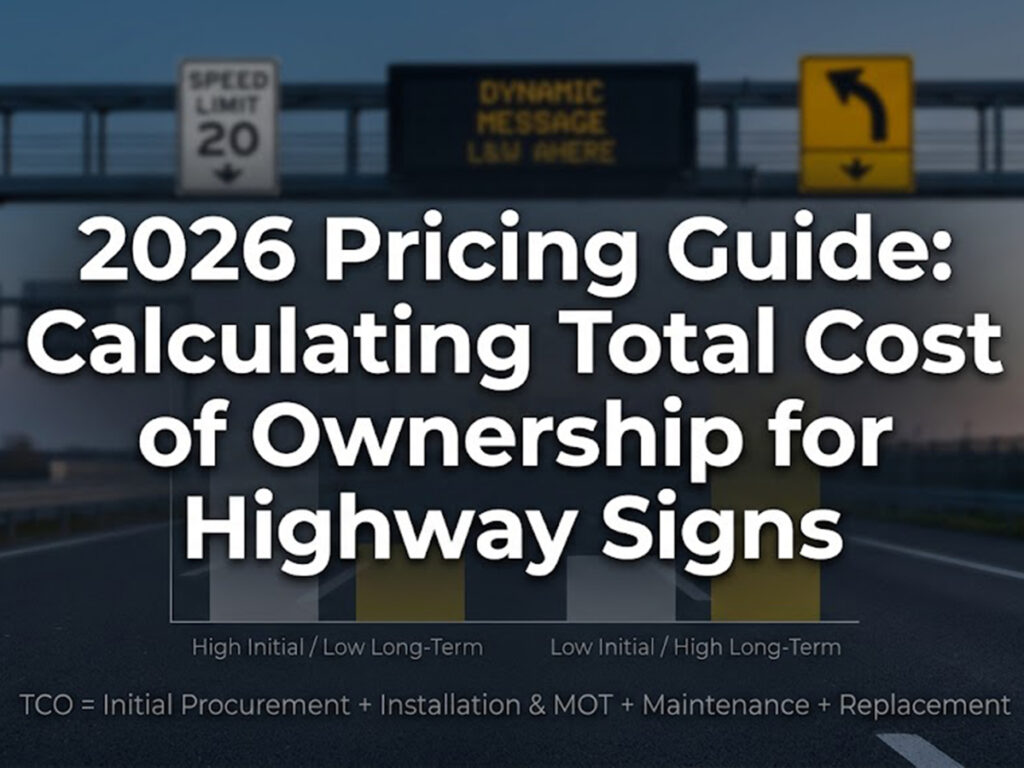
TCO = Initial Procurement + Instalação & Logística + Manutenção + Replacement Cycle Costs
Each component directly impacts project profitability and long-term asset performance. Failing to account for installation or maintenance often leads to significant financial friction later.
Before finalizing your highway signage budget calculation, it is essential to verify that your selected specifications meet local DOT requirements. We have detailed the impact of different production methods in our complete guide to custom highway signs, providing the technical data needed for precise bid preparation.
Fase 1: Initial Acquisition and Manufacturing Variables
Material Grade and Reflective Sheeting Performance Levels
Material choice dictates the initial cost of custom road signs and their long-term viability. Engineers must align sheeting selection with the specific visual requirements of high-speed corridors. Under the ASTM D4956 standard, performance levels vary significantly in brightness and durability.
The table below illustrates the 2026 cost-to-performance ratio based on current procurement data from the Federal Highway Administration (Fhwa) and leading manufacturers.
| Tipo de Folha (ASTM D4956) | 2026 Leste . Preço (por metro quadrado. ft) | Vida de serviço | Primary Application |
| Tipo IV (QUADRIL) | $8.50 - $11.50 | 7–10 Years | Secondary roads & zonas temporárias |
| Tipo XI (Grau de diamante) | $15.50 - $21.00 | 12+ Anos | Interestaduais & zonas críticas de segurança |
| Infrared-Reflective | $23.00+ | 12+ Anos | ADAS-optimized corridors |
Data source: https://fdotwww.blob.core.windows.net/sitefinity/docs/default-source/fpo/fpc/reports/sres/quarterly/2025-2026-1st-quarter-sres-report.pdf?sfvrsn=6d8f5443_1
UM “higher entry, lower exit” cost structure defines these investments. While Type XI requires a higher upfront spend, it offers superior retroreflectivity for older drivers and heavy vehicles. Em 2026, the industry is shifting toward infrared-reflective materials. These enhance detection for CMOS sensors in Advanced Driver Assistance Systems (ADAS). Integrating these future-ready materials adds value to infrastructure projects by ensuring compatibility with autonomous vehicle technology.
Engineering and Customization Premiums for Custom Road Signs
The cost of custom road signs escalates when projects move beyond standard regulatory markers. Customization introduces structural complexities that require certified professional oversight. Any highway signage budget calculation must account for these engineering man-hours and specialized fabrication.
O 2026 highway sign pricing guide 2026 must integrate the following regulatory and structural drivers:
- MUTCD 11th Edition Compliance (Seção 2A.08 & Table 2A-3): This updated regulation mandates that agencies must maintain retroreflectivity at or above minimum levels. Especificamente, Table 2A-3 (formerly Table 2A-5 in older versions) defines strict candela thresholds (cd/lx/m^2). Por exemplo, white regulatory signs must maintain a minimum of 50 cd/lx/m^2, while yellow or orange warning signs require at least 75 cd/lx/m^2 (ou 50 cd/lx/m^2 for bold symbols).
- Structural Load Calculations: Signs in high-wind zones require a specific gauge thickness for aluminum substrates. Engineers must calculate the “drag” of the sign face to prevent structural failure. Para 2026 projetos, structural steel prices remain volatile, making efficient design more critical than ever.
- Foundation and Support: Large overhead gantry structures require reinforced steel supports. These components often exceed the cost of the sign face itself.
Contractors must integrate wind load ratings and structural integrity documentation into their initial bids. This proactive approach prevents underbidding and ensures the long-term durability of traffic signs under extreme environmental stress. By referencing established standards, project managers can justify the procurement of high-tier materials as a risk-mitigation strategy.
Fase 2: The “Invisible” Costs of Installation and Logistics
Mobilization, Gerenciamento de tráfego, and Foundation Costs
Installation is frequently underestimated in highway sign pricing guide 2026 models. Na prática, mobilization, maintenance of traffic (MOT), and foundation construction can exceed the manufacturing cost of custom road signs. According to the Associated Builders and Contractors (ABC), construction input prices surged at an annualized rate of 12.6% in early 2026 (Fonte: https://www.abc.org/News-Media/News-Releases). This spike directly increases the labor and equipment costs required for site preparation.
A detailed highway signage budget calculation must account for the following deployment variables:
- Maintenance of Traffic (MOT) Conformidade: A parte da 11ª edição do MUTCD 6 governs temporary traffic control. Especificamente, Section 6C.01 requires contractors to justify any lane closures with a formal traffic control plan. Certified crews must deploy attenuator trucks and temporary barriers to protect workers. These safety measures often add $2,500 para $5,000 per day to urban installation projects.
- Foundation Engineering: Seção 2A.06 of the MUTCD stipulates that sign supports must be crashworthy or shielded. Em 2026, the cost of installing steel sign supports averages approximately $131 per foot in high-activity states like Illinois. Foundations in urban areas must also navigate underground utilities, significantly increasing labor hours for certified crews.
- Equipment and Mobilization: Máquinas pesadas, such as cranes and post drivers, carries high daily rental rates. Regional mobilization fees fluctuate based on distance from the dispatch hub.
| Installation Factor | Urban Site Est. Custo (2026) | Remote Site Est. Custo (2026) |
| MOT / Controle de tráfego | Alto ($5k+ per day) | Baixo ($1.5k+ per day) |
| Foundation Labor | Alto (Utility conflicts) | Moderado (Standard soil) |
| Mobilization Fee | Baixo | Alto (Long distance) |
Data based on 2026 RSMeans Heavy Construction Cost Data
Supply Chain Logistics and Shipping in 2026
Global supply chain dynamics continue to influence pricing in 2026. Ongoing geopolitical instability and energy spikes have pushed freight costs higher. Contractors who optimize logistics planning can significantly improve infrastructure procurement ROI by reducing per-unit transportation costs.
Key logistics considerations for 2026 incluir:
- Fuel Surcharges: Diesel price volatility directly impacts freight rates for heavy highway markers. De acordo com o 2026 Construction Economics Report, shipping and freight costs remain elevated by 4% para 8% compared to previous years due to new trade tariffs (Fonte: https://www.wsinc.com/blog/construction-supply-chain-disruptions-2026/).
- Bulk Shipping Efficiencies: Consolidation reduces the environmental and financial impact of transportation. Ordering highway signs in bulk allows contractors to amortize fixed shipping costs across a larger volume of units.
- Lead Time Risks: Supply constraints on primary metals, such as aluminum and steel, can delay project schedules. Early procurement is essential to avoid liquidated damages associated with late project delivery.
Effective logistics management prevents budget overruns and ensures the long-term durability of traffic signs by avoiding rushed, improper handling during transit. Project managers should coordinate closely with suppliers to secure fixed freight rates during the bidding phase.
Fase 3: Lifecycle Management and Maintenance Expenditures
Maintenance Costs of Highway Signs and Compliance Audits
Ongoing maintenance costs of highway signs represent a substantial portion of the TCO. Agencies must perform regular inspections to satisfy the MUTCD 11th Edition Section 2A.08. This section mandates that agencies use a defined method to maintain sign retroreflectivity at or above established minimum levels.
Contractors must budget for several high-cost maintenance activities over a 15-year period:
- Retroreflectivity Audits: Handheld retroreflectometers, essential for compliance, custo entre $12,000 e $25,000 desde cedo 2026. Mobile units for highway-speed data collection can exceed $150,000 por veículo.
- Asset Tracking and Data Management: MUTCD Seção 2A.08 encourages digital inventory systems to track the “expected sign life.” Modern cloud-based management platforms typically involve annual subscription fees ranging from $1,500 para $5,000 for mid-sized districts.
- Environmental Cleaning and Treatments: Road salt residue and pollution drastically reduce nighttime visibility. In urban corridors, anti-graffiti coatings are now a standard requirement. Professional-grade non-sacrificial coatings cost approximately $65 para $85 per gallon in 2026.
Failure to maintain these standards increases liability risks. If an accident occurs due to poor visibility, agencies face significant legal penalties. According to FHWA nighttime visibility guidelines, signs that fall below minimum candela thresholds are considered to have exhausted their useful service life.
Long-term Durability of Traffic Signs: Preventing Early Replacement
The long-term durability of traffic signs directly determines how often you must spend on replacement labor. Choosing lower-quality materials creates a cycle of unplanned expenses. Emergency replacements often cost three to five times more than scheduled installations due to overtime labor and expedited shipping.
| Durability Factor | Low-Tier Sheeting (Tipo IV) | High-Tier Sheeting (Tipo XI) |
| Typical Warranty | 7–10 Years | 12–15 Years |
| Ciclo de reposição | 1.5x to 2x more frequent | Stable long-term performance |
| Adhesive Integrity | Risk of edge delamination | Superior weather resistance |
| Visibility at 10 Anos | Often below 50% of initial | Remains above MUTCD minimums |
Data source: 3M Road Safety Durability Comparison 2026 e Ohio DOT Technical Manuals.
Structural degradation is another critical factor. Inferior substrates may corrode or warp, leading to premature failure of the reflective face. High-performance materials maintain their retroreflectivity even after a decade of UV exposure. By investing in premium sheeting and heavy-gauge aluminum, contractors significantly improve their infrastructure procurement ROI. This proactive choice avoids the $40–$75 per hour overtime rates typical for emergency sign crews in 2026.
Strategic Scenario: 10-Year Cost Analysis (Comparison Case Study)
Comparing two distinct procurement strategies reveals the breakeven point between initial savings and long-term profitability. The following data draws from the 2026 FHWA Asset Management Model and the FDOT 2026 Q1 Material Cost Reports.
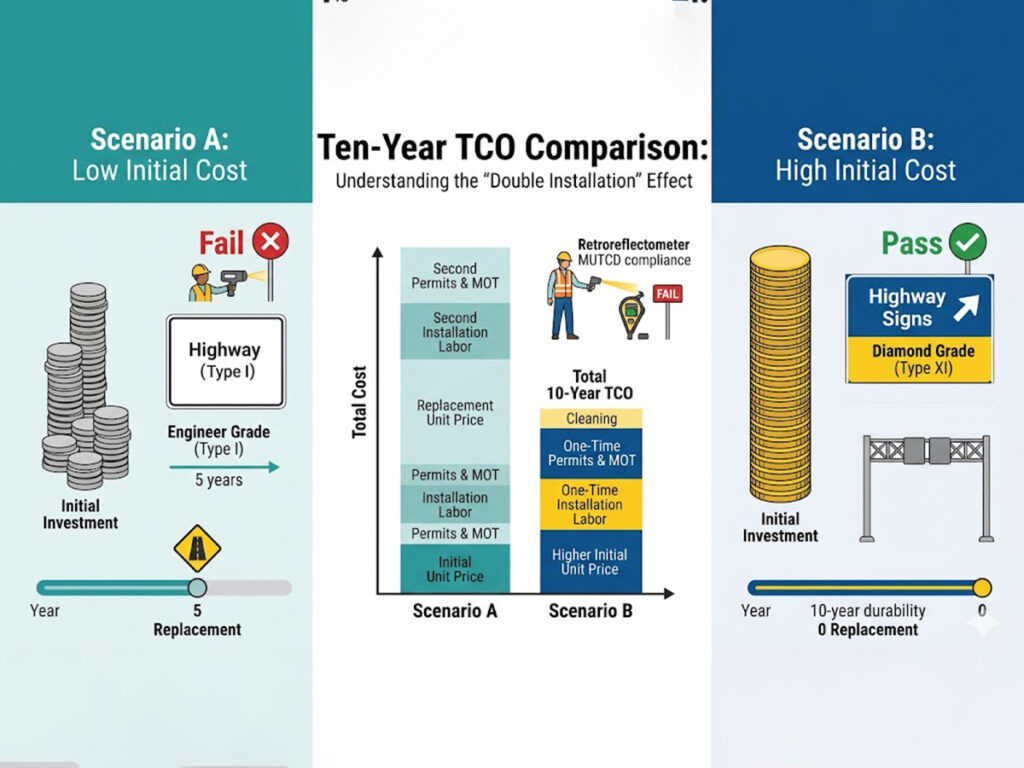
Case Study A: The Low-Initial-Cost Trap (Grau do engenheiro)
Neste cenário, a contractor selects Engineer Grade (Type I/II) reflective sheeting to meet a tight initial budget for a state highway resurfacing project.
- Investimento inicial: Aproximadamente $8.50 por pé quadrado.
- Operational Outcome (Years 1–5): The signs show significant retroreflectivity decay by year four. According to MUTCD 11th Edition Table 2A-3, 35% of the warning signs fail compliance audits by year five.
- Ciclo de reposição (Ano 6): The contractor must perform a non-scheduled full-scale replacement.
- Secondary Procurement Cost: Due to 2026 raw material volatility, the unit price rises to $9.50/sq.ft.
- Custos ocultos: Re-applying for lane closure permits (MOT) and labor fees average $3,200 por dia.
- 10-Year TCO Result: While the initial cost was low, o “double installation” causes total expenditures to exceed the original estimate by 145%.
Data Source: Compiled from FHWA Minimum Retroreflectivity Maintenance Standards and 2026 Regional Labor Indices.
Case Study B: High-Performance Investment (Grau de diamante)
In this comparison, the project manager selects high-performance materials such as 3M™ Diamond Grade™ DG3 (Tipo XI).
- Investimento inicial: Aproximadamente $18.50 por pé quadrado (aproximadamente 117% higher than Option A).
- Operational Outcome (Years 1–10): The signs maintain exceptional photometric stability. De acordo com o 2026 FDOT Quarterly SRES Report, these materials typically retain over 80% of their initial retroreflectivity after a decade.
- Maintenance Profile: Only routine cleaning is required every three years, costing approximately $65 per gallon for specialized cleaning agents.
- Risco de conformidade: Zero compliance penalties occur over 10 anos. The signs remain fully compatible with the sensor requirements of ADAS (Sistemas avançados de assistência ao motorista) widely adopted in 2026.
- 10-Year TCO Result: Despite the higher initial spend, the Total Cost of Ownership is 38% lower than Option A due to the elimination of secondary labor, logística, and traffic management fees.
Data Source: Data extrapolated from FDOT 2025/2026 1st Quarter SRES Report and manufacturer durability benchmarks.
Finalizing Your 2026 Procurement Strategy for Sustainable Profitability
Resumindo, a professional highway signage budget calculation must focus on avoiding the “low-price trap.” To ensure project success and protect your margins, consider the following strategic pillars:
- Prioritize ROI over CapEx: During the bidding phase, use 10-year or 15-year lifecycle cost models to justify the use of premium materials.
- Mitigate Labor Risks: Labor and Maintenance of Traffic (MOT) costs will continue to rise throughout 2026. Reducing the replacement frequency is the most effective way to increase long-term project profit.
- Ensure Regulatory Safety: Selecting materials that exceed MUTCD 11th Edition Section 2A.08 standards is the best defense against legal liability and audit failures.
Strategic Advice: Contractors should partner with suppliers capable of providing detailed reflective sheeting performance levels and TCO projection models. This data-driven approach not only optimizes your bid but also ensures long-term viability in the competitive 2026 infrastructure market.
Frequently Asked Questions Regarding 2026 Highway Signage Procurement
1º trimestre: Why is the 10-year Total Cost of Ownership (TCO) more critical than the initial unit price for highway signs?
While a low initial cost of custom road signs may appeal to procurement officers, the unit price often accounts for less than 40% of the total lifecycle expenditure. Em 2026, the primary expenses stem from labor-intensive activities like Maintenance of Traffic (MOT) and site mobilization. Selecting high-performance materials reduces the replacement frequency, directly lowering the long-term highway signage budget calculation by eliminating repetitive installation and permitting fees.
Q2: How does the MUTCD 11th Edition impact the 2026 highway sign pricing guide?
The MUTCD 11th Edition Section 2A.08 mandates that agencies establish a maintenance program to keep retroreflectivity above minimum levels defined in Table 2A-3. Choosing materials with superior reflective sheeting performance levels ensures compliance for 12 para 15 anos. Por outro lado, lower-grade sheeting may fail audits within 5 para 7 anos, triggering mandatory, unplanned replacement costs that significantly degrade your infrastructure procurement ROI.
3º trimestre: What hidden installation factors most frequently lead to budget overruns in 2026 projetos?
Beyond the physical highway signs, the most volatile costs are foundation engineering and traffic management. Para 2026 projetos, MOT requirements under MUTCD Part 6 have become more stringent, often requiring attenuator trucks and certified safety crews. Em ambientes urbanos, esses “invisível” costs can exceed $3,000 por dia. Contractors must include wind load structural engineering and utility clearance labor in their initial bids to prevent margin erosion.
4º trimestre: Are infrared-reflective materials a necessary investment for 2026 infrastructure bids?
As Advanced Driver Assistance Systems (ADAS) and autonomous vehicle technologies achieve higher market penetration, infrastructure must become machine-readable. Infrared-reflective materials provide a “future-proof” advantage by ensuring CMOS sensors can detect highway signs in low-visibility conditions. Investing in these materials now secures the long-term durability of traffic signs and prevents premature obsolescence as DOT standards evolve toward smarter road systems.
Q5: How can contractors mitigate the impact of 2026 supply chain volatility on signage costs?
The highway sign pricing guide 2026 is heavily influenced by fuel surcharges and fluctuating aluminum prices. To protect profit margins, contractors should utilize bulk procurement strategies to amortize fixed logistics and shipping fees. Securing fixed-rate contracts with manufacturers during the early bidding phase ensures that your highway signage budget calculation remains stable, even if regional freight costs spike during the construction period.
Artigos relacionados nesta série
Projetando sinais de rodovia para ADAS e reconhecimento de veículos autônomos
Um guia estado por estado para projeto e conformidade de marcadores rodoviários
Back to Pillar: O guia completo para sinalização rodoviária personalizada: Materiais, Custos, e Fabricação
Referências
- FHWA — MUTCD 11th Edition, Seção 2A.08 & Table 2A-3: Maintaining Minimum Retroreflectivity (Minimum candela requirements for 2026 conformidade): https://mutcd.fhwa.dot.gov/pdfs/11th_Edition/part2a.pdf
- FHWA — MUTCD 11th Edition, Papel 6: Controle temporário de tráfego (Standards for MOT and lane closures): https://mutcd.fhwa.dot.gov/pdfs/11th_Edition/part6.pdf
- Administração Federal de Rodovias (Fhwa) — Nighttime Visibility and Sign Retroreflectivity FAQ (Lifecycle and maintenance benchmarks): https://highways.dot.gov/safety/other/visibility/nighttime-visibility-sign-retroreflectivity-frequently-asked-questions
- Florida Department of Transportation (FDOT) — SRES Report Q1 2025-2026 (State-level material cost and durability data): https://fdotwww.blob.core.windows.net/sitefinity/docs/default-source/fpo/fpc/reports/sres/quarterly/2025-2026-1st-quarter-sres-report.pdf
- Departamento de Transporte de Ohio (ODOT) — Traffic Engineering Manual, Seção 2 (Standard service life and substrate durability): https://www.transportation.ohio.gov/working/engineering/roadway/manuals-standards/tem/02
- ASTM International — ASTM D4956 – 19: Standard Specification for Retroreflective Sheeting for Traffic Control (Material classification and performance tiers): https://www.astm.org/d4956-19.html
- 3M Road Safety — Transportation Asset Management & Durability Guide (Comparative data for Type IV vs. Type XI materials): https://www.3m.com/3M/en_US/road-safety-us/