In the United States litigation environment, US construction safety signage is far more than a visual warning—it is a critical piece of “defense evidence.” While many project managers believe they are safe as long as they meet the bare minimum of federal regulations, relying on 60-year-old design standards could leave a firm vulnerable in a “failure to warn” lawsuit.
While federal regulations allow for both standards, the shift toward a more visual safety language is clear. If you are new to these regulations, you can start with our foundational guide on ANSI Z535 and OSHA requirements before diving into the legal and material complexities discussed below.
This guide analyzes the critical transition from legacy OSHA 1910.145 to the modern ANSI Z535 standard and why the choice of material is as important as the words on the sign.
The Evolution of Site Safety: Moving Beyond “Legal Minimums”
수십 년 동안, the standard for US construction safety signage was defined by OSHA 1910.145. These signs are characterized by simple, text-heavy headers (위험, 경고, or CAUTION). While still technically “합법적인” under federal law, they were designed for an era before high-speed machinery and diverse, multilingual workforces.
The modern industry gold standard is ANSI Z535. ~ 안에 2013, OSHA updated its regulations to incorporate ANSI Z535 designs. 오늘, while both are permitted, ANSI is the preferred standard for EPC (공학, 획득, and Construction) firms because it is engineered for human factors—ensuring warnings are seen, 이해했다, and followed in milliseconds.
Why the ANSI Header System Reduces Liability
The primary reason to upgrade site safety signs to ANSI Z535 is liability protection. In a US courtroom, an “adequate warning” must explain the nature of the hazard and the consequences of ignoring it.
The ANSI Z535.2 three-panel design provides a robust warning structure:
- The Signal Word Header: Color-coded urgency (위험 for fatal risks, 경고 for serious injury, 그리고 주의 for minor risks).
- The Safety Pictogram: A universal icon that bridges language barriers on multicultural jobsites.
- The Message Panel: Explicitly states the consequence (예를 들어, “Can cause severe internal burns”) and the action required to stay safe.
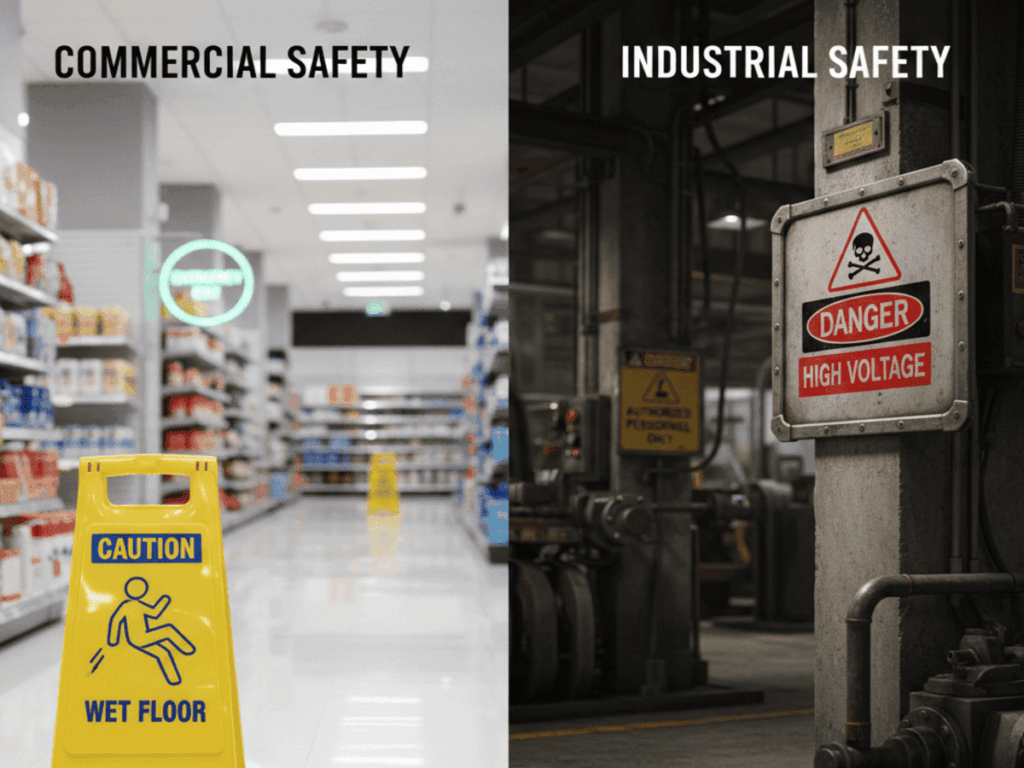
업계 통찰력: A legacy OSHA sign that simply says “위험: 고전압” is often deemed “inadequate” by modern safety auditors. An ANSI sign that explains why the voltage is dangerous and how to avoid the hazard provides a significantly stronger legal defense for the site operator.
The use of universal pictograms is a growing global trend to ensure on-site safety regardless of a worker’s native language. 하지만, the specific symbols used in the US can differ significantly from those used in Commonwealth countries. Discover how these visual languages diverge in our guide to 오스트레일리아 사람 (처럼 1319) 대. 영국인 (ISO 7010) 건설 안전 표지판.
Why Material Science is the Backbone of ANSI Compliance
Most general guides overlook a critical legal reality: A sign that has faded beyond the specified ANSI safety color gamut (Munsell Notation) is no longer compliant.
In high-UV regions like the Texas oil fields or Florida construction zones, standard screen-printed signs often suffer from “chalking” 이내에 12 달. When the red of a DANGER header fades to a pale pink, its psychological urgency—and its legal standing—evaporates.
High-Performance Engineering Solutions:
To ensure 10-year ANSI compliance, industrial-grade manufacturing focuses on:
- Sub-Surface Printing: Graphics are printed on the backside of UV-stabilized polycarbonate, using the material as a shield.
- ASTM G154 Tested Overlaminates: Materials proven to maintain 95% color retention after 2,000 hours of intense UV exposure (simulating years of desert sun).
- Fluoropolymer Coatings: Preventing chemical “wicking” and ink degradation in oil and gas environments.
The Physics of Recognition: Retroreflectivity and Safety
ANSI Z535.2 dictates that signs must be legible under their intended lighting conditions. For night shifts or low-visibility mining sites, 기준 “엔지니어 성적” film is often a liability.
Industrial safety signage utilizes 고강도 프리즘 (IV 형) 판금. The difference is measured in the Coefficient of Retroreflection ($R_A$):
- Standard Sign: $\대략 70\ cd/lx/m^2$
- Industrial ANSI Sign: $> 360\ cd/lx/m^2$
This extra luminosity provides vehicle operators with an additional 3 에게 4 seconds of reaction time—the difference between a near-miss and a fatal site accident.
기술 비교: Standard OSHA vs. Heavy-Duty ANSI
| 특징 | Legacy OSHA 1910.145 | Modern ANSI Z535 (Industrial Grade) |
| 의사소통 | Text-Only (영어) | Iconic + Multi-Panel Message |
| Legal Standing | Minimum Requirement | 모범 사례 / Liability Protection |
| 반사율 | Optional/Basic | Type IV Prismatic (높은 가시성) |
| UV 저항 | 6 – 12 개월 | 5 – 10 연령 (UV-Stabilized) |
| 언어 | 단일 언어 | Universal Pictograms (Multilingual Friendly) |
결론: Investing in Industrial Integrity
In the US construction and energy sectors, “industrial-grade” is not a marketing term—it is a risk management strategy. 선택 US Construction Safety Signage that meets the ANSI Z535 standard and survives extreme environments ensures the protection of both the workforce and the site’s legal standing.
To support that level of control, 광교통 manufactures durable, compliance-focused safety signs for harsh sites, and it backs large-scale delivery with factory-level QC and consistent production. Explore OPTRAFFIC’s signage capabilities here: Construction Safety Signs & Industrial Site Signage.
FAQ: US Construction Safety Signage Procurement
Technically, OSHA 1910.145 is the law, but OSHA’s 2013 Direct Final Rule officially incorporates ANSI Z535. While you won’t be fined for using legacy OSHA signs (as long as they are legible), you may face “일반 의무 조항” citations if a legacy sign is proven to be “inadequate” for a specific hazard that the modern ANSI standard would have mitigated.
ANSI Z535.2 says crews should place signs at a height that stays “readily visible” to the intended viewer. For general site safety, teams typically set the sign center about 5–7 feet (1.5–2.1 m) above the ground. 하지만, crews should adjust placement for underground utilities or floor-level hazards, based on the operator’s actual line of sight.
If a US jobsite is located in California, federal OSHA/ANSI compliance is not enough. Proposition 65 requires specific warnings for exposure to chemicals like lead, 석면, or silica. These must include the exact statutory language and a yellow triangle pictogram. Failure to include these “State-Specific” warnings can result in civil penalties of up to $2,500 per day per violation.
For outdoor daytime construction, it is not mandatory. 하지만, for tunnels, high-rise stairwells, or enclosed industrial facilities, the International Building Code (IBC) and NFPA 101 require photoluminescent exit path markings (tested to ASTM E2072 standards) to ensure evacuation capability during a total power failure.