Si vous dirigez des équipes pour le contrôle de la circulation routière, vous n'avez pas besoin d'un autre mur de texte : vous avez besoin d'un manuel prêt à l'emploi auquel vous pouvez faire confiance 2 suis. Ce guide traduit la partie MUTCD 11e édition 6 et les attentes de l'OSHA en mesures concrètes, mesures sur place pour les fermetures de voies, cônes, opérations bidirectionnelles à une voie avec signalisation, travail utilitaire/mobile, travail de nuit, et événements spéciaux. Il est écrit pour les superviseurs du contrôle de la circulation (TCS), responsables des opérations, et les chefs d'équipage qui doivent s'installer rapidement, rester conforme, Et gardez tout le monde en sécurité.
Le contexte compte dans 2026. La 11e édition de la règle finale de la FHWA est entrée en vigueur en janvier 18, 2024; les États doivent atteindre une conformité substantielle dans un délai d'environ deux ans pour les changements pertinents conformément au tableau 1B-1 de la partie 1. Selon la règle finale du Federal Register intitulée National Standards for Traffic Control Devices (Déc. 19, 2023), la 11e édition est en vigueur et les États s'alignent sur leurs propres délais d'adoption. Pour des références faisant autorité, consultez le manuel complet de la 11e édition de la FHWA et la partie 1 aperçu des dates cibles de conformité. Vérifiez toujours votre adoption par l'État et tous les suppléments avant le déploiement sur le terrain.
- Voir le Règle finale du Federal Register pour la 11e édition (efficace 1/18/2024).
- Consultez le Manuel complet de MUTCD 11e édition et Partie 1 pour les délais de conformité du tableau 1B‑1 et les définitions de norme/orientation/option.
Pourquoi ce manuel de jeu? Parce que « assez près » arrête les équipages, cité, ou, pire, blesser. Voici l'affaire: nous garderons la théorie légère, les étapes sont claires, et les citations à portée de main pour que vous puissiez vérifier localement. Où les valeurs numériques varient selon les caractéristiques de l'État, nous le dirons et vous indiquerons des miroirs que vous pourrez utiliser comme vérification croisée. Vérifiez toujours auprès des typiques de votre état MUTCD ou DOT avant le déploiement.
Comment fonctionne le contrôle temporaire du trafic MUTCD sur le terrain
Le langage MUTCD est classé. Standard signifie obligatoire (devoir). Moyens d'orientation recommandés (devrait). Option signifie permis (peut). En partie 6 (Contrôle du trafic temporaire), la structure est conçue pour vous aider à maintenir le flux des usagers de la route tout en protégeant les travailleurs et le public.
Les deux éléments les plus demandés par les équipes sont les longueurs coniques et l'espacement des panneaux d'avertissement préalable.. Partie 6 ancre les deux. La 11e édition perpétue les formules coniques et la logique de séquence de signes de longue date; les miroirs d'état fournissent des tables pratiques que vous pouvez transporter. Pour un contexte et une formulation faisant autorité, utiliser la partie 11e édition 6 PDF; pour un miroir opérationnel rapide, voir l'aperçu MoDOT EPG des éléments du chapitre 6B et de la série Pennsylvania Turnpike PTS‑900, qui fait écho aux mêmes formules de conicité dans la pratique.
- Partie MUTCD 11e édition 6 PDF: reportez-vous à la partie 6 pour les exigences de l'appareil, cônes, et applications typiques maintenues par FHWA.
- EPG MoDOT 616.2 reflète le chapitre 6B du MUTCD et aide à expliquer les éléments du TTC de manière opérationnelle.
- Pennsylvania Turnpike PTS‑900 note le calcul de la conicité L = S × W dans ses caractéristiques, s'aligner sur la pratique courante pour les vitesses ≥45 mph.
Réductions et avertissement préalable: les chiffres essentiels (avec des exemples)
L'étiquetage ci-dessous suit les conventions MUTCD:
- Standard: Les cônes et les dispositifs doivent être de taille et de type adaptés à la vitesse et à l'installation; l'utilisation nocturne nécessite des panneaux/dispositifs rétroréfléchissants.
- Conseils: Déterminez la longueur du cône à l'aide de formules qui tiennent compte de la vitesse et du décalage latéral; fusionner, changement, et les cônes d'épaule ont des minimums différents. Fournir une série de panneaux d'avertissement avancés adaptés à la vitesse/à l'installation.
- Option: Ajustez l'espacement des panneaux et la densité des appareils en fonction du jugement technique en fonction des contraintes du site. (courbes, notes, intersections) comme le permet le manuel.
Référence compacte pour un déplacement latéral de 12 pieds (W = 12 ft). Vérifiez par rapport aux normes de votre état.
| Type de cône | Relation centrale | Exemple à 35 mph | 45 mph | 55 mph | 65 mph |
|---|---|---|---|---|---|
| Fusion | L = L × S (mph) quand S ≥ 45 mph; sinon L = (L × S²) / 60 | ≈245 pieds | 540 ft | 660 ft | 780 ft |
| Déplacement | ≥ 0.5 ×L | ≈122 pieds | ≥270 pieds | ≥330 pieds | ≥390 pieds |
| Épaule | ≥ 0.33 ×L | ≈81 pieds | ≥178 pieds | ≥218 pieds | ≥257 pieds |
| En aval | Typique 50 à 100 pieds | 50–100 pieds | 50–100 pieds | 50–100 pieds | 50–100 pieds |
| Une voie bidirectionnelle | Typique 50 à 100 pieds | 50–100 pieds | 50–100 pieds | 50–100 pieds | 50–100 pieds |
Notes de formule reflétées dans les documents fédéraux/étatiques: L est la longueur en pieds, W est le décalage latéral en pieds, S est la vitesse en mph; voir la partie MUTCD 6 contexte pour les formules et les tables California MUTCD (2026 matériels) pour une table miroir de valeurs précalculées pour W = 12 ft qui correspondent à la 11e édition.
L’espacement des panneaux d’avertissement avancé suit le type d’installation et la vitesse. La 11e édition 6 présente des tableaux d'espacement des panneaux; les autoroutes/autoroutes nécessitent des séries beaucoup plus longues (souvent jusqu'à un 1/2 mile ou plus en amont pour le premier panneau), tandis que les rues urbaines compriment les distances. Lorsque les conditions réduisent la distance de visibilité ou ajoutent de la complexité, augmenter l'espacement et la visibilité; où l'espace est restreint, maintenir au moins le panneau le plus proche à une distance raisonnable pour la vitesse d'approche. Pour le contexte faisant autorité et la numérotation des tableaux, consulter la 11ème édition partie 6 PDF et ses tableaux; le 2009 la liste de modifications affiche une numérotation antérieure si vous croisez des matériaux existants, mais utilisez les tables de la 11e édition pour les projets en cours.
Deux scénarios d'espacement rapide pour immobiliser votre équipage:
- Artère urbaine à 35 mph avec des signaux tous les quarts de mile: conserver une séquence de trois panneaux mais compresser les distances afin que le premier panneau ne soit pas caché derrière une file d’attente; positionner le panneau le plus proche à quelques centaines de pieds en amont afin que les conducteurs puissent décider avant la dernière intersection.
- Autoroute rurale à 65-70 mph: attendez-vous à ce que le premier panneau s'affiche à un demi-mile ou plus en amont, puis un deuxième et un troisième signe en séquence. Là où interviennent les échanges, placer le premier panneau avant la rampe précédente pour éviter les changements de voie de dernière seconde.
Pour plus d’informations sur les tableaux et figures coniques, la part de la FHWA 6 Notes PDF « Voir le tableau 6B‑4 » pour les formules et fournit des notes de figure qui reflètent ces relations; La Californie 2026 les brouillons de tableaux montrent les mêmes formules et multiplicateurs; Pennsylvania Turnpike PTS‑900 imprime explicitement L = S × W pour les vitesses 45 mph et plus.
Fermetures de voies stationnaires: une configuration reproductible
Ce flux de travail couvre une fermeture à une seule voie sur une route à plusieurs voies. Vérifiez les distances avec les types de votre état et le projet TCP.
Évaluer et marquer les limites. Confirmer l'espace de travail, conditions d'épaule, vitesse, et voie à fermer. Identifiez où votre séquence d'avertissement préalable peut commencer et notez les points de décision (rampes, signaux, courbes).
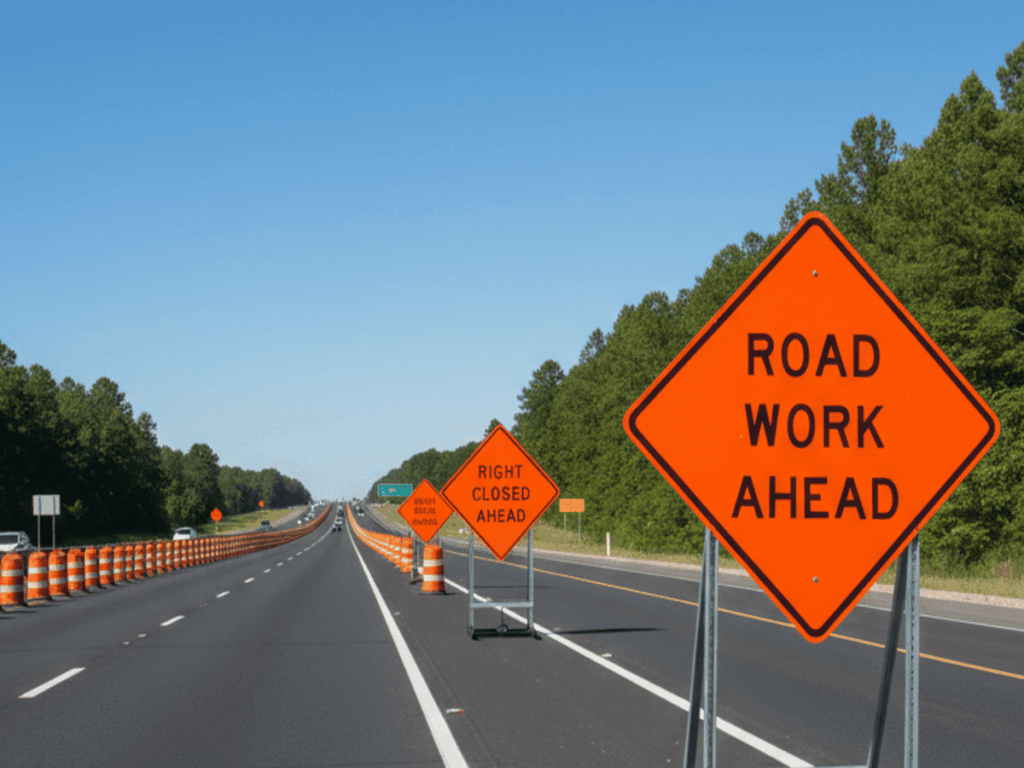
Déployer la séquence de pré-alerte. Sur les autoroutes/autoroutes, utilisez des séries de trois signes et étendez-vous en amont selon le tableau en fonction de votre vitesse; dans les rues urbaines, les distances se compressent. Placez les panneaux de manière à ce qu'ils soient visibles, niveau, et ne pas rivaliser avec le désordre d'arrière-plan. Si votre équipe a besoin d'un rappel sur les techniques d'installation des panneaux, consultez cet aperçu pratique de la sélection et de la stabilité du matériel de signalisation sur le terrain dans l'introduction au choix du matériel de signalisation routière..
Régler les dispositifs de canalisation menant au cône. Commencez par un espace tampon en amont du cône; placer les appareils à un espacement approprié à la vitesse et à la géométrie. Les appareils doivent être propres, droit, et cohérent : remplacez tout ce qui est décoloré ou endommagé.
Construire le cône de fusion. Utilisez le bon L pour votre vitesse et votre décalage; pour une voie de 12 pieds à 55 mph, planifier à propos 660 pieds de cône. Dans des contextes urbains contraints, envisager un épaulement court ou un cône de changement de vitesse, le cas échéant et permis par le TCP.
Sécuriser l'espace de travail. Utiliser des fûts ou des cônes avec un espacement approprié dans la zone de travail, fournir un dispositif de protection positive si votre TCP l'exige, et maintenir une conicité en aval (50–100 pieds typique) pour guider le trafic de retour.
Vérifier la visibilité de jour comme de nuit. Tout travail de nuit nécessite des panneaux et des dispositifs rétroréfléchissants; effectuer une inspection de nuit pour confirmer que les colliers rétroréfléchissants et les faces des enseignes sont visibles sans éblouissement.
Astuce — Photographiez la séquence. Avant l'ouverture à la circulation, capturez des photos de chaque emplacement de panneau et de la conicité complète du point de vue du conducteur. Cela crée une documentation défendable si les inspecteurs demandent une preuve de conformité au contrôle temporaire de la circulation MUTCD..
Lecture connexe pour les équipages: découvrez les erreurs courantes de placement des panneaux qui entraînent des retouches et des retards afin que vous puissiez éviter les pièges habituels sur les approches à grande vitesse et urbaines.
Changement de voie sans perte de capacité
Les changements maintiennent toutes les voies mais déplacent latéralement la circulation. Ils sont courants pour les déplacements de barrières et les passes de fraisage/pavage..
Confirmer le déport latéral et la vitesse. Calculer L pour le type de fusion, alors utilisez au moins 0.5 × L pour un cône de changement de vitesse. Exemple: à 65 mph et W = 12 ft, L (fusionner) est 780 ft; un cône de changement de vitesse est ≥390 pieds.
Séquencer les signes. Un changement de voie nécessite un préavis clair. Pour les segments à grande vitesse, ajoutez un panneau fléché sur la séquence « Attention » et placez-le là où les conducteurs peuvent traiter le mouvement.
Maintenir la densité des appareils grâce à l’alignement décalé. Gardez un espacement suffisamment serré pour définir le chemin; ajouter une courte stabilisation en aval au-delà du changement de vitesse afin que les conducteurs ne dérivent pas.
Auditer les lignes de visibilité dans le trafic réel. Observez quelques pelotons de véhicules pour vous assurer que l'alignement se lit naturellement; modifiez l'espacement des appareils ou l'emplacement du tableau fléché si vous observez des corrections de dernière seconde.
Une voie, opérations bidirectionnelles avec marquage
Le trafic alterné nécessite des communications étroites et des signaleurs formés. Utilisez deux signaleurs avec une ligne de vue dégagée ou un contact radio bidirectionnel fiable.
Positionnement et appareils (Paraphrase des normes et des lignes directrices). Les signaleurs doivent se tenir sur l'épaule, faire face au trafic qui approche, et avoir un chemin d'évacuation défini. Utiliser les palettes STOP/SLOW; les palettes sont le dispositif de signalisation manuelle préféré avec des légendes et des tailles spécifiées. La nuit, les pagaies doivent être rétroréfléchissantes ou éclairées, et les vêtements du signaleur doivent offrir une visibilité à 360°. Pour la structure et les minimums, faire référence à la 11e édition 6 et chiffres associés; pour un miroir opérationnel sur les principes de contrôle des signaleurs, voir l'aperçu du chapitre 6E du MoDOT.
Séquence de contrôle. Établir un cône à chaque extrémité (50–100 pieds typique). Espaces tampons de scène entre le cône et l'espace de travail. Confirmer les mots de contrôle radio et les redondances des signaux manuels. Coordonner les fenêtres de libération afin que les files d'attente soient dégagées avant de changer de direction.
Vérifications sur le terrain. Maintenez si la distance de visibilité est marginale. Réduisez la longueur du segment ouvert pour garder le contrôle si les pentes ou les courbes limitent la visibilité.. Si tu cours la nuit, transférer les vêtements vers la classe 3 ensembles par risque, et vérifier la rétroréflectivité des appareils en continu.
Opérations mobiles et à court terme des services publics
Arrêts courts et travail mobile (Par exemple, réparation des nids-de-poule, poignées de boîte utilitaire) je ne peux pas déployer longtemps, installations stationnaires, mais elles ont toujours besoin de contrôle.
Travaux de courte durée à proximité des voies. Utilisez une séquence d'avertissement préalable compacte et un épaulement court ou un cône de changement de vitesse pour protéger l'espace de travail.. Là où le TCP le permet, un véhicule de travail équipé de gyrophares/gyrophares à haute intensité peut compléter la visibilité. Gardez l’empreinte au sol faible et déménagez fréquemment; ne laissez jamais les appareils s'attarder après le déplacement de l'opération.
Opérations de voies mobiles. Utilisez l'ombre et avancez les véhicules avec les panneaux fléchés appropriés; l'utilisation de l'appareil est dynamique et suit l'opération. Maintenir la communication entre le conducteur/opérateur et le personnel au sol; maintenir des vitesses adaptées à la distance de visibilité. Si votre équipe a besoin d'un rappel sur les choix de panneaux et les couleurs lors d'opérations dynamiques, ce guide sur les couleurs et les significations des panneaux de zone de travail peut aider à aligner les choix de terrain sur les attentes des conducteurs.
Travail de nuit et visibilité des travailleurs (OSHA + Mutcd)
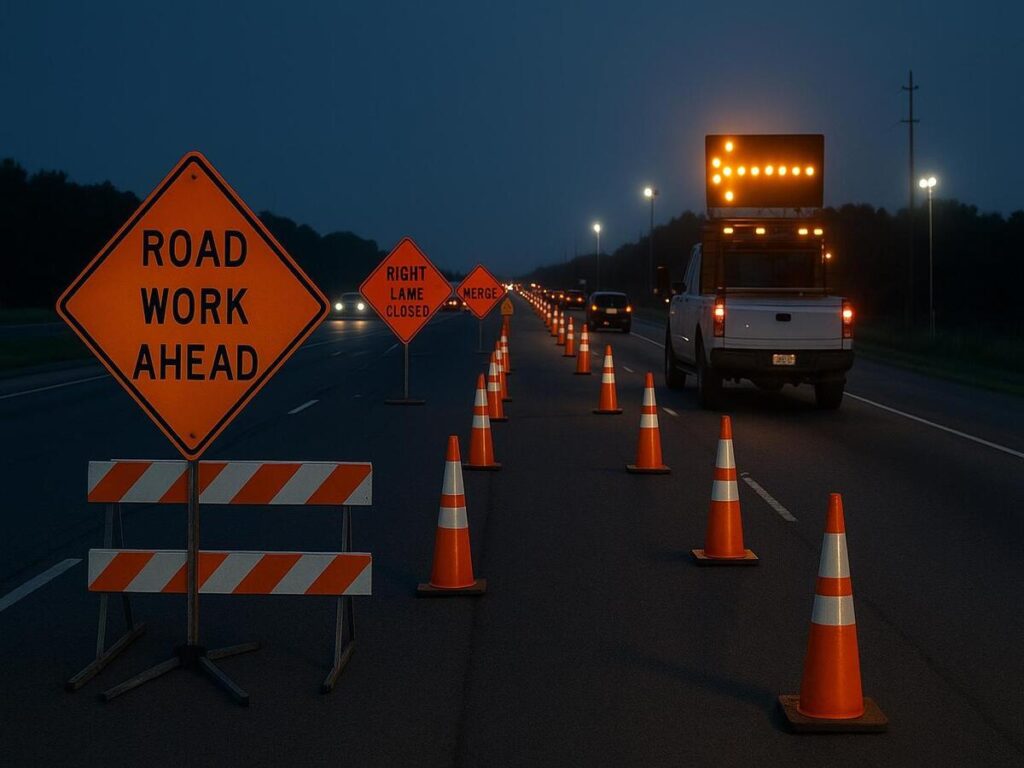
La nuit rend tout plus difficile: la distance de détection du conducteur diminue, l'éblouissement augmente, et les équipages se fatiguent. Partie MUTCD 6 exige des panneaux et des dispositifs rétroréfléchissants pour les opérations de nuit; les cônes utilisés la nuit doivent être rétroréfléchissants et, sur les routes à grande vitesse, au moins 28 pouces de haut. En pratique, 28Les cônes de –36 po portent deux colliers rétroréfléchissants: une bande supérieure de 6 pouces près du haut et une bande inférieure de 4 pouces espacée en dessous; les appareils doivent être propres et entretenus. Voir la partie 11e édition 6 pour les exigences relatives aux appareils et les pratiques de transfert reflétées dans les chapitres précédents et les listes de modifications.
Les directives de sécurité des zones de travail de l'OSHA attendent des employeurs qu'ils préviennent les incidents avec collision grâce à des plans de contrôle de la circulation appropriés., entraînement, et vêtements de sécurité à haute visibilité répondant aux normes ANSI/ISEA 107. La sélection de vêtements s'aligne sur le risque: Classe 2 pour les arrière-plans complexes et 25 à 50 mph; Classe 3 (et souvent des pantalons classe E) pour >50 opérations mph ou de nuit. L'OSHA met l'accent sur la visibilité à 360°, formation pour les signaleurs, et maintenir une séparation sûre. Pour des attentes fédérales concises, voir la fiche d'information sur la sécurité routière dans la zone de travail de l'OSHA.
Exemple d'équipement neutre pour une fermeture de voie d'autoroute de nuit. Pour les cônes pouvant être utilisés pour répondre aux attentes MUTCD nuit/haute vitesse (28Hauteur de ‑pouces avec colliers doubles) auprès de tout fournisseur conforme à MUTCD, les équipes mettent souvent en scène des modèles de 28 pouces avec deux bandes réfléchissantes et un poids de base adéquat pour la stabilité. Pour un tel exemple, voir OPTRAFIC. Utilisez la parité tout au long de votre chaîne d'approvisionnement et vérifiez les marquages des appareils et la rétroréflectivité par rapport aux listes acceptées de votre état avant l'achat..
Cadence d’éclairage et d’inspection. Évitez d'éblouir les conducteurs avec les lampes de travail; viser un éclairage uniforme et garder les luminaires hors de vue des cônes. Effectuer des inspections tôt et tard dans la nuit pour confirmer la rétroréflectivité, lisibilité des signes, et la propreté de l'appareil après la poussière ou la pluie. Remplacez ou nettoyez tout ce qui perd sa signature nocturne.
Piétons, les cyclistes, et continuité ADA
Le contrôle temporaire de la circulation ne concerne pas seulement les véhicules. Quand le travail touche les trottoirs, sentiers à usage partagé, ou arrêts de bus, le couloir doit rester pratique et accessible. Partie MUTCD 6 fournit un langage d'orientation sur le maintien d'un chemin utilisable et la communication claire des détours, y compris des barrières détectables pour les personnes ayant une déficience visuelle et une attention particulière aux arrêts de bus et aux signaux temporaires. Les détails numériques pour la largeur libre minimale, surfaces, rampes, et la protection des bords se trouvent dans les normes ADA et aux États-Unis.. Lignes directrices en matière d’accessibilité des emprises publiques de l’Access Board (Proue). Si vous publiez des valeurs numériques dans votre TCP, citez directement ADA/PROWAG et vérifiez auprès de l’adoption de votre juridiction.
Approche pratique de terrain. Gardez les sentiers piétonniers directs et nivelés autant que possible; si tu dois faire un détour, signez-le tôt au point de décision et fournissez des fonctionnalités accessibles tout au long (ferme, écurie, surfaces antidérapantes, équivalents de rampe de trottoir, bords détectables à proximité des dénivelés). Coordonner avec les transports en commun locaux pour les emplacements d'arrêt temporaires. Quand l'espace est restreint, resserrez votre empreinte de travail plutôt que de réduire le chemin piétonnier en dessous des minimums acceptables.
Pour une introduction opérationnelle plus approfondie sur les détours et l’orientation, vos équipages peuvent consulter ceci guide pratique de gestion des panneaux de détour pour aligner le TTC sur le comportement réel des utilisateurs.
Inspection, documentation, et preuves photographiques
Vous ne pouvez pas gérer ce que vous n’inspectez pas. Partie MUTCD 6 souligne que le TTC doit être inspecté et entretenu – jour et nuit – pour rester efficace; les appareils doivent être maintenus propres, correctement positionné, et fonctionnel. Les agences et les principaux acteurs doivent pouvoir interrompre leur travail si les conditions se dégradent.; les équipages ont besoin de l’autorité nécessaire pour corriger les lacunes immédiatement.
Un quotidien simple qui résiste aux audits: effectuer une vérification avant le quart de travail dans la zone de présignalisation, cône(s), espace de travail, et cône aval; confirmer le nombre d'appareils, espacement, et la propreté, et vérifiez les plans de vêtements et d'éclairage si le quart de travail se prolonge la nuit. Milieu de travail, après que le trafic se soit stabilisé, revérifier la dérive de l'appareil, visibilité des panneaux, et toute nouvelle obstruction de la vue (véhicules stationnés, équipement portatif), et réespacer les cônes si des espaces sont ouverts. Si les travaux se prolongent après le crépuscule, effectuer un passage en mode nuit pour vérifier les colliers rétroréfléchissants, lisibilité des panneaux sans éblouissement, et lisibilité du panneau fléché aux vitesses d'approche. Enfin, document photo du point de vue du conducteur: chaque emplacement de panneau, le cône complet, le périmètre de l'espace de travail, et le cône aval; étiquetez les photos avec des points de stationnement ou de référence et stockez les séries quotidiennes par date et lieu.
Conservez vos journaux et photos quotidiens avec les notes TCP et de l'inspecteur. Pour les projets du secteur public, votre approche documentaire doit faire écho aux attentes décrites dans ce guide pour garantir la conformité de la signalisation pour les projets du secteur public, en particulier sur la conservation des dossiers et la démonstration du respect des normes approuvées.
Mini boîtier — cône court corrigé (avant/après)
Facilité: artère suburbaine à quatre voies, posté 55 mph. Problème initial: l'équipage a utilisé un cône de fusion raccourci (~ 300 pieds) pour un changement de voie de 12 pieds, provoquant des fusions tardives et un freinage brusque. Action corrective: recalculé L = W × S, reconstruit un 660 cône de fusion en pieds, augmentation de la densité cône/tambour grâce au changement, et ajout d'un deuxième panneau d'avertissement préalable. Résultat: des fusions plus fluides ont été observées, file d'attente réduite, et aucun avis d'inspecteur sur le suivi.
Dépannage des échecs courants
Cônes courts à grande vitesse. Les diminutions de longueur à 55-65 mph provoquent des fusions tardives et un freinage brusque. Recalculez L à partir de votre vitesse réelle et W; étendre la conicité et la densité du dispositif pour stabiliser les flux.
Espacement des panneaux qui ne correspond pas à l'installation. L'utilisation de l'espacement des rues urbaines sur une autoroute réduit le temps de décision du conducteur. Ajoutez un panneau en amont et prolongez les distances selon le tableau pour votre classe de vitesse.
Appareils sales ou incompatibles. Les cols décolorés et les pancartes sales éliminent la visibilité nocturne. Nettoyer ou échanger les appareils rapidement; maintenir un stock de rechange sur le camion.
Visibilité et communication du signaleur. La nuit ou sous la pluie, rien de moins que la classe 3 les vêtements à forte rétroréflexion constituent un risque. Testez les radios avant d'ouvrir la voie et établissez des mots de contrôle clairs.
Des détours piétons qui démarrent trop tard. Annoncez les détours où les gens peuvent choisir un autre chemin, pas à la fermeture elle-même. Ajoutez un panneau supplémentaire à l'intersection précédente si nécessaire.
Si vos équipes ont besoin d’un rappel sur les bases : ce que signifie chaque panneau de zone de travail, comment installer, et comment éviter les retouches : ces amorces peuvent vous aider: un aperçu complet de la signalisation de construction pour un contexte global; étapes d'installation des panneaux pour les panneaux de style série T; et un article ciblé sur l'emplacement des panneaux Road Work Ahead dans des conditions urbaines et à grande vitesse..
- Guide complet de la signalisation de construction
- Installation correcte des panneaux de signalisation routière de la série T
- Conseils pour l'emplacement des panneaux de travaux routiers à venir
Que vérifier avant chaque fermeture ou quart de travail (passe rapide)
- Vérifier l'adoption par l'État. Confirmez si votre état a adopté la 11e édition et si les suppléments modifient les numéros ou les valeurs des tableaux..
- Confirmer les vitesses. Utiliser la vitesse affichée ou en vigueur (le plus élevé applicable selon la pratique de votre agence) pour les calculs de conicité et d'espacement.
- Valider les appareils. Bonnes hauteurs, rétroréflectivité droite, bonne densité; la nuit, confirmer la visibilité avec les vrais phares.
- Aligner le personnel. Signaleurs formés en cas de besoin; protocoles radio bidirectionnels; sauvegardes si un appareil tombe en panne ou si un véhicule bloque la vue.
- Planifier les VRU. Si des piétons ou des cyclistes sont présents, concevoir d'abord un chemin utilisable; puis ajustez votre espace de travail à l'enveloppe restante.
Références pour une vérification plus approfondie
- Manuel complet de MUTCD 11e édition. Utilisez-le pour les définitions, Partie 1 délais de conformité, et références croisées entre les pièces 6 et 7: voir le PDF de la 11e édition hébergé par FHWA.
- Partie MUTCD 6 (Contrôle du trafic temporaire). L'appareil central, cône, et les conseils du TTC sont en direct ici; utilisez la pièce FHWA 6 PDF en citant des tableaux et des figures actuels.
- Règle finale du Federal Register (Déc. 19, 2023). L'avis d'adoption fédéral pour la 11e édition fournit la date d'entrée en vigueur et le cadre statutaire dans le dossier des normes nationales via le Federal Register..
- Fiche d'information sur la sécurité routière dans la zone de travail de l'OSHA. Devoirs de l’employeur en matière de prévention des accidents, entraînement, et la sélection HVSA sont résumées dans cette publication OSHA.
- Californie MUTCD 2026 Partie 6 tableaux (ébauches de documents). Ces tableaux reflètent les formules de conicité de la 11e édition et fournissent des valeurs précalculées pour W = 12 multiplicateurs de type ft et conique.
- EPG MoDOT 616.2. Miroir d'état qui explique les éléments TTC alignés sur le chapitre 6B de MUTCD.
- Autoroute à péage de Pennsylvanie PTS‑900 (Avril 2024). Typiques pratiques avec la note L = S × W pour un calcul de champ plus rapide.
Pour tous les détails externes ci-dessus, vérifiez toujours les derniers suppléments d'état et les applications typiques avant le déploiement sur le terrain.