Introduction: The Physics of Cold-Weather Traffic Safety
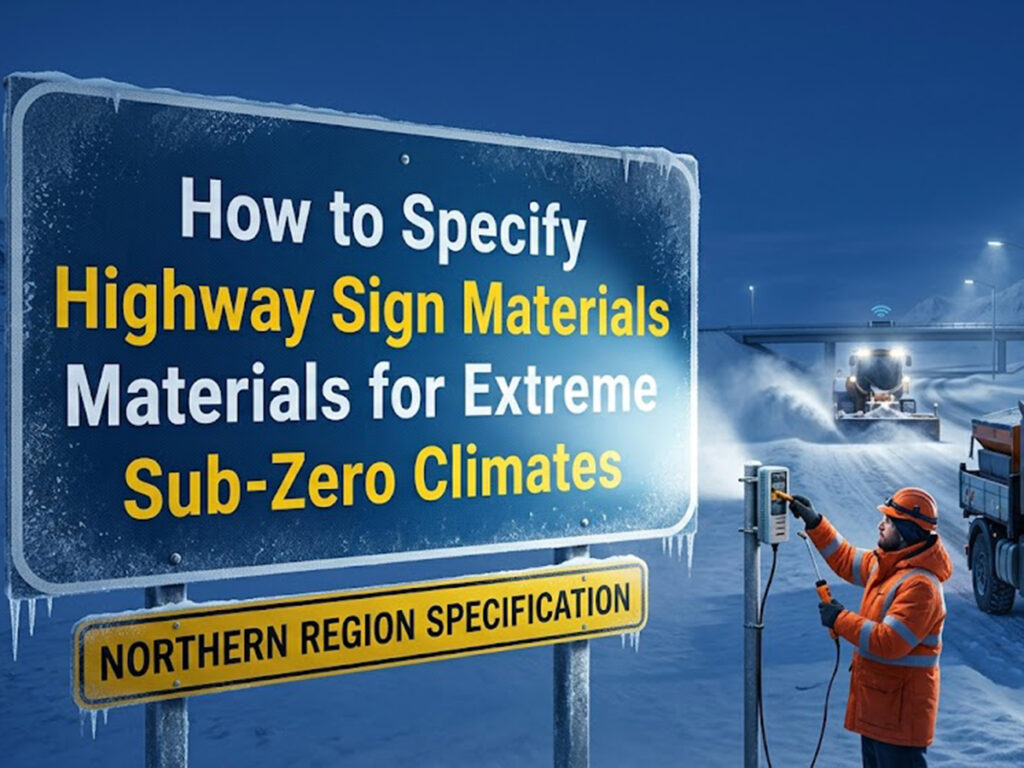
In northern regions where temperatures routinely drop below -40°C, highway sign performance shifts from a routine specification to a critical safety imperative. These extreme environments demand advanced material science.
Standard materials often fail at these temperatures. Substrates become brittle, adhesives lose grip, and frost accumulation causes “sign blackout.” These failures compromise driver reaction times and increase liability for departments.
While basic highway sign material selection suffices for temperate climates, sub-zero conditions require specialized mechanical and chemical engineering. Procurement officers must prioritize matériaux de signalisation routière for extreme cold to ensure visibility.
The Role of Retroreflective Sheeting in High-Latitude Visibility
Cold Weather Retroreflective Sheeting Performance Metrics
Sub-zero environments force matériaux de signalisation routière to endure extreme thermal contraction. Standard microprismatic structures often misalign or deform when temperatures plummet rapidly. This physical distortion reduces retroreflection and creates visual “fantôme,” which confuses drivers during critical winter nights.
Engineering resilience requires maintaining the precise geometry of optical prisms under thermal stress. Material fatigue often leads to micro-cracking during repeated freeze cycles. Water enters these microscopic fissures, expands, and eventually delaminates the sheeting from the substrate.
Effective low-temperature traffic sign specifications must prioritize high R_A retention. The sheeting must resist brightness loss during “heure bleue,” when low-angle sunlight reflects off snow and ice. Procurement teams should seek materials with specialized polymers that maintain elasticity at -40°C.
ASTM D4956 Cold Climate Compliance and Grade Selection
The ASTM D4956 standard serves as the primary benchmark for retroreflective performance. Section 6.4 of this specification mandates that sheeting must remain flexible enough to wrap around a mandrel without cracking. Cependant, extreme northern climates require performance far beyond these baseline tests.
The following table compares the performance of common grades for matériaux de signalisation routière for extreme cold:
| Fonctionnalité | Type IV (Prismatique à haute intensité) | Type XI (Full Cube Diamond Grade) |
| Optical Efficiency | Modéré; provides adequate mid-range visibility. | Supérieur; captures light at wider angles. |
| Snow Conditions | Prone to “blackout” under heavy frost. | Enhanced angularity cuts through ice haze. |
| Thermal Durability | Standard stability; higher risk of edge lifting. | Advanced polymer backing resists contraction. |
| 2026 Normes | Répond aux exigences de base des points. | Exceeds 2026 safety benchmarks for AV/ADAS. |
Under ASTM D4956 Section 7.1, manufacturers must provide specific values for the coefficient of retroreflection at various observation angles. Type XI sheeting typically provides 100% more light return than Type IV in dark, snowy conditions.
En outre, Section 7.4 dictates colorfastness requirements. In northern regions, fluorescent yellow-green signs often suffer from “chromaticity shift” under gray winter skies. Specifying high-grade cold-weather retroreflective sheeting ensures these colors remain within the legally defined “daytime color” boxes even in low-light environments.
Overcoming Mechanical Failures in Arctic Infrastructure
Managing Thermal Expansion of Aluminum Substrates
The thermal expansion of aluminum substrates dictates the lifespan of signage in the high north. Aluminum has a high thermal expansion coefficient (23 x 10^-6 m/m·K). This causes rapid contraction when temperatures drop from daytime highs to sub-zero nights.
If the sheeting and the aluminum contract at different rates, the bond experiences massive shear stress. This physical mismatch leads to “oil-canning,” where the sign face warps and distorts. These surface stress fractures destroy the flat plane required for proper retroreflection.
Procurement officers should specify 5052-H38 aluminum alloys for arctic environments. This specific temper provides superior fatigue resistance compared to standard 6061 notes. It maintains dimensional stability across a 60-degree temperature swing. Engineers must also optimize panel thickness to prevent wind-chill-induced vibration from cracking brittle mounts.
Low-Temperature Adhesion (LTA) Films and Pressure Sensitive Adhesives
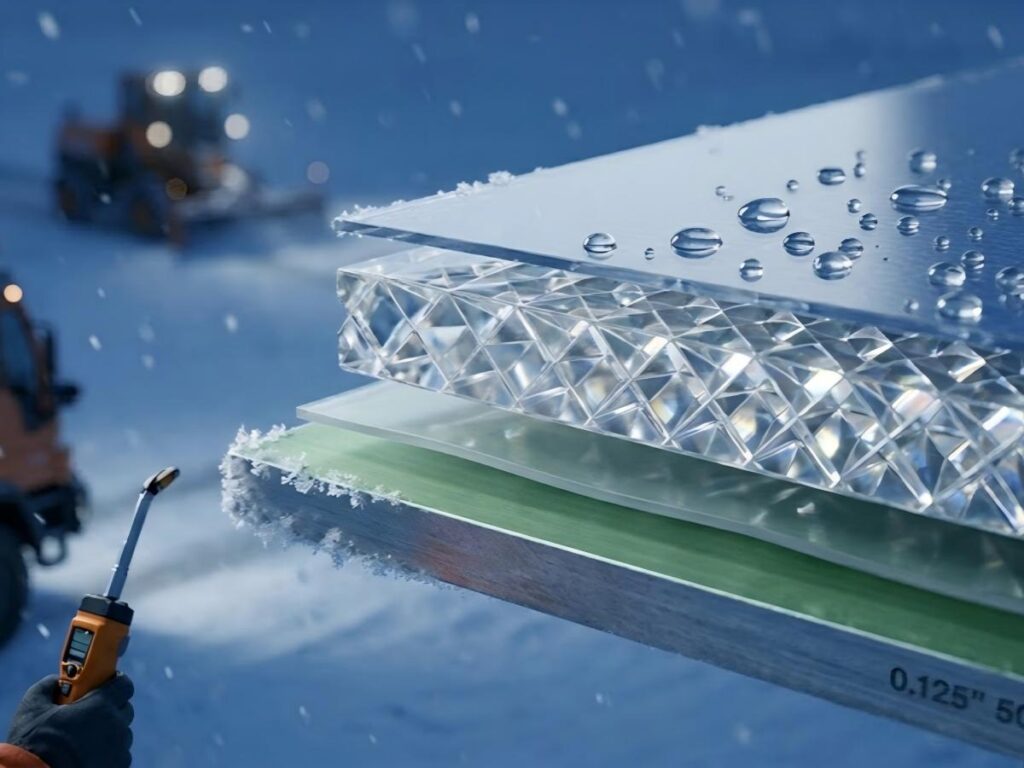
Adhesive failure is the leading cause of sign delamination in frozen corridors. Standard pressure-sensitive adhesives (PSA) reach their “glass transition temperature” quickly in the cold. Once the adhesive becomes glass-like, it loses its ability to flex and peels away.
Low-temperature adhesion (LTA) films solve this by utilizing specialized chemical tackifiers. These polymers remain “rubbery” and compliant even at -40°C. They provide a high initial tack, which is vital for preventing edge lifting during high-velocity winter winds.
| Adhesive Property | Standard PSA | Advanced LTA Films |
| Minimum Application Temp | 10℃ to 15℃ | -10℃ to 4℃ |
| Service Temp Range | Modéré | Extrême (-50℃ to 80℃ ) |
| Bond Type | Rigid/Brittle | Elastic/Shear-Resistant |
| Résistance à l'humidité | Faible; prone to ice-jacking | Haut; seals edges against ingress |
Source: https://graphics.averydennison.com/content/dam/averydennison/graphics/eu/en/Data-Sheets/screen-and-cut/avery-dennison-signflex-en.pdf, https://www.henkel-adhesives.com/ma/en/industries/tapes-labels-graphics/graphics.html
Installation matériaux de signalisation routière in the field requires strict environmental controls. Workers should never apply sheeting based on room-temperature assumptions. Effective low-temperature traffic sign specifications require pre-conditioning the substrate with heat lamps. This ensures the LTA film achieves a molecular bond before the mercury drops. Without these specialized films, the mechanical bond fails, leading to costly mid-winter replacements.
Advanced Surface Protection for Snow and Ice Management
Anti-Icing Sign Coatings and Hydrophobic Topcoats
In snow-dense corridors, anti-icing sign coatings prevent “panne de courant” by drastically lowering the surface energy of the sign face. High surface energy allows water droplets to flatten and freeze into a tenacious ice bond. Nano-scale hydrophobic coatings force water to bead and roll away before crystallization occurs.
These advanced matériaux de signalisation routière utilize fluorinated polymers or ceramic-based topcoats. These materials create a microscopic “lotus effect” on the retroreflective sheeting. This technology ensures that heavy, wet snow slides off the sign under its own weight.
Specifying these coatings is a critical safety requirement for high-latitude regions. They maintain the legibility of regulatory messages during active blizzards. En outre, the self-cleaning properties prevent road salt and grime from embedding into the prismatic cells, which preserves long-term optical clarity.
Source: http://hyperphysics.phy-astr.gsu.edu/hbase/Chemical/waterdens.html
| Failure Mechanism | Technical Impact | Stratégie de prévention |
| Moisture Ingress | Delamination of reflective layers. | Edge sealing and hydrophobic barriers. |
| Ice-Jacking | Rapid cracking of microprisms. | High-elongation polymer selection. |
| Salt Corrosion | Pitting of the aluminum substrate. | Chrome-free conversion coatings (ASTM B449). |
Procurement officers should mandate testing that aligns with matériaux de signalisation routière for extreme cold benchmarks. Signs must demonstrate zero loss of adhesion after 500 freeze-thaw cycles. This durability is essential for maintaining safety standards in permafrost zones where maintenance access is limited.
Strategic Procurement and Technical Specifications
Establishing Low-Temperature Traffic Sign Specifications
Procurement officers in northern regions must look beyond generic highway standards. Standard municipal codes often fail to account for “Arctic Amplification” effects seen in 2026 climate data. To ensure infrastructure resilience, RFP requirements must mandate specific low-temperature thresholds.
Essential low-temperature traffic sign specifications include:
- ASTM D4956 Section 7.11 Conformité: Mandates that sheeting shows no cracking or delamination after impact at -20℃.
- Adhesion Certification: Testing must prove the LTA adhesive system retains 90% of its peel strength at -40℃.
- Hydrophobic Efficiency: Verification that anti-icing sign coatings reduce ice adhesion by at least 70% compared to untreated surfaces.
- Edge Sealing Standards: Mandatory perimeter sealing to prevent capillary water action in permafrost zones.
Spécification “standard grade” materials in Alaska, Canada, or Scandinavia creates a liability. Environmental loads in these regions often exceed design assumptions by 40% during polar vortex events. Comprehensive specifications reduce the risk of catastrophic visibility loss during the winter months.
Analyse comparative: Coût vs. Lifecycle for Sub-Zero Materials
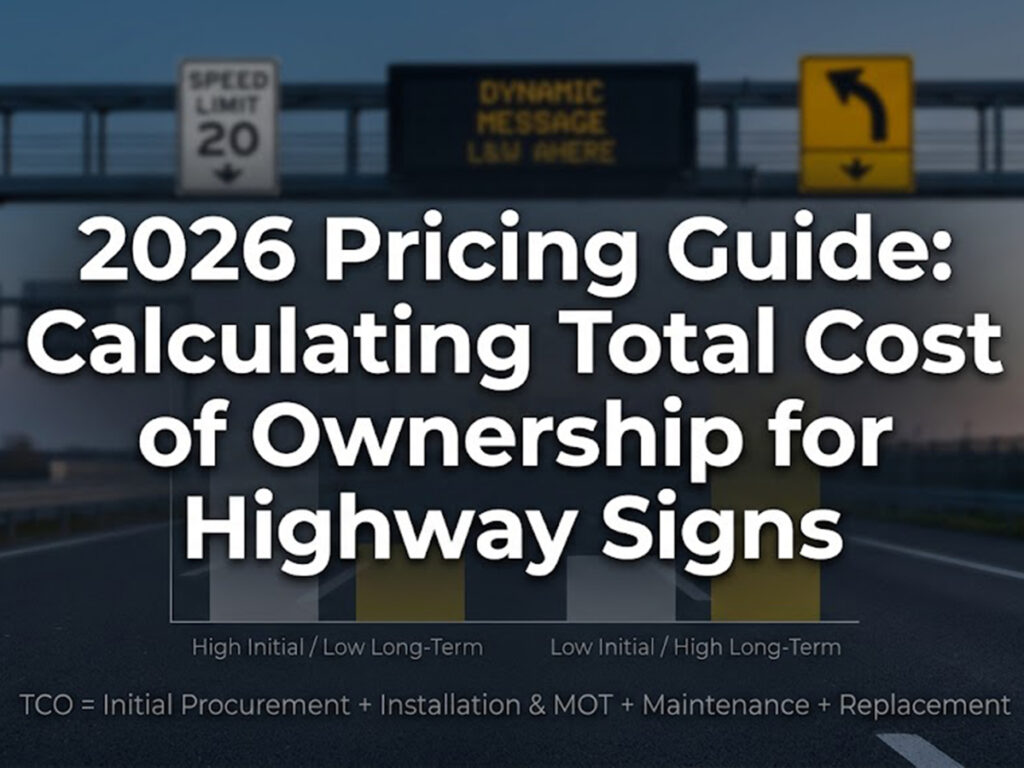
Haute performance matériaux de signalisation routière require a higher initial investment but deliver superior long-term value. In remote northern corridors, le “hidden cost” of maintenance—including specialized bucket trucks and road closures—often triples the total expense of a single sign failure.
The following data compares the economic impact over a 12-year lifecycle:
| Métrique | Standard Signage | Sub-Zero Optimized Materials |
| Initial Unit Cost | 100% (Base de base) | 135% – 150% |
| Taux d'échec (5 Années) | 35% due to cracking/peeling | < 5% |
| Maintenance Cycles | Every 3–5 years | Chaque 12+ années |
| Coût total de possession | 280% (Includes 2 remplaçants) | 160% (Single installation) |
Investing in premium matériaux de signalisation routière for extreme cold generates a measurable ROI. By extending the service life from 5 à 15 années, agencies reduce labor costs by approximately 45% over the asset’s life. This strategy aligns with the 2026 “Smart Infrastructure” objectifs, focusing on durability and carbon-neutral maintenance cycles.
Future-Proofing Northern Roadways for 2026 et au-delà
Increased climate variability makes extreme weather more frequent across wider geographies. This trend demands a holistic approach to signage specification. Procurement officers must integrate advanced technologies to maintain infrastructure reliability.
Effective solutions combine four critical pillars:
- High-index cold weather retroreflective sheeting for low-light visibility.
- Dimensional stability via thermal expansion of aluminum substrates.
- Molecular bonding through specialized low-temperature adhesion (lta) films.
- Surface protection using anti-icing sign coatings.
Updating regional DOT supplements to include matériaux de signalisation routière for extreme cold is essential. This shift ensures year-round safety and drastically reduces lifecycle costs. Authorities must prioritize these standards to withstand the harshest 2026 conditions environnementales.
Transportation authorities should immediately revise technical specifications to mandate cold-climate performance criteria. Modernizing these standards ensures roadway signage remains visible, durable, and compliant throughout the winter season.
Foire aux questions: Engineering Signs for Sub-Zero Environments
How do low-temperature adhesion (LTA) films prevent sign delamination in the Arctic?
Standard adhesives reach their glass transition temperature in extreme cold, becoming brittle and losing their molecular bond. Low-temperature adhesion (LTA) films utilize specialized tackifiers that remain elastic at -40°C. This elasticity allows the adhesive to stretch and contract alongside the substrate, preventing edge lifting and moisture ingress during rapid thermal shifts.
Why is ASTM D4956 Type XI sheeting preferred over Type IV for northern highway sign materials?
While both meet basic standards, Type XI (Full Cube) sheeting offers superior angularity and brightness in snow-heavy environments. Selon la norme ASTM D4956, Type XI provides higher light return at the wide observation angles common for drivers navigating snowy or frosted roads. This extra luminance is critical for penetrating “heure bleue” haze and heavy winter overcast.
How does the thermal expansion of aluminum substrates affect long-term sign durability?
Aluminum contracts significantly when temperatures drop, creating shear stress between the metal and the reflective face. If the matériaux de signalisation routière do not share similar expansion coefficients, the sheeting may warp or develop “oil-canning” distortions. Specifying 5052-H38 aluminum ensures the sign maintains its flat plane, which is essential for consistent retroreflective performance.
Do anti-icing sign coatings interfere with the retroreflective properties of the sheeting?
High-quality anti-icing sign coatings are optically clear and engineered specifically for traffic safety applications. These hydrophobic topcoats reduce surface energy so snow and ice slide off naturally. They protect the microprismatic structure from grime and salt without reducing the coefficient of retroreflection (R_A), ensuring the sign remains legible during active storms.
What are the primary ROI factors when specifying highway sign materials for extreme cold?
The initial price of sub-zero optimized materials is higher, but the Total Cost of Ownership (Coût total de possession) is significantly lower. Standard materials often fail within 3–5 years in permafrost zones due to freeze-thaw damage. Premium materials extend the service life to over 12 années, reducing the frequency of high-cost maintenance trips to remote regions and lowering the overall labor expenditure.
How does freeze-thaw resistance for road signs impact 2026 infrastructure safety goals?
2026 safety mandates emphasize “all-weather” reliability for both human drivers and ADAS sensors. Freeze-thaw resistance for road signs prevents the internal “ice-jacking” that cracks reflective prisms. By maintaining the physical integrity of the sign face, agencies ensure that machine-vision systems and human eyes can detect critical safety markers even after hundreds of winter temperature cycles.
Articles connexes dans cette série
2026 Guide des prix: Calculer le coût total de possession des panneaux routiers
Conception de panneaux routiers pour l'ADAS et la reconnaissance des véhicules autonomes
Un guide État par État sur la conception et la conformité des balises routières
Retour au Pilier: Le guide complet des panneaux routiers personnalisés: Matériels, Frais, et fabrication
Référence
- FHWA — MUTCD 11e édition, Section 2A.08 & Tableau 2A-3: Maintenir une rétroréflectivité minimale (Exigences minimales en candela pour 2026 conformité). https://mutcd.fhwa.dot.gov/pdfs/11th_Edition/part2a.pdf
- ASTM International — ASTM D4956-19: Spécification standard pour les feuilles rétroréfléchissantes pour le contrôle de la circulation (Guidelines for Type IV and Type XI performance). https://www.astm.org/d4956-19.html
- AASHTO — M 268-15: Standard Specification for Retroreflective Sheeting for Flat Structures (Prismatic material benchmarks for state DOTs). https://store.transportation.org/Item/TrainingDetail?ID=2538&srsltid=AfmBOoqlRljegmQ_qkR9NOA56KLPiYQ7-HcOIbDaqammGGVZJNzl4Pjv