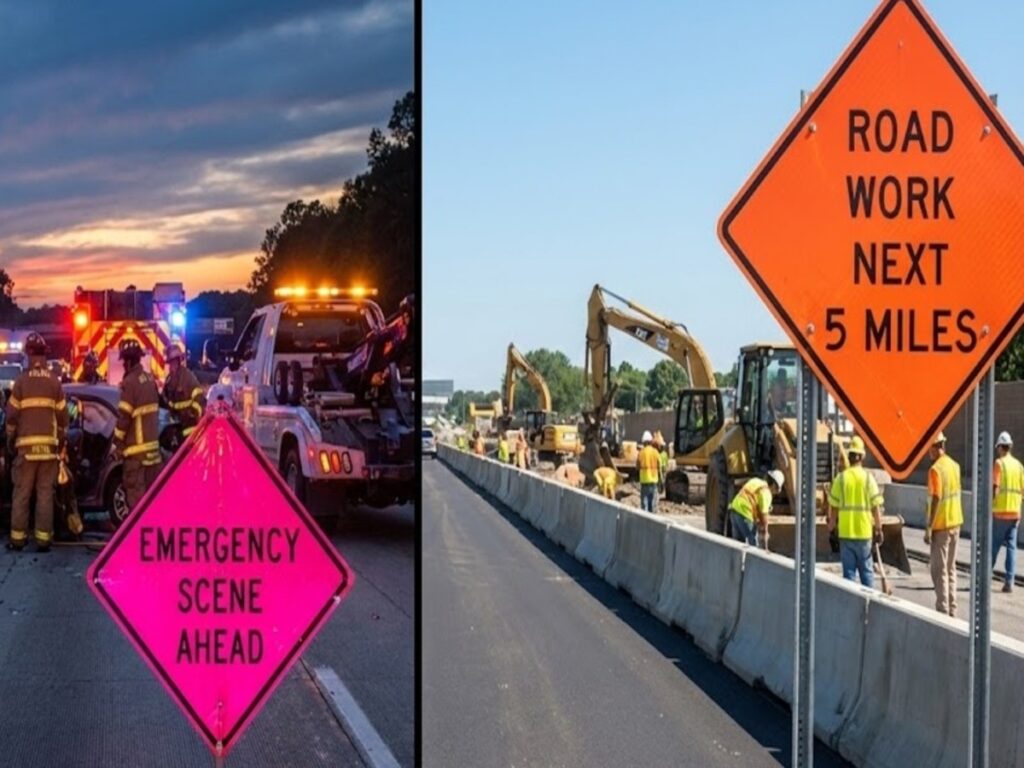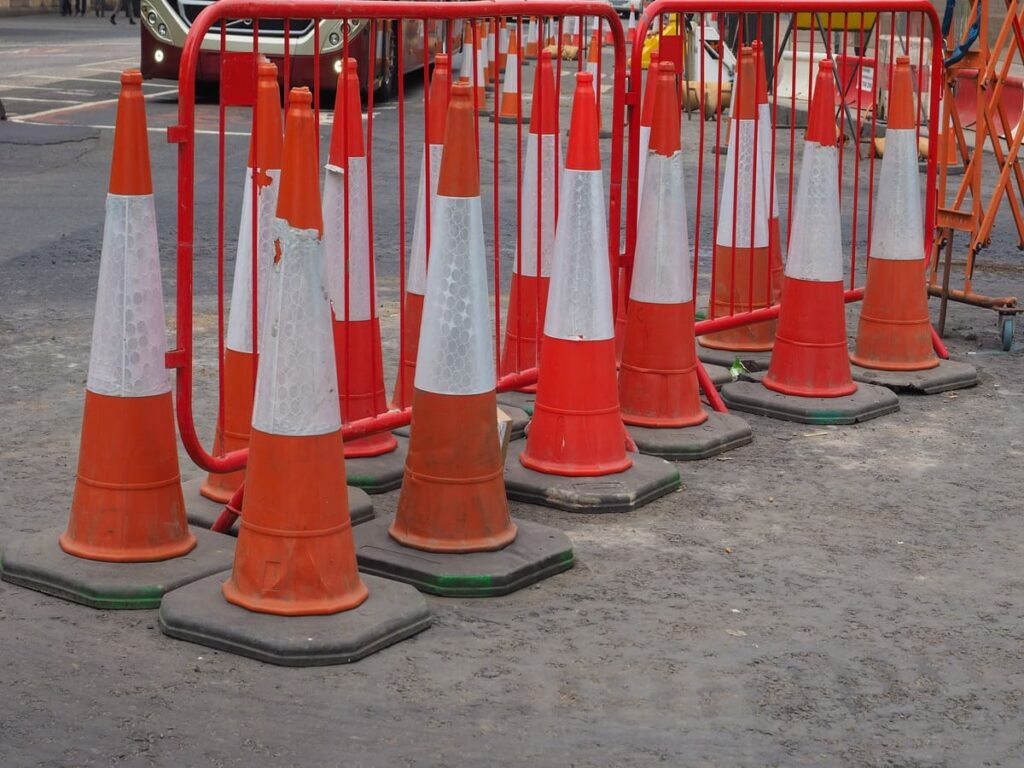
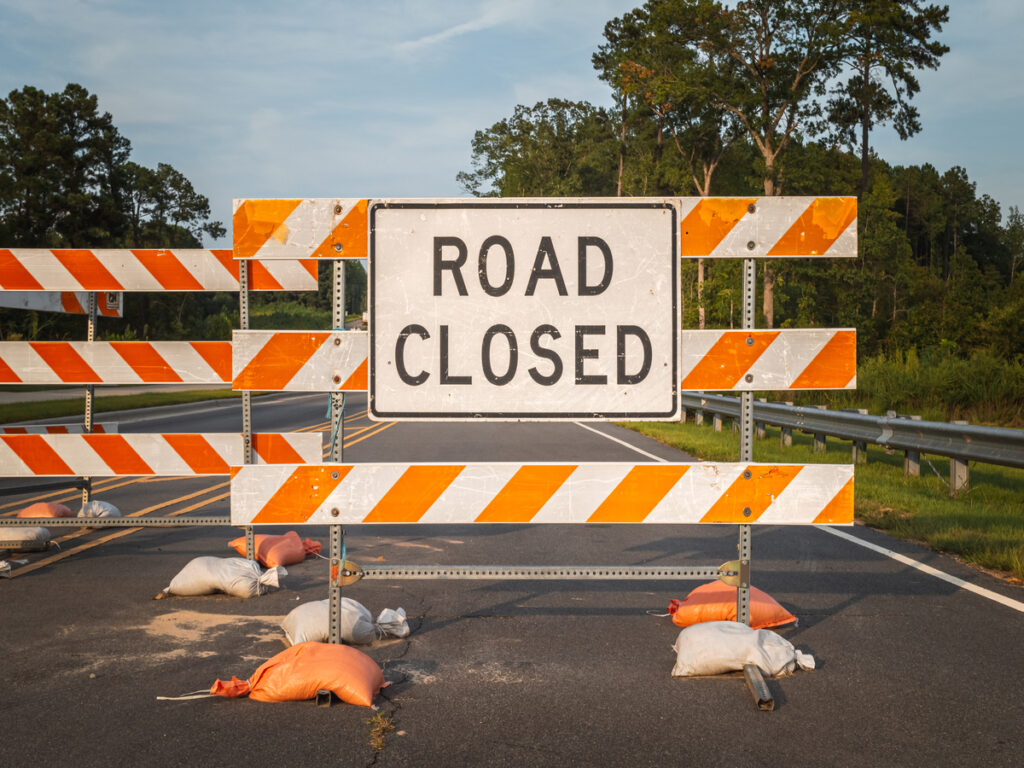
Dans l’industrie civile lourde américaine, la sécurité d'une zone de travail se mesure à la précision de son aménagement. Vous pouvez vous procurer les matériaux les plus avancés au monde, mais si votre placement des panneaux routiers de construction est imparfait, tout l’écosystème de la sécurité s’effondre. Les panneaux mal installés ne constituent pas seulement un risque pour la sécurité : ils constituent la principale source de problèmes du ministère des Transports. (POINT) citations et responsabilité juridique catastrophique.
En tant qu'ancre de notre Série d'installation professionnelle, ce guide fournit une plongée approfondie dans l'ingénierie, mathématiques, et les tactiques de terrain nécessaires au déploiement panneaux routiers de construction qui répondent au Manuel fédéral sur les dispositifs uniformes de contrôle de la circulation (Mutcd) normes.
1. L'anatomie d'une zone de travail conforme: Séquençage pour la sécurité
Un professionnel configuration de la zone de travail est un exercice psychologique d'orientation du conducteur. Drivers traveling at high speeds require a predictable sequence of information to transition safely from normal travel to a restricted construction area.
The Four-Zone Structure
- Zone d'avertissement à l'avance: This is where you tell the driver what to expect. This zone is where your heaviest temporary construction signs (comme Travail sur la route à venir) are deployed.
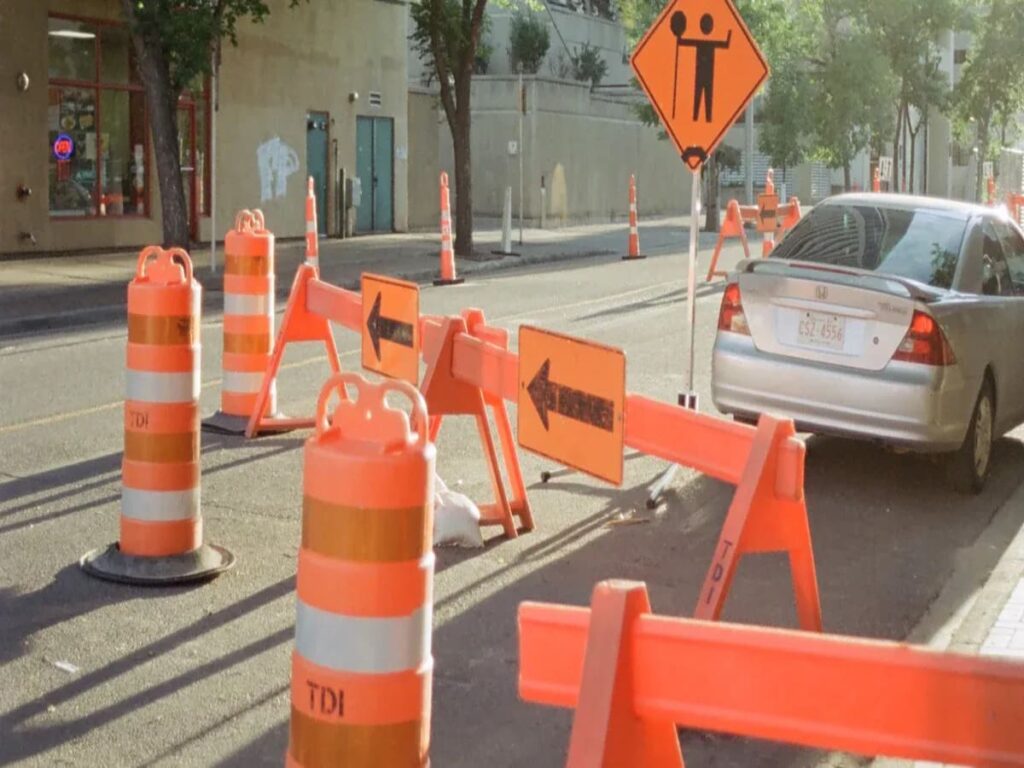
- Zone de transition: This is the most dangerous section. It is defined by the “Cône”—the strategic line of channelizing devices and directional signs that move traffic laterally.
- Zone d'activité: The protected space for your crew and equipment. Placement here focuses on internal traffic control and protecting the “Buffer Space.”
- Zone de résiliation: The area used to return traffic to its normal path, anchored by the Mettre fin aux travaux routiers signe.
2. The Spacing Cheat Sheet: MUTCD Table 6C-1 Standards
The most common point of failure in a work zone audit is the espacement entre les panneaux d'avertissement avancés. De nombreux équipages comptent sur “frappant” la distance, mais le MUTCD est clair: l'espacement doit être calculé en fonction de 85vitesse au ième percentile-la vitesse à laquelle 85% du trafic est en déplacement, quelle que soit la limite affichée.
UN. Le “Trois signes” Logique (UN, B, et C)
Quand vous regardez la table d'espacement MUTCD, vous verrez trois colonnes intitulées A, B, et C. Pour un professionnel placement des panneaux routiers de construction, tu dois comprendre le “compte à rebours” logique:
- Signe A (L'action): Le signe le plus proche de la transition ou de la conicité (Par exemple, Extrémités des voies).
- Signe B (L'avertissement): Le signe intermédiaire (Par exemple, Voie de droite fermée).
- Signe C (Le crochet): Le premier signe que voit le conducteur (Par exemple, Travail sur la route à venir).
B. Tableau MUTCD fédéral 6C-1: Espacement suggéré
| Type de route | Limitation de vitesse (Mph) | Distance A (ft) | Distance B (ft) | Distance C (ft) | Distance totale d'avertissement |
| Urbain (Faible vitesse) | $\le $ 25 mph | 100 | 100 | 100 | 300 ft |
| Urbain (Grande vitesse) | 30 - 50 mph | 350 | 350 | 350 | 1,050 ft |
| Routes rurales | 45 - 65 mph | 500 | 500 | 500 | 1,500 ft |
| Entre États / Expway | 65 - 80 mph | 1,000 | 1,500 | 2,640 | 5,140 ft (environ. 1 mile) |
C. Pourquoi les distances rurales et interétatiques sont si grandes
Un véhicule circulant à 75 mph sur une autoroute américaine couvre 110 pieds chaque seconde.
- Distance de perception: Il faut un conducteur moyen 2.5 secondes juste pour reconnaître un signe et traiter le message (275 pieds parcourus).
- Distance de réaction: Un autre 1.5 secondes pour vérifier les rétroviseurs et signaler (165 pieds parcourus).
- Le “Tampon” Exigence: Si vous placez vos panneaux trop rapprochés sur une autoroute, le conducteur atteindra le cône avant d'avoir physiquement déplacé son véhicule. C'est pourquoi la distance totale d'avertissement sur les autoroutes dépasse 5,000 pieds.
D. Ajustements sur le terrain: Quand la table ne suffit pas
En tant que superviseur de chantier, la table MUTCD est votre “sol,” pas ton “plafond.” Vous devez étendre ces distances dans les scénarios suivants:
- Courbes verticales (Collines): Si votre panneau C est caché derrière la crête d'une colline, vous devez le reculer pour qu'il soit visible par le conducteur avant ils atteignent la crête.
- Courbes horizontales (Turns): Les panneaux doivent être placés à l'extérieur des virages, là où les phares sont le plus susceptibles de les heurter directement..
- Encombrement visuel: Dans les zones urbaines denses comme le centre-ville de New York ou Chicago, le grand nombre de néons et d’enseignes de magasins peut “laver” un signe standard. Dans ces cas, augmenter l'espacement ou ajouter un panneau à message modifiable portable (PCMS) est recommandé pour assurer votre placement des panneaux routiers de construction reste efficace.
3. Géométrie conique: Placement stratégique des panneaux routiers de construction pour les transitions de voies
Un cône est plus qu'une simple ligne de cônes; c'est un vecteur directionnel qui oblige un véhicule à changer sa position latérale. Si le cône est trop raide, le « conflit de fusion » augmente de façon exponentielle. Pour un conforme installation de panneaux routiers de construction, vous devez vous assurer que la longueur de la transition correspond à la vitesse de la chaussée.
Formules simplifiées pour l'espacement des panneaux routiers de construction en cônes
Au lieu d'une ingénierie complexe, la plupart des États-Unis. les entrepreneurs suivent deux “règle empirique” formules pour déterminer la longueur de transition ($L$) où est ton panneaux routiers de construction doit guider la circulation:
- Autoroutes à grande vitesse (45 mph ou plus): La longueur est simplement la largeur de la voie ✖ Vitesse.
- Exemple: Pour une voie de 12 pieds à 65 mph, vous avez besoin d'une transition de 780 pieds.
- Rues urbaines à basse vitesse (40 mph ou moins): Les calculs sont réduits pour une géographie urbaine plus stricte.
- Exemple: Une voie de 12 pieds à 35 mph ne nécessite qu'une transition de 245 pieds.
Quatre types de cônes pour le placement des panneaux de signalisation routière de construction
Chez un professionnel configuration de la zone de travail, différents scénarios nécessitent différentes intensités de installation de panneaux routiers de construction:
- Le cône de fusion: La distance totale (L) utilisé lorsqu'une voie est fermée et que la circulation doit fusionner.
- Le cône changeant: Utilisé lorsque la circulation se déplace latéralement mais que le nombre de voies reste le même. Cela ne nécessite que la moitié de la distance (0.5L).
- Le cône d’épaule: Utilisé lorsque le travail se produit sur l'épaule. Cela nécessite un tiers de la distance (0.33L).
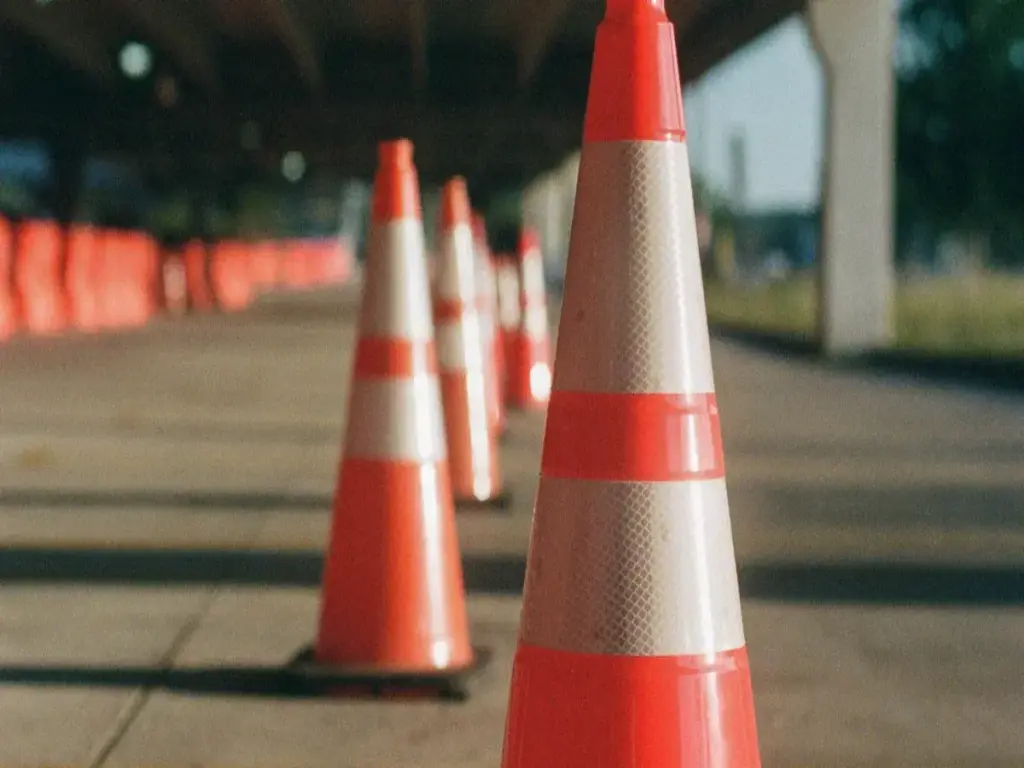
- Le cône en aval: Une courte section de 100 pieds à la fin de la zone de travaux pour ramener la circulation.
Espacement des dispositifs de canalisation pour les dispositions de panneaux de signalisation routière de construction
Une fois la longueur du cône réglée, vous devez placer vos cônes ou fûts. Une norme industrielle commune pour placement des panneaux routiers de construction et la canalisation est:
- Espacement maximal: La distance entre les appareils (en pieds) devrait être égal à la limite de vitesse affichée (en mph).
- Astuce sur le terrain: Sur un 65 autoroute en mph, appareils spatiaux 65 à pied.
Placement critique de la signalisation au point d’entrée conique
Ton Fusionner droite/gauche signes symboliques ou Grands panneaux fléchés doit être positionné exactement à l’extrémité amont (le début) du cône. C'est le plus critique installation de panneaux routiers de construction point parce que c'est là que le “Effet Vortex” est le plus fort.
Le passage des camions crée une pression atmosphérique intense; si vous utilisez des produits de qualité inférieure, signes minces, ils flotteront et finiront par arracher leurs montures. C'est pourquoi les cônes à grande vitesse nécessitent .080 panneaux de signalisation de construction en aluminium de jauge pour garantir que l'installation reste verticale et visible.
4. Normes verticales et latérales: Montage pour la visibilité
Un panneau est inutile s’il est caché derrière un SUV ou un buisson. Approprié installation de panneaux routiers de construction nécessite une attention particulière à la hauteur et au décalage.
- Zones urbaines (7-Règle du pied): Dans les quartiers d'affaires ou résidentiels, le bas du panneau doit être au moins 7 pieds au dessus du sol. Cela garantit qu'il reste au-dessus de la ligne de toit des voitures garées et permet le passage des piétons..
- Zones rurales (5-Règle du pied): Sur les autoroutes ouvertes, une hauteur de montage de 5 pieds est standard.
- Décalage latéral: Des panneaux doivent être placés 6 à 12 pieds du bord de l'épaule. Cela protège l'installation des “effet vortex”—le vide de vent intense créé par les semi-remorques—que nous analysons dans notre Étude sur la fatigue des panneaux et la charge de vent.
5. Point de vue d’un expert régional: Variations du DOT dans l'État
Bien que le MUTCD fédéral fournisse le cadre, installation de panneaux routiers de construction est souvent régi par des suppléments spécifiques à l'État qui sont plus stricts. Si vous êtes un entrepreneur opérant à travers les frontières de l'État, un “standard” une mise en page qui a réussi l'inspection dans un état peut échouer dans un autre.
Pour assurer une conformité réglementaire totale, les superviseurs de chantier doivent tenir compte de la géographie régionale, climat, et la densité du trafic lors de la planification de leur placement des panneaux routiers de construction.
UN. Texas (Txdot): Stabilité à grande vitesse & Conformité à la charge de vent
Au Texas, la combinaison de vastes plaines ouvertes et de limites de vitesse élevées entre États (souvent 75+ mph) fait de la charge de vent le principal défi pour temporary construction signs.
- Le “Torsion texane”: TxDOT nécessite souvent des supports de signalisation spécifiques montés sur patins qui ont été testés pour des rafales de vent plus élevées que les minimums fédéraux.
- Espacement d'installation: En raison des vitesses élevées, TxDOT impose souvent des mandats plus longs “Espaces tampons” que les minimums MUTCD. Lors de l'exécution placement des panneaux routiers de construction au Texas, vous devez vous assurer que vos panneaux d'avertissement préalable sont ancrés avec suffisamment de lest pour résister aux “Effet Vortex” de passer des triples (camions lourds).
B. Californie (Caltrans): Visibilité & Exigences de contraste élevé
La Californie installation de panneaux routiers de construction les normes se concentrent fortement sur le contraste et “Pop visuelle” en raison de sa géographie variée – des routes côtières brumeuses aux bassins urbains sujets au smog.
- Mandat Orange Fluo: Caltrans a été un pionnier en rendant obligatoire les feuilles orange fluo pour tous temporary construction signs. Ils ont découvert que la canette orange standard “grisé” dans les couches marines côtières de Californie.
- Précision du placement: Caltrans est notoirement strict en ce qui concerne le décalage latéral des panneaux dans les couloirs urbains comme l'I-405, où l'espace est limité mais la visibilité est primordiale.
C. Floride (FDOT): Conformité MASH & Résistance à la corrosion
DOT de Floride (FDOT) donne la priorité à la résistance aux chocs et à la durabilité environnementale.
- Test MASH: Florida is a leader in enforcing the Manual for Assessing Safety Hardware (ÉCRASER) normes. Chaque installation de panneaux routiers de construction must use stands and hardware that have passed rigorous crash testing to ensure they don’t become projectiles during a high-speed impact.
- Coastal Salt-Air: For projects along the Atlantic or Gulf coasts, FDOT inspectors look for signs of “piqûres” ou corrosion. If the installation uses low-grade hardware that rusts, it can compromise the sign’s stability, leading to a failed audit.
D. New York (NYSDOT): Urban Complexity & Night-Work Standards
Gérant placement des panneaux routiers de construction in New York requires navigating some of the densest traffic environments in the world.
- Exigences de réflectivité: Because much of the work in NYC or Albany is done at night, NYSDOT often requires a higher grade of retroreflective sheeting (Type XI) than other states.
- Sign Clutter Management: In New York’s urban geography, il y a une forte concentration de signalisation permanente. Les normes d'installation du NYSDOT exigent que les entrepreneurs “masque” ou couvrir tous les panneaux permanents qui entrent en conflit avec les panneaux temporaires de la zone de travail pour éviter toute confusion chez les conducteurs..
E. Illinois (TEMPS): Le “Loi sur la sécurité des zones de travail” Normes
L'Illinois applique certaines des sanctions les plus strictes des États-Unis.. pour les violations de la zone de travail, ce qui se traduit par des choses très spécifiques installation de panneaux routiers de construction protocoles.
- Signalisation d'application de photos: IDOT nécessite une signalisation spécifique avertissant les conducteurs de l'application automatisée des caméras. L'installation de ces panneaux doit être précisément chronométrée avec le début de la zone de travaux afin de garantir le caractère exécutoire des contraventions pour excès de vitesse..
6. L'audit de nuit: Le test final du succès de l'installation
Aux États-Unis, plus que 40% des travaux routiers se déroulent dans l’obscurité afin de minimiser les perturbations de la circulation. Cependant, les environnements nocturnes transforment une zone de travail standard en un théâtre à haut risque où la seule chose qui protège votre équipe est l'efficacité d'installation de votre signalisation réfléchissante. UN “Audit de nuit” est la procédure de terrain obligatoire pour garantir que votre placement des panneaux routiers de construction reste visible et conforme à la loi sous un éclairage artificiel.
UN. La science de la rétroréflectivité: Prisme contre. Perception
Lors de la réalisation d’un audit de nuit, tu ne cherches pas seulement “briller”; vous auditez les normes de rétroréflectivité. Dans notre Guide des matériaux pour les panneaux de construction, nous avons détaillé la physique des feuilles micro-prismatiques, mais sur le terrain, cela se traduit par Distance de vue de décision.
- Performances des angles d'observation: Sur des rampes d'autoroute courbes ou dans une géographie vallonnée, la luminosité d’un panneau peut varier. Lors de votre audit, vous devez parcourir la zone dans un véhicule standard pour vous assurer que installation de panneaux routiers de construction maintient son “populaire” même si l'angle de vos phares change.
- La règle des 500 pieds: Les normes fédérales exigent souvent qu'un panneau soit lisible d'au moins 500 pieds la nuit. Si le texte “auréoles” (saigne) ou semble sombre pendant votre passage en voiture, l'installation échoue à l'audit.
B. Gestion de l'éblouissement et positionnement des tours d'éclairage
L'un des échecs les plus courants dans temporary construction signs la configuration est “Luminance voilée”—éblouissement causé par des phares de travail mal positionnés.
- Le conflit: Les tours d'éclairage portatives sont essentielles à la sécurité de l'équipage, mais si la visée est incorrecte, ils peuvent effacer les propriétés rétroréfléchissantes de vos panneaux, rendre le texte illisible.
- Protocole d'audit: Assurez-vous qu'aucune tour d'éclairage n'est dirigée directement vers le visage de votre panneaux routiers de construction. La lumière doit être focalisée sur “Zone d'activité,” tandis que les panneaux dépendent uniquement des phares des véhicules pour leur retour réfléchissant.
C. Impact environnemental sur l'intégrité de l'installation
Nighttime geography introduces unique environmental variables that can compromise your placement des panneaux routiers de construction after the sun goes down:
- Dew and Frost Accumulation: In high-humidity regions like the Southeast or the Midwest, “dew-shielding” becomes an issue. Moisture on the sign face can scatter light, reducing reflectivity by up to 60%. If your audit reveals moisture-blindness, you may need to upgrade to sheeting with anti-dew coatings.
- Ambient Light Interference: Dans les zones urbaines, le “visual noise” of streetlights and commercial neon can overwhelm orange signage. Your Night-Audit must verify that your panneaux routiers de construction are positioned to create a high-contrast silhouette against the urban background.
D. Le “Drive-Through” Documentation: Your Legal Shield
A professional Night-Audit must be documented to provide a “Defense of Compliance” in the event of an accident.
- Dashcam Verification: Beaucoup de États-Unis. les entrepreneurs utilisent désormais des dashcams 4K pour enregistrer toute l'approche de la zone de travail la nuit. Cela fournit une preuve horodatée que chaque placement des panneaux routiers de construction était visible et droit.
- Le “Fantôme” Vérifier: Lors de la vérification, recherchez les panneaux qui ont été renversés par le vent ou “fantôme” (ombragé) par de gros engins de chantier.
- Signer un audit de propreté: Saleté de la route, poussière, et le brouillard salin dégradent considérablement les performances des feuilles de type IV et de type XI.. Un simple essuyage lors de l'Audit de Nuit permet de restaurer la conformité visuelle de l'ensemble d'une installation..
7. Documentation défensive: Protection contre la responsabilité
Aux États-Unis. système juridique, “S'il n'a pas été enregistré, cela n'est pas arrivé.” Une installation professionnelle comprend un Journal quotidien de contrôle de la circulation.
Le journal de placement des panneaux
Chaque matin, le technicien de contrôle de la circulation (TCT) doit documenter:
- La localisation GPS exacte de chacun panneau de construction temporaire.
- Vérification que tous les panneaux sont conformes à MASH (pas de blocs de béton ni de roches comme ballast; sacs de sable uniquement).
- Preuve photographique de l'aménagement à la hauteur des yeux du conducteur.
Conclusion: Construire pour la conformité, Installer pour la sécurité
Correct placement des panneaux routiers de construction est un mélange de mathématiques d'ingénierie et d'expérience sur le terrain. En adhérant aux tables d'espacement MUTCD, calculer des cônes précis, et choisir les bons substrats, vous créez une zone de travail qui protège votre équipage, le public, et la réputation de votre entreprise.
OPTRAFIC résout ces défis critiques en matière de zones de travail en fournissant une signalisation conforme à la norme MUTCD. Des substrats en aluminium haut de gamme aux feuilles rétroréfléchissantes avancées, Panneaux routiers de construction OPTRAFFIC sont conçus pour maintenir l’intégrité et la lisibilité de leur placement, fournir aux entrepreneurs un matériau durable, solution nécessitant peu d'entretien.
Conformité réglementaire & Autorités
| Région / Standard | Lien de référence officiel |
| Normes fédérales | Manuel FHWA sur les dispositifs uniformes de contrôle du trafic (Mutcd) |
| Matériel de sécurité | Normes de crash-test AASHTO MASH |
| Texas | Signalisation routière TxDOT & Manuels de contrôle de la circulation |
| Californie | Caltrans Californie MUTCD (COMME MUTCD) |
| Floride | Forfaits standard FDOT & Normes de conception |
| New York | Sécurité de la zone de travail du NYSDOT & Règles d'ingénierie |
| Illinois | Directives de sécurité de la zone de travail IDOT |
Configure Your Zone: Specific Traffic Control Layouts
UN “taille unique” approach often fails inspections. Use the following technical guides to execute precise layouts for shoulder work, flagging operations, and pedestrian detours.
Explore our scenario-specific safety guides:
- Épaule & Fermetures de voies:
- Traffic Control Operations:
- Signalisation & Pedestrian Standards:
FAQ
Selon le tableau MUTCD 6C-1, pour des vitesses de 65-80 mph, l'espacement recommandé est 1,000 ft (Signe A), 1,500 ft (Signe B), et 2,640 ft (Signe C), totalisant plus 5,000 pieds de distance de préavertissement.
Oui. Bien que le MUTCD fédéral fournisse la référence nationale, des États comme la Californie (Caltrans) ou au Texas (Txdot) ont souvent des exigences plus strictes en matière de réflectivité, lest chargé par le vent, et couleurs de panneaux spécifiques (Par exemple, orange fluorescent).
La vitesse du 85e centile est la vitesse à laquelle 85% du trafic est en déplacement. Le MUTCD impose d'utiliser cette vitesse, plutôt que la limite affichée, pour calculer les longueurs coniques et l'espacement des panneaux afin de garantir une sécurité réelle.
Pour les environnements d'autoroutes à grande vitesse, .080 jauge en aluminium est la norme de l'industrie. Il offre l'intégrité structurelle nécessaire pour résister aux “Effet Vortex” et des rafales de vent provoquées par le passage de camions lourds.