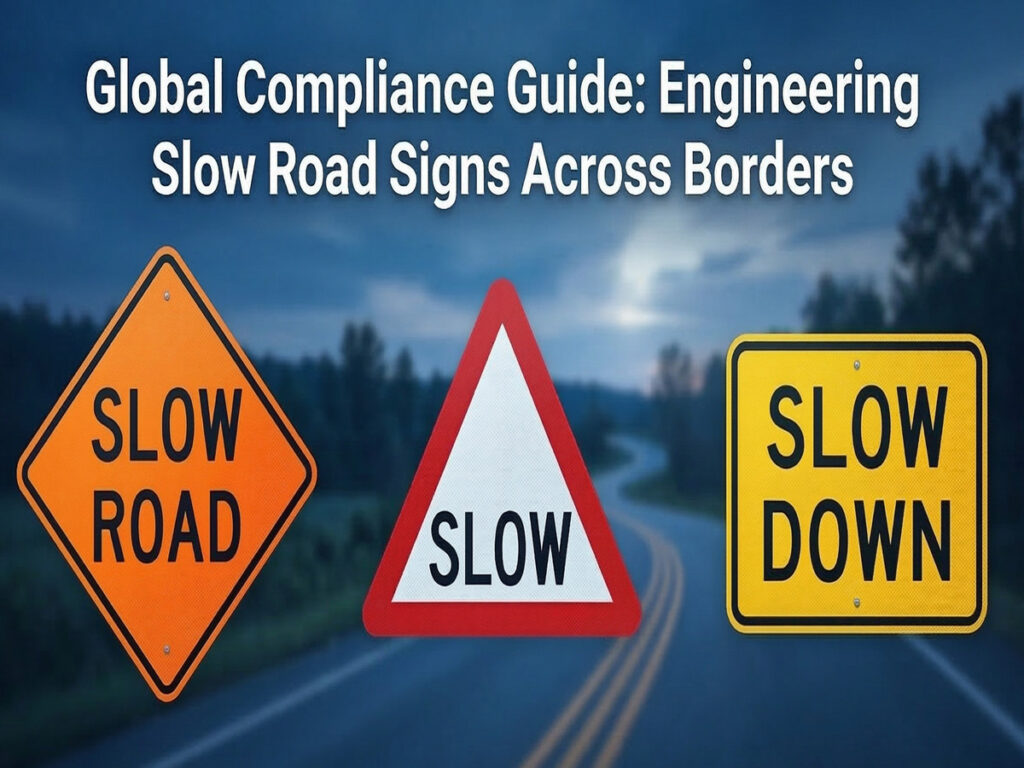
Engineering authorities worldwide mandate specific corner radii for all traffic control devices. These regulations provide a foundation for road safety and equipment longevity. Understanding the technical divergence between North American, européen, and Australian standards is essential for bulk procurement.
Optrafic operates as a global supplier specializing in high-precision Solutions de sécurité de la circulation. The team utilizes advanced hydraulic stamping technology to ensure 100% compliance with international R-corner specifications. These precision-engineered edges minimize installation risks and prevent premature reflective sheeting failure.
The Regulatory Logic Behind Standardized Radii
The corner radius serves as a critical safety feature rather than a decorative finish. Standardized edge geometry addresses three primary engineering concerns.
Eliminating Legal Liability
Engineers prioritize rounded corners to fulfill a “duty of care” toward the public. Sharp 90-degree edges on ébauches de panneaux en aluminium pose significant laceration risks. Site foremen handle hundreds of signs during major highway installations. Non-compliant edges lead to preventable workplace injuries. These accidents often result in expensive legal claims and project delays. Following established Traffic Sign Corner Radius standards mitigates these risks entirely.
Ensuring Structural Uniformity
Standardized radii ensure that signs from different manufacturers fit existing mounting hardware. Most bracket systems and u-channel posts assume a specific edge profile. Inconsistent corner geometry causes alignment issues during installation. This leads to uneven tension on mounting bolts. Finalement, this mechanical stress causes the sign to vibrate and fail prematurely.
Protecting Reflective Integrity
High-intensity reflective sheeting requires a stable substrate. Sharp corners create high-tension zones at the vertex of the sign. Thermal expansion cycles cause the metal to move at different rates than the film. Without a rounded radius, the sheeting begins to delaminate at the edges. Standardized corners ensure that bulk traffic signs maintain their retroreflectivity for over a decade.
North American Standards: The MUTCD and FHWA Framework
The United States utilizes the Manual on Uniform Traffic Control Devices (Mutcd). Ce document, managed by the Federal Highway Administration (Fhwa), dictates all physical sign characteristics.
Les panneaux routiers standards (SHS) Manuel
The FHWA provides precise radius tables within the “Panneaux routiers standards” manuel. Engineers use these tables to calibrate stamping dies for panneaux de signalisation personnalisés. The radius directly correlates to the overall dimensions of the sign blank.
| Sign Dimension (Pouces) | Required Corner Radius (Pouces) | Contexte d'application |
| 24 x 24 | 1.50 | Standard Urban Intersections |
| 30 x 30 | 1.875 | Secondary Arterial Roads |
| 36 x 36 | 2.25 | High-Speed Rural Highways |
| 48 x 48 | 3.00 | Interstate Freeway Systems |
The Calculation Formula for Guide Signs
Large-scale guide signs on interstate highways follow a different logic. Engineers often apply the “one-eighth rule” for these massive structures. This rule sets the radius at approximately one-eighth of the shortest side of the sign. Cependant, the MUTCD caps the maximum radius at 12 pouces. This limit prevents the sign from losing too much surface area for text and borders.
European and UK Markets: BS One 12899 Conformité
The United Kingdom and Europe operate under the BS EN 12899-1:2007 standard. This regulation focuses on “Fixé, Vertical Road Traffic Signs.”
Structural Classes and Edge Protection
European standards classify signs based on their structural performance. BS One 12899-1 emphasizes the “safety of the edge.” Manufacturers must ensure that edges are not sharp or burred. The standard requires specific radius measurements to achieve CE or UKCA marking.
Metrication and Precision Stamping
Unlike the imperial US system, European standards use metric measurements. A standard 600mm sign typically requires a 40mm radius. These subtle differences matter during the tooling phase. A 1.5-inch (38.1mm) die does not meet the 40mm European requirement. Procurement teams must verify that the factory uses metric-specific molds for UK projects.
Impact of the UK Highway Works Specification
Le Royaume-Uni “Specification for Highway Works” (Série 1200) further refines these requirements. It demands that all panneaux de trafic personnalisés use specific edge treatments. These treatments prevent salt-water ingress between the sheeting and the aluminum substrate. Rounded corners are mandatory to ensure the protective border remains intact.
Asia-Pacific Focus: Norme australienne comme 1742.2
Australia maintains some of the strictest traffic engineering standards in the world. The primary document is AS 1742.2 (Manuel de dispositifs de contrôle de la circulation uniformes).
COMME 1319 contre. COMME 1742 Exigences
Australia distinguishes between workplace safety signs (COMME 1319) and road traffic signs (COMME 1742).
- COMME 1319: Focuses on worker protection. It requires rounded corners to prevent injuries in industrial environments.
- COMME 1742: Focuses on high-speed road environments. It emphasizes the aerodynamic stability of the sign blank.
Corrosion Prevention in Coastal Regions
Much of Australia’s road infrastructure sits near coastal areas. Salt-air corrosion quickly destroys the edges of aluminum signs. COMME 1742.2 promotes rounded corners to allow for better powder coating or anodizing coverage. Sharp edges often have “thin spots” in the protective coating. These spots become the primary sites for oxidation. A smooth corner radius ensures a uniform protective layer across the entire sign.
Road Sign Manufacturing Precision: Avoiding Common Failures
High-quality manufacturing prevents expensive field failures. Procurement managers must evaluate a factory’s technical capabilities.
Vortex Shedding and Vibration Data
Engineering studies analyze how air moves around different sign profiles. A square edge creates “vortex shedding.” This occurs when wind creates alternating low-pressure zones behind the sign. These zones cause the sign to oscillate or “flutter.”
Data indicates that a compliant corner radius promotes “flow reattachment.” This allows the air to move smoothly around the edge. Smooth airflow reduces the drag coefficient by up to 15%. This reduction is critical for the stability of large bulk traffic signs during storms.
Le “Radius Gauge” Quality Test
Quality control teams use GO/NO-GO gauges to verify batch consistency. A precision-stamped sign must fit the gauge perfectly. Any gaps indicate a worn stamping die or improper hydraulic pressure. Procurement managers should demand a quality report showing these gauge results. This report proves that the manufacturer adheres to the specified Traffic Sign Corner Radius.
CNC Routing vs. Stamping Dies
Large factories use two primary methods for shaping corners.
- Precision Stamping: This method uses massive hydraulic presses. It is the gold standard for bulk traffic signs. Il garantit 100% consistency across thousands of units.
- CNC Routing: This method uses computer-controlled cutting tools. It is ideal for unique panneaux de trafic personnalisés. CNC routing provides extreme accuracy for non-standard shapes.
Conclusion: Streamlining Global Procurement
Managing cross-border traffic projects requires deep technical knowledge. A minor deviation in corner geometry can lead to catastrophic project failures. Engineers must match the radius to the specific standards of the target region.
- Verify the Region: Use MUTCD for North America, BS One 12899 for Europe, Et comme 1742 pour l'Australie.
- Check the Size: Ensure the radius scales correctly with the sign dimensions.
- Audit the Factory: Confirm the use of precision stamping or CNC routing.
Choosing a manufacturer that understands these international nuances is critical. High-precision manufacturing ensures that every sign meets strict safety and durability goals. For your next major infrastructure project, explore our catalog of compliant panneaux de trafic personnalisés. Our engineering team utilizes standardized tooling to guarantee global compliance.
FAQ: Traffic Sign Corner Radius and Engineering Compliance
What is the Traffic Sign Corner Radius?
The corner radius defines the specific arc measurement at the vertex of a sign blank. Engineering teams specify this geometry to eliminate sharp 90-degree edges. This feature prevents metal shearing and protects workers from lacerations during handling.
Why do engineering standards mandate rounded corners?
Rounded corners significantly improve the aerodynamic profile of the sign. This design disperses wind-induced stress and prevents structural fatigue. Standardized radii also ensure that signs fit universal mounting brackets and hardware.
Does corner radius affect the lifespan of reflective sheeting?
Oui. Sharp corners create localized tension during thermal expansion and contraction cycles. This tension often causes the reflective film to delaminate or peel at the edges. Un lisse Traffic Sign Corner Radius ensures the sheeting remains securely bonded to the substrate.
Are corner radius requirements the same for all countries?
Non. Engineering specifications vary by region to match local safety laws. US projects must adhere to FHWA and MUTCD tables. UK and European projects require BS EN 12899 conformité. Australian contractors must follow AS 1742 lignes directrices.
How do procurement teams verify radius compliance?
Teams should use precision radius gauges to check batch consistency. Procurement managers must also demand material certifications from the manufacturer. These documents prove that the stamping process meets the required engineering tolerances.
What happens if a sign has a non-compliant corner radius?
Non-compliant signs often face immediate rejection during official project inspections. Sharp edges also increase legal liability for contractors in the event of an injury. En outre, incorrect geometry leads to premature material failure and higher maintenance costs.