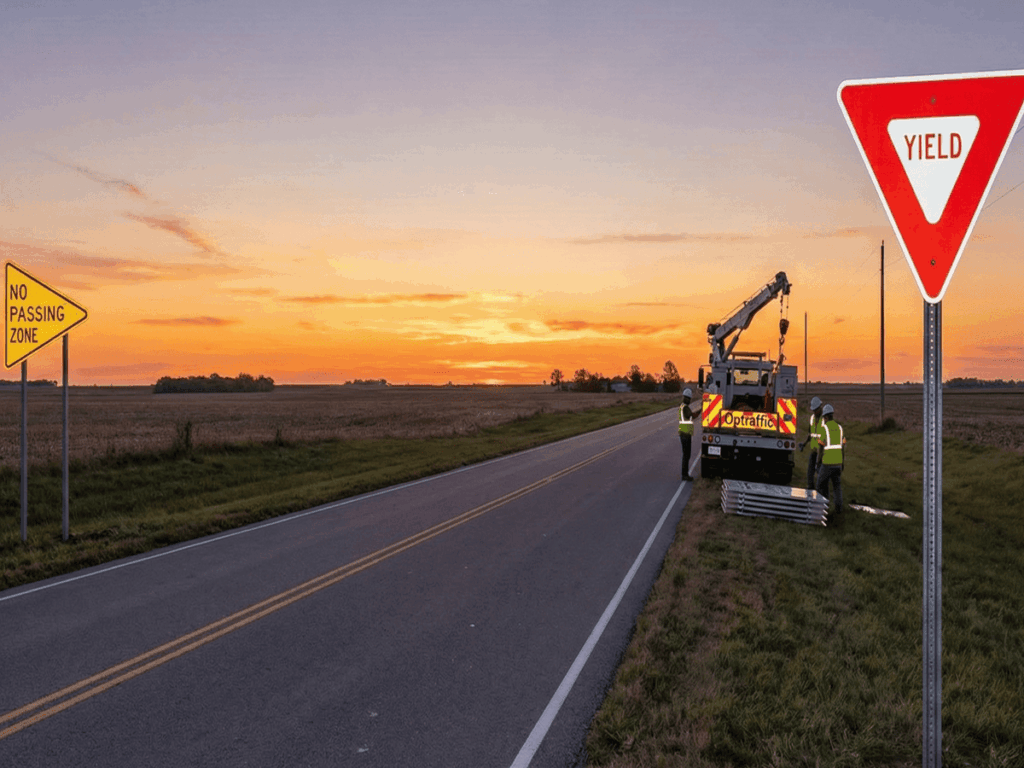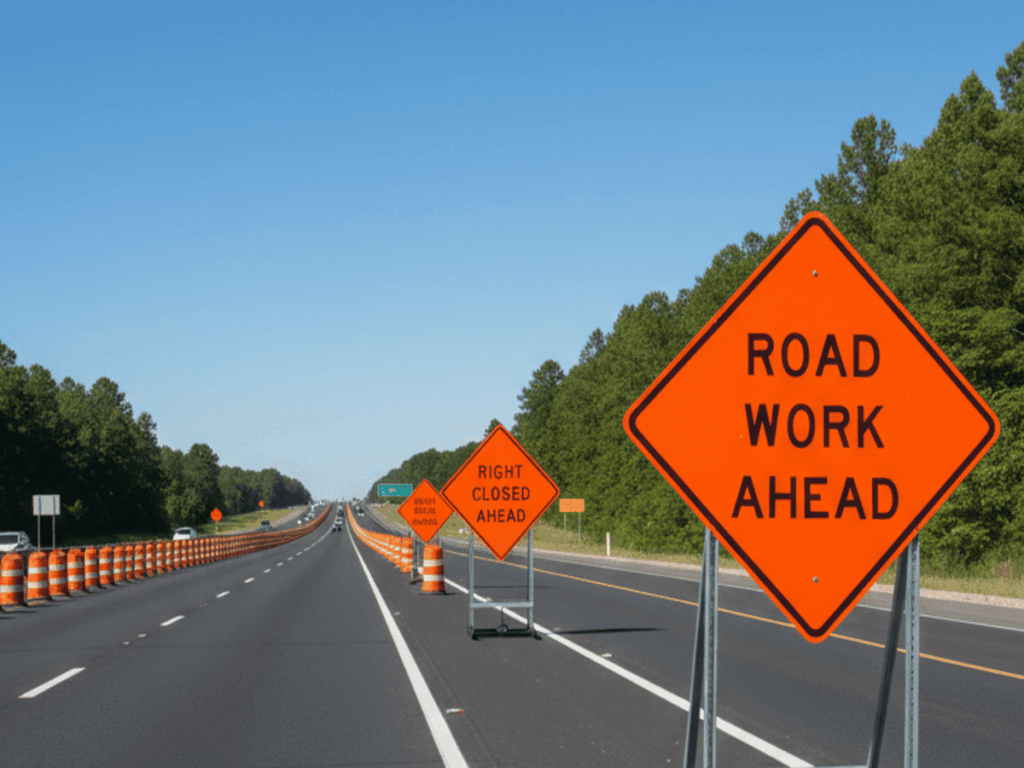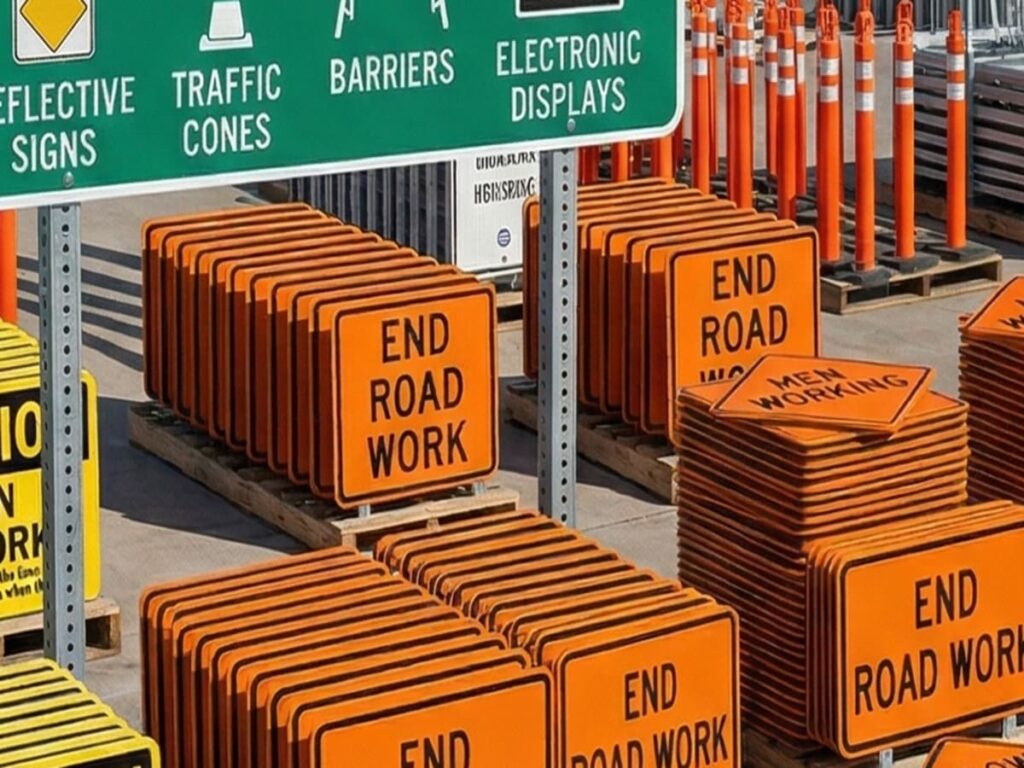
Panneaux de signalisation personnalisés represent a small but strategically important part of a rental fleet’s inventory. Most work zone deployments rely entirely on MUTCD standard signs — road work ahead, voie fermée, drapeaux devant. But four scenarios consistently push rental operators toward custom orders: non-standard project requirements, fleet branding and asset protection, state DOT supplement specifications, and specialty municipal or event work.
Ordering custom signs introduces complexity that standard wholesale orders do not carry. Specifications must be precise. MUTCD compliance must be verified before, pas après, production. Lead times are longer. And the cost-per-unit is higher, which makes getting the specification right the first time essential.
This guide covers when custom traffic signs make sense for a rental fleet, how to specify them correctly, how to manage the ordering process from a manufacturer, and how to protect your custom sign investment through asset marking.
If you are sourcing standard MUTCD work zone signs for bulk fleet stocking, voir notre guide sur wholesale traffic sign sourcing for rental fleets. For custom traffic sign options built to your fleet specification, parcourez notre custom safety signage range — available for wholesale fleet orders with ASTM D4956 documentation on request.
Principaux à retenir
- Most rental fleet deployments use standard MUTCD signs — custom orders apply in four specific scenarios.
- Custom signs must still meet MUTCD dimensional and retroreflectivity requirements — customization applies to legend, couleur, or layout, not compliance standards.
- Substrate specification for rental-grade custom signs: .080″ aluminium, 5052-H38 ou 6061-T6, ASTM D4956 Type III sheeting minimum.
- MOQ for custom traffic signs from manufacturers typically ranges from 10–50 units per sign design — plan orders accordingly.
- Lead time for custom orders is typically 2–4 weeks vs. 24–48 hours for standard stock signs — factor this into project timelines.
- Asset marking (company name, serial number) on custom signs is the most practical fleet protection measure for high-value inventory.
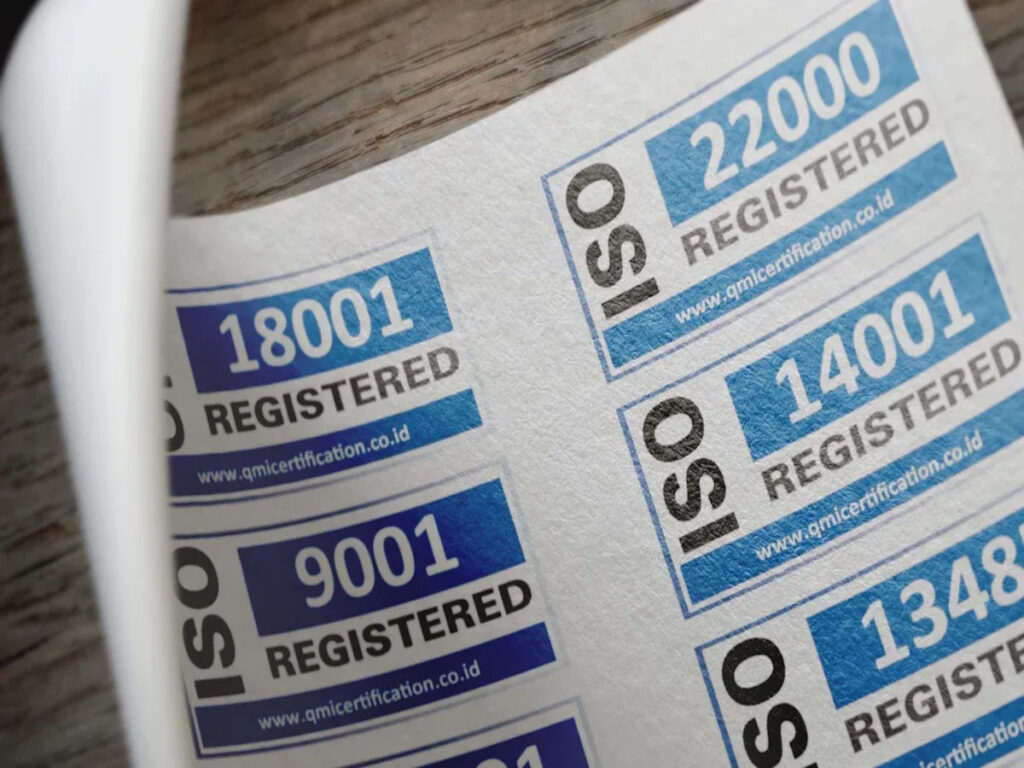
- ISO 9001-certified manufacturers with documented custom production processes reduce the risk of specification errors on bulk custom orders.
Custom Construction Signs: Four Scenarios Where Standard Signs Are Not Enough
Scénario 1: Non-Standard MUTCD Legend Requirements
Partie MUTCD 6 prescribes specific sign legends and codes for the most common work zone situations. Cependant, some project conditions require legends that fall outside the standard catalog. Examples include project-specific distance information, contractor-specific permit signs required by local DOTs, or combined message signs that do not exist as standard MUTCD codes.
Dans ces cas, MUTCD permits the development of special word message signs based on engineering judgment, provided they follow the general requirements for color, forme, alphabet size, and series. Custom signs for this scenario must match the applicable MUTCD shape, background color, and font — only the legend differs from the standard catalog.
Scénario 2: State DOT Supplement Requirements
Several states maintain MUTCD supplements that specify sign types not included in the national standard. As covered in our state-by-state compliance guide, des États comme la Californie (COMME MUTCD), Texas (TMUTCD), et New York (supplément d'état) add sign requirements that differ from national standards. Rental operators serving these markets may need custom signs to meet state-specific project requirements.
Before ordering custom signs for state supplement compliance, confirm the exact legend, couleur, taille, and MUTCD reference from the applicable state DOT document. State supplement signs must meet the same retroreflectivity and dimensional standards as national MUTCD signs — the customization is in the legend and sometimes the layout, not in the material specification.
Scénario 3: Fleet Branding and Asset Protection
Rental companies operating large fleets face a persistent operational challenge: sign loss and misidentification. Standard MUTCD signs are identical regardless of who owns them. A sign that goes out on a rental and does not come back is effectively unrecoverable without some form of ownership marking.
Custom signs with company name, logo, or contact information stamped or printed on the reverse face address this problem directly. Some operators also add serialized asset tags or unique color-coded edge treatments to high-value sign types. This is a legitimate and increasingly common use of custom ordering in the rental industry.
Scénario 4: Municipal and Event Specialty Signage
Municipalities and event organizers occasionally require temporary signs that carry specific local authority branding, permit references, or event-specific messaging. These signs are frequently rented rather than purchased because the need is time-limited. Rental operators who can supply custom signs for these applications — event detour signs, permit-reference traffic control signs, branded parking management signs — access a higher-margin customer segment that standard catalog suppliers cannot serve.
Custom Road Traffic Signs: The Decision Framework
Before placing a custom order, every rental operator should confirm that a standard MUTCD sign does not already cover the requirement. Custom signs cost more per unit, carry longer lead times, and introduce specification risk. The decision to go custom should be deliberate, not a default.
| Exigence | Use Standard Sign | Use Custom Sign |
| Work zone warning (avertissement préalable, lane closure, braquage) | ✅ Standard MUTCD W-series covers all common scenarios | Only if state supplement requires non-standard legend |
| Speed limit in work zone | ✅ Standard R2-1 with WORK ZONE plaque | Only if combined sign format required by DOT |
| Road closed / DEVIATION | ✅ Standard R11-3, W20-2, M4-9 | Only if project-specific routing legend needed |
| Company identification on signs | ❌ Not available on standard signs | ✅ Custom reverse-face branding or edge marking |
| State supplement sign type | Only if national MUTCD equivalent exists | ✅ When state DOT specifies non-national sign type |
| Municipal event traffic control | Sometimes — check MUTCD catalog first | ✅ When event-specific legend or branding required |
| Unusual project-specific messaging | ❌ No standard equivalent | ✅ With engineering judgment per MUTCD Section 2A.06 |
If the requirement maps to a standard MUTCD sign, order standard. Custom orders for situations where standard signs exist create unnecessary cost and lead time without a compliance benefit.
Heavy Duty Custom Aluminum Signs: Specification Requirements for Rental Grade
Why Rental Grade Is a Higher Standard Than Standard Custom
Off-the-shelf custom traffic signs from retail suppliers are typically built to single-deployment standards. Rental signs need to survive repeated handling cycles — setup, takedown, transport in truck beds, and storage — across their entire service life. This means rental-grade custom signs carry tighter specifications than what most custom sign suppliers deliver as standard.
Complete Specification for Custom Rental Fleet Signs
| Élément de spécification | Rental Fleet Standard | Remarques |
| Épaisseur du substrat | .080″ minimum | Do not accept .040″ ou .063″ — insufficient for rental handling cycles |
| Alliage en aluminium | 5052-H38 ou 6061-T6 | Higher strength alloys; resist bending under repeated handling |
| Qualité de feuille | ASTM D4956 Type III minimum | Type IX or XI for highway/high-speed applications |
| Traitement des coins | Rounded corners per FHWA Standard Highway Signs | Reduces injury risk during handling; required for MUTCD compliance |
| Trous de montage | Pre-drilled to match your standard frame specification | Confirm hole diameter and pattern with your frame supplier before ordering |
| Stratification UV | Required for all signs | Protects sheeting from abrasion and graffiti across multiple rental cycles |
| Revêtement anti-graffiti | Recommended for high-value custom signs | Allows cleaning without damaging reflective sheeting |
| Reverse face marking | Company name, téléphone, serial number minimum | Asset protection — use permanent ink stamp or engraving, not adhesive labels |
| Conformité MUTCD | Forme, couleur, legend per applicable MUTCD section | Custom legend does not exempt sign from MUTCD dimensional and color standards |
Sheeting and Compliance Documentation
Custom signs must carry the same ASTM D4956 sheeting certification as standard signs in your fleet. Request the sheeting certification from the original sheeting manufacturer — not a distributor attestation — and confirm it covers the specific Type used on your custom order. This documentation feeds into your MUTCD Section 2A.22 management method records the same way standard sign documentation does.
Bulk Custom Traffic Signs: The Ordering Process and Timeline
Étape 1: Write a Complete Specification Sheet Before Contacting Any Supplier
The most common cause of custom sign order errors is an incomplete specification at the time of inquiry. Suppliers who receive vague requests will interpret gaps in their favor — usually toward the minimum viable specification rather than rental-grade quality. Before contacting any manufacturer, prepare a written specification sheet that covers every element in the table above.
Include with your specification: a dimensioned drawing or sketch of the sign face (even hand-drawn is useful), the MUTCD section or state DOT document reference that governs the sign type, your required mounting hole pattern with dimensions, and the target quantity and delivery date.
Étape 2: Request a Pre-Production Sample
For any custom order above 25 unités, request a pre-production sample before approving full production. The sample confirms that the manufacturer has interpreted your specification correctly — legend position, taille de la police, précision des couleurs, qualité de feuille, corner treatment, and mounting holes. Approving a sample before full production is far less expensive than rejecting a complete batch.
For custom signs that must comply with a specific MUTCD section or state DOT supplement, verify the sample against the applicable document yourself before approval. Do not rely solely on the manufacturer’s self-attestation of compliance.
Étape 3: Understand MOQ and Lead Time
Custom traffic sign MOQ and lead time reference
Typical MOQ from traffic sign manufacturers: 10–50 units per sign design
Lower MOQ (10–25 units): smaller manufacturers or higher per-unit price at lower quantity
Higher MOQ (50+ unités): larger manufacturers; better per-unit pricing
Lead times by order type:
Standard stock signs: 24–48 hours
Simple custom (standard shape, custom legend only): 5–10 business days
Full custom (non-standard shape, custom sheeting layout): 2–4 weeks
Large batch custom (500+ unités): 3–6 weeks including sample approval
Always confirm lead time in writing before placing order.
Étape 4: Verify Documentation Before Accepting Delivery
Before accepting any custom sign shipment, confirm that the following documentation arrives with the order: ASTM D4956 sheeting certification for the specific sheeting type used, certificate of conformance confirming the sign meets the specified MUTCD or state DOT standard, acquisition date on the invoice or packing list, and the pre-production sample approval record. Without these documents, the custom signs cannot enter your MUTCD Section 2A.22 compliance management system with a defensible record chain.
OEM Custom Road Signs: Why Manufacturer-Direct Sourcing Matters
The Quality Control Difference in Custom Orders
Custom sign orders amplify the quality gap between manufacturers and distributors. For standard MUTCD signs, a distributor can source from multiple manufacturers and maintain consistent quality because the product specification is fixed by MUTCD. For custom signs, the specification is set by the buyer — and a distributor passing that specification to a third-party manufacturer has less visibility into and control over how it is interpreted and executed.
Manufacturer-direct ordering for custom signs means your specification goes directly to the production team without intermediary translation. It also means direct access to the manufacturer’s ISO 9001 quality management process, which covers custom production runs the same way it covers standard product runs.
What to Verify in a Custom Sign Manufacturer
- ISO 9001 certification with scope covering traffic sign manufacturing — confirm scope statement explicitly covers custom sign production, not just standard catalog items.
- In-house sheeting application — manufacturers who apply reflective sheeting in-house have better control over consistency across a custom batch than those who outsource the sheeting step.
- Custom design review process — a manufacturer with a documented sign-off process for custom specifications (artwork approval, pre-production sample, dimensional verification) reduces the risk of production errors on your order.
- Reference orders — ask for references from other rental operators or municipalities who have placed custom orders. A manufacturer experienced with rental-grade custom sign requirements is a different supplier from one accustomed to retail custom sign requests.
For a full supplier evaluation framework covering ISO 9001 attestation, ASTM D4956 documentation, and purchase order requirements, voir notre guide sur what supplier certifications actually mean for US buyers.
Wholesale Custom Construction Signs: Asset Protection and Fleet Branding
The Business Case for Branded Custom Signs
A rental fleet of 500 signs at $85 per unit represents a $42,500 capital investment. Standard signs are indistinguishable from each other — and from competitors’ signs — once they are deployed at a job site. Branded custom signs with company identification on the reverse face are the simplest and most cost-effective asset protection measure available to rental operators.
Beyond asset protection, branded signs build market presence. A contractor who sees your company name on signs at multiple job sites over several months develops brand familiarity that translates to repeat rental business. This is particularly valuable in competitive local markets where rental operators serve overlapping customer bases.
Practical Asset Marking Options
- Reverse face printing: company name, phone number, and a unique asset code printed on the back of every custom sign. Most reliable method — integrated into the sign production process.
- Stamped or engraved identification: company name stamped into the aluminum substrate. Permanent and tamper-resistant — cannot be removed without damaging the sign.
- Color-coded edge treatment: a distinctive color applied to the sign edges that visually identifies your inventory at a glance during post-rental inspection.
- QR code asset tags: QR codes linking to your inventory management system. More sophisticated, but requires robust mobile infrastructure at your operation.
For high-volume custom orders with asset marking, the per-unit cost premium over unmarked standard signs is typically $2–5 depending on marking method and order size. At that cost, asset marking pays for itself with the recovery of even a small percentage of signs that would otherwise be lost.
Foire aux questions: Panneaux de signalisation personnalisés pour les flottes de location
T1: Do custom traffic signs still need to comply with MUTCD standards?
Oui. MUTCD compliance applies to all traffic control signs used on public roads, regardless of whether they are standard catalog signs or custom orders. Custom signs must meet the applicable MUTCD requirements for shape, couleur, rétro -flectivité, and dimensions. The customization applies to the legend, mise en page, or branding — not to the compliance standards that govern the sign’s physical characteristics.
Q2: What is the minimum order quantity for custom traffic signs from a manufacturer?
Typical MOQ from traffic sign manufacturers ranges from 10–50 units per sign design. Smaller manufacturers or those accepting higher per-unit prices may accommodate orders from 10 unités. Larger manufacturers typically set MOQ at 25–50 units to justify the setup cost of a custom production run. For very small quantities — fewer than 10 units — a domestic custom sign printer may be more practical than an international manufacturer, though unit cost will be significantly higher.
T3: How long does a custom traffic sign order take to deliver?
Lead time depends on order complexity. Simple custom signs — standard MUTCD shape with a custom legend — typically take 5–10 business days from order approval. Full custom orders with non-standard layouts or large batch quantities typically take 2–4 weeks. Always confirm lead time in writing before placing the order and factor the lead time into your project scheduling. Custom signs cannot substitute for standard stock signs in time-critical deployments.
T4: Can I add my company logo to standard MUTCD work zone signs?
Oui, with an important limitation. Company identification should be placed on the reverse face of the sign — not on the sign face. Adding any marking to the front face of an MUTCD-regulated sign risks creating a non-compliant device if the marking interferes with the prescribed legend, couleur, or retroreflectivity. Reverse-face marking — company name, phone number, asset code — is the standard approach and does not affect front-face compliance.
Q5: What documentation should I receive with a custom sign order?
Request: ASTM D4956 sheeting certification from the original sheeting manufacturer for the specific type used; a certificate of conformance confirming compliance with the specified MUTCD section or state DOT standard; acquisition date on the invoice or packing list for MUTCD Section 2A.22 management method records; and the pre-production sample approval record. Without these documents, the custom signs cannot enter your compliance management system with a defensible record chain.
Q6: Is it worth ordering custom signs for a small rental fleet?
Custom signs make sense for small fleets when the specific use case is clear and recurring. Asset branding is worth the investment at any fleet size — even 50–100 branded signs reduce loss risk meaningfully. State supplement-specific signs make sense when you serve a specific market consistently. Avoid custom orders for one-off project requirements where a standard sign alternative exists — the cost and lead time premium is not justified for infrequent use.
Conclusion
Custom traffic signs serve a specific and limited role in a rental fleet’s inventory. Most work zone deployments run entirely on standard MUTCD catalog signs. Custom orders add value in four scenarios: non-standard project requirements, state DOT supplement specifications, fleet branding and asset protection, and specialty municipal or event work.
When custom orders are appropriate, the specification discipline matters more than it does for standard signs. Rental-grade custom signs require .080″ aluminium, ASTM D4956 Type III sheeting minimum, MUTCD-compliant dimensions, and complete supplier documentation. These requirements are non-negotiable — a custom sign that fails on retroreflectivity or dimensional compliance creates the same liability exposure as a non-compliant standard sign.
The ordering process — written specification, pre-production sample, MOQ planning, documentation verification — protects your investment and ensures the custom signs that enter your fleet are compliant, durable, and recoverable. Custom signs built to rental-grade specification, ordered in appropriate quantities from ISO 9001-certified manufacturers, are a legitimate and profitable part of a full-service rental operation.
Ready to source custom traffic signs built to your fleet specification? Request a quote for custom work zone signage — available for wholesale fleet orders with ASTM D4956 documentation and ISO 9001 certification on request.
Références
- FHWA — MUTCD 11th Edition, Partie 6: Contrôle du trafic temporaire (à compter de janvier 18, 2024): https://mutcd.fhwa.dot.gov/pdfs/11th_Edition/part6.pdf
- FHWA — MUTCD 11th Edition, Section 2A.22: Maintaining Minimum Retroreflectivity: https://mutcd.fhwa.dot.gov/pdfs/11th_Edition/part2a.pdf
- OSHA — 29 CFR 1926.200: Signes, Signaux, et barricades: https://www.osha.gov/laws-regs/regulations/standardnumber/1926/1926.200
- ISO — ISO 9001:2015: Quality Management Systems — Requirements: https://www.iso.org/standard/62085.html
Articles connexes dans cette série
- Comment se procurer des panneaux de signalisation en gros pour une flotte de location (C1)
- CE & Fournisseurs de panneaux de signalisation certifiés ISO: Ce que signifient réellement les certifications (C2)
- Tailles des panneaux de zone de travail: Référence des dimensions MUTCD pour les flottes de location (B3)
- Retour au pilier: Panneaux de signalisation pour les sociétés de location — Flotte complète & Guide d'approvisionnement