Einführung: Die Bedeutung von Spursperrschildern
Es ist gefährlich, den Hochgeschwindigkeitsverkehr zwangsweise zusammenzuführen. Autofahrer reagieren oft spät auf Spurverkleinerungen. Um Chaos zu verhindern, Standortmanager müssen eine genaue Reihenfolge festlegen Spursperrschilder. Diese statischen Warnungen erzeugen eine “visueller Trichter.” Sie führen den Fahrer lange vor Erreichen der Leitkegel aus der gesperrten Spur.
Dieses Setup basiert auf dem Standard “Vier Komponentenbereiche” einer temporären Verkehrskontrollzone.
Beherrsche die Grundlagen: Bevor Sie eine konkrete Schließung planen, Sehen Sie sich die vier Kernzonen in unserem an Einrichtung der Arbeitszone 101 Führung.
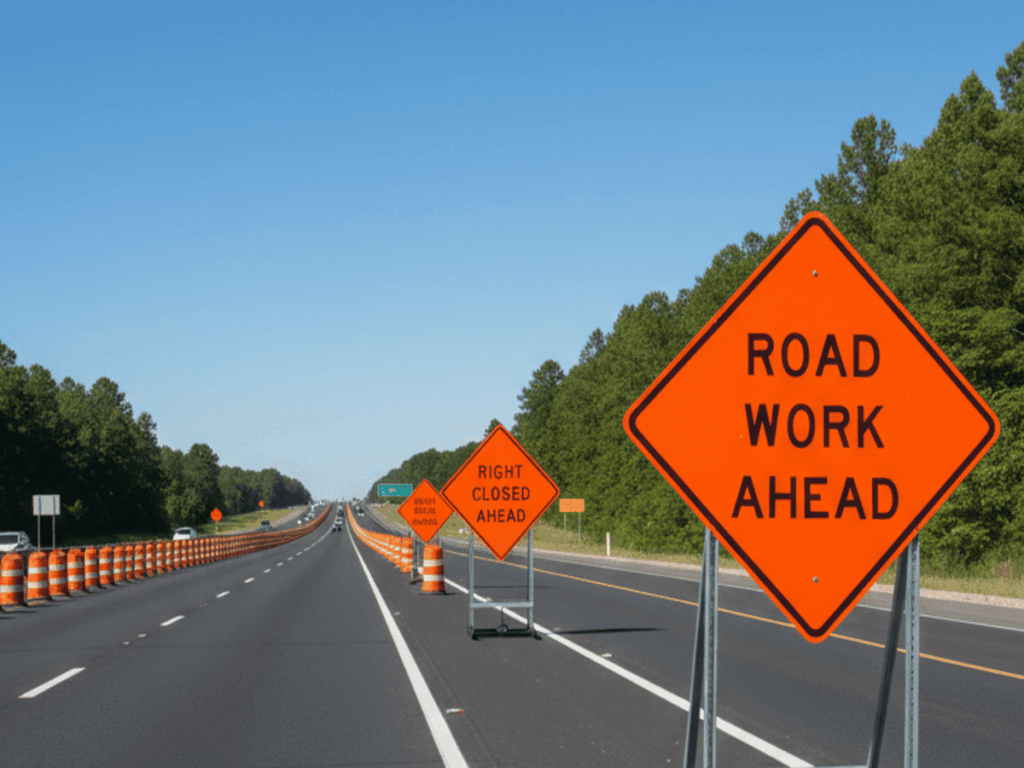
Jedoch, wenn Sie eine Fahrspur sperren müssen, Du brauchst das volle “Vorwarnbereich” aufstellen. Dies erfordert spezifische Spur gesperrt vor Schildern in genauen Abständen platziert werden.
Auswahl des richtigen Schildes „Fahrspur gesperrt“.
Bei einer einspurigen Sperrung, Spezifität rettet Leben. Sie können keine generische Nachricht verwenden. Sie müssen den Fahrern anhand der entsprechenden Angaben genau mitteilen, welche Seite gesperrt ist Spur gesperrt vor Schild.
Platzieren des Schildes „Rechte Spur gesperrt“.
Hier passieren die meisten Zusammenfahrunfälle. Autofahrer auf der rechten Spur müssen sich links in den schnelleren Verkehr einreihen.
- Zeichen: Benutze die Schild „Rechte Fahrspur gesperrt“. (W20-5R).
- Platzierung: Platzieren Sie dieses Schild als “B” Warnung in Ihrer Drei-Schritte-Sequenz.
- Aktion: Dadurch wird der Verkehr gezwungen, frühzeitig nach links zusammenzufahren. Es verhindert ein Zuschneiden in letzter Minute.
Anbringung des Schildes „Linke Spur gesperrt“.
Der “Überholspur” birgt hohe Geschwindigkeitsrisiken. Autofahrer erwarten einen klaren Weg.
- Zeichen: Benutze die Schild „Linke Spur gesperrt“. (W20-5L).
- Verkehrsfluss: Dadurch wird schneller Verkehr gezwungen, nach rechts zusammenzufahren.
- Sichtweite: Stellen Sie sicher, dass Ihre Spursperrschilder sind aus größerer Entfernung sichtbar. Hochgeschwindigkeitsfahrer benötigen mehr Reaktionszeit.
Tauschen Sie diese Schilder niemals aus. A “Geschlossen gelassen” melden Sie sich an “Rechts geschlossen” Das Projekt sorgt für katastrophale Verwirrung.
Spursperrschilder & Kegelformel
Sie müssen Ihre positionieren Spursperrschilder zu unterstützen “Verschmelzungskegel.” This is the critical difference from shoulder work. You are forcing traffic out of a live lane.
- The Full L Rule: Verwenden Sie die Formel L = Width x Speed.
- Beispiel: Auf a 60 mph road with 12-foot lanes, the taper must be 720 Füße lang.
- Sign Support: Place your final Spur gesperrt vor Schild well before the taper begins.
This creates a long, gradual path. It guides drivers away from the closed lane safely.
Spursperrschilder & Der “Full L” Kegelformel
The placement of your Spursperrschilder dictates the success of the merge. Jedoch, the signs only warn the driver. The physical “Merging Taper” actually moves the traffic.
Crucial Difference: Unlike a shoulder closure which only uses a short “1/3 L” verjüngen, a lane closure requires the Full Taper Length (L).
Need the “1/3 L” Regel? If you are only closing the edge, do not use this formula. Read our Shoulder Work Setup Guide stattdessen.
For a lane closure, a short taper forces aggressive merging. This causes side-swipe accidents. You must use the full length.
Calculating “L” Based on Speed
MUTCD defines specific formulas for “L” depending on the speed limit (S) and lane width (W).
- Hohe Geschwindigkeit (45 mph oder mehr): Verwenden Sie die Formel L = B x S.
- Beispiel: For a 12-ft lane at 60 Meilen pro Stunde: 12 X 60 = 720 Füße.
- Niedrige Geschwindigkeit (40 mph oder weniger): Verwenden Sie die Formel L = (W x S²) / 60.
- Beispiel: For a 10-ft lane at 30 Meilen pro Stunde: (10 X 900) / 60 = 150 Füße.
Aligning Signs with the Taper
Dein Spur gesperrt vor Schildern must align with this calculated distance.
- Pufferspeicher: Do not start the work area immediately after the taper. Leave a longitudinal buffer space.
- Zeichenabstand: Ensure the final Spur gesperrt vor Schild (Symbol W4-2) is placed well before the taper starts.
Positioning Lane Closure Signs (Vorwarnbereich)
You must give drivers enough time to read the lane closed signs and react. The spacing depends strictly on the speed limit. MUTCD Table 6C-1 defines these “Vorwarnung” intervals.
Urban Low-Speed Roads (A, B, C Spacing)
Auf den Straßen der Stadt (35 mph oder weniger), space your signs closer together. Long gaps confuse drivers here because of intersections and driveways.
- First Sign: Platzieren Sie die Schild „Straßenarbeiten voraus“. 100 feet from the next sign.
- Second Sign: Place the specific Lane Closed Ahead sign 100 feet from the taper.
- Ziel: Keep the message immediate and clear.
Autobahn & Freeway Spacing
High speeds require much longer gaps. Drivers need seconds, not feet, to make decisions.
- Abstand: Increase the distance between each lane closure sign Zu 1,000 Füße, 1,500 Füße, oder auch 2,640 Füße (0.5 Meilen) on freeways.
- Sichtweite: Stellen Sie sicher, dass Left/Right Lane Closed Ahead sign is not blocked by trucks or vegetation.
- Reaktionszeit: This extended zone allows drivers to merge safely without panic braking.
Channelizer Spacing (Der “1-to-1” Regel)
Lane closure signs have done their job. They have warned the driver of the upcoming merge. Jetzt, physical devices must take over. As the driver passes the final Spur gesperrt vor Schild, they enter the “Transition Area.”
Hier, you must switch from information to guidance. You need a continuous line of channelizers (cones or drums) to physically push traffic out of the closed lane.
Building the “Visual Wall” (Taper Spacing)
In the taper, spacing is critical. If gaps are too wide, Autofahrer könnten denken, die Fahrspur sei noch offen. Sie könnten versuchen, sich einzuschränken. Sie müssen eine erstellen “Visual Wall” Das sieht aus der Ferne wie eine solide Barriere aus.
- Die Regel: Der maximale Abstand zwischen Geräten (in Fuß) entspricht der Geschwindigkeitsbegrenzung (in Meilen pro Stunde).
- Die Formel: Abstand = 1.0 x Geschwindigkeitsbegrenzung.
- Beispiel: Auf a 60 Meilen pro Stunde Autobahn, Platzieren Sie jeweils einen Straßenkegel 60 Füße.
- Städtischer Kontext: Auf a 25 Meilen pro Stunde Straße, Platzieren Sie sie alle 25 Füße.
Die Grenze wahren (Tangentenabstand)
Sobald die Verjüngung endet, Die “Tangente” beginnt. Dies ist die gerade Linie entlang des aktiven Arbeitsbereichs. Die Autofahrer befinden sich bereits auf der freien Spur, So können Sie den Abstand lockern.
- Die Regel: Hier können Sie den Abstand verdoppeln.
- Die Formel: Abstand = 2.0 x Geschwindigkeitsbegrenzung.
- Beispiel: Darüber hinaus 60 Meilen pro Stunde Autobahn, Sie können jeden Zapfen platzieren 120 Füße hinter der Verjüngung.
Für die Spitze: Auf Hochgeschwindigkeitsautobahnen, Standard-28-Zoll-Leitkegel erwecken oft keinen Respekt. Verwenden Sie 42-Zoll-Kanalisierer oder Trommeln. Ihr größeres Profil verstärkt Ihre Botschaft Spursperrschilder und schützt den Arbeitsbereich effektiver.
Abschluss: Compliance beginnt mit der richtigen Beschilderung
Eine einspurige Sperrung ist ein Hochrisikoeinsatz. Es erfordert eine genaue Berechnung, keine Vermutung. Sie müssen das berechnen “Full L” Verjüngung basierend auf der Geschwindigkeit. Sie müssen das Spezifische auswählen Schild „Rechte oder linke Spur gesperrt“.. Endlich, Sie müssen diese Warnungen richtig platzieren, um den Fahrern Zeit zum Reagieren zu geben.
Sicherheit hängt von der Sichtbarkeit ab. Verwendung eines Generikums Schild „Straßenarbeiten voraus“. oder falscher Abstand führt zu Haftung. Es gefährdet Ihre Crew und die Öffentlichkeit.
Rüsten Sie Ihre Flotte mit Optraffic aus
Stellen Sie sicher, dass Ihr Team über die richtigen Werkzeuge für die Aufgabe verfügt. Optraffic liefert MUTCD-konform Bauzeichen und Schwerlastständer. Wir gestalten unsere Spursperrschilder für gute Sichtbarkeit sowohl in der Stadt als auch auf der Autobahn.
Kontaktieren Sie uns noch heute um Ihre Großbestellung konformer Sicherheitsausrüstung zu sichern.
FAQ: Spursperrschilder & Aufstellen
Auf Hochgeschwindigkeitsstraßen (45+ Meilen pro Stunde), Sie benötigen genau definierte Lücken. Platzieren Sie das Schild „Straßenarbeiten voraus“. 1,000 Füße zu 1 Meile flussaufwärts. Platzieren Sie das entsprechende Schild „Fahrspur gesperrt“. 1,500 Fuß darüber hinaus. Dies gibt den Fahrern ungefähr Auskunft 1 Minute Reaktionszeit bei Autobahngeschwindigkeit.
NEIN. Sie müssen konkret sein. Ein Schild „Linke Fahrspur gesperrt“ zwingt den Verkehr nach rechts. Bei einer Rechtsspursperrung wird der Verkehr in den Arbeitsbereich geleitet. Dies führt unmittelbar zu Unfällen. Passen Sie immer den Text an (Links rechts) zur eigentlichen Blockade.
Für Geschwindigkeiten von 45 mph oder höher, Verwenden Sie die Formel L = Breite x Geschwindigkeit. Für eine standardmäßige 12-Fuß-Spur bei 60 Meilen pro Stunde, Deine Verjüngung muss sein 720 Füße lang. Verkürzen Sie diesen Abstand nicht.
Ja. Sie benötigen nicht mehrere Anbieter. Optraffic fungiert als Ihr One-Stop-Hersteller für die gesamte Einrichtung. Wir liefern MUTCD-konforme Fahrbahnsperrschilder, Hochleistungs-Schilderständer, und hochsichtbare Channelizer (Trommeln und Kegel). Dadurch wird sichergestellt, dass Ihr gesamter Arbeitsbereich ein gleichbleibendes Qualitäts- und Reflexionsniveau beibehält.