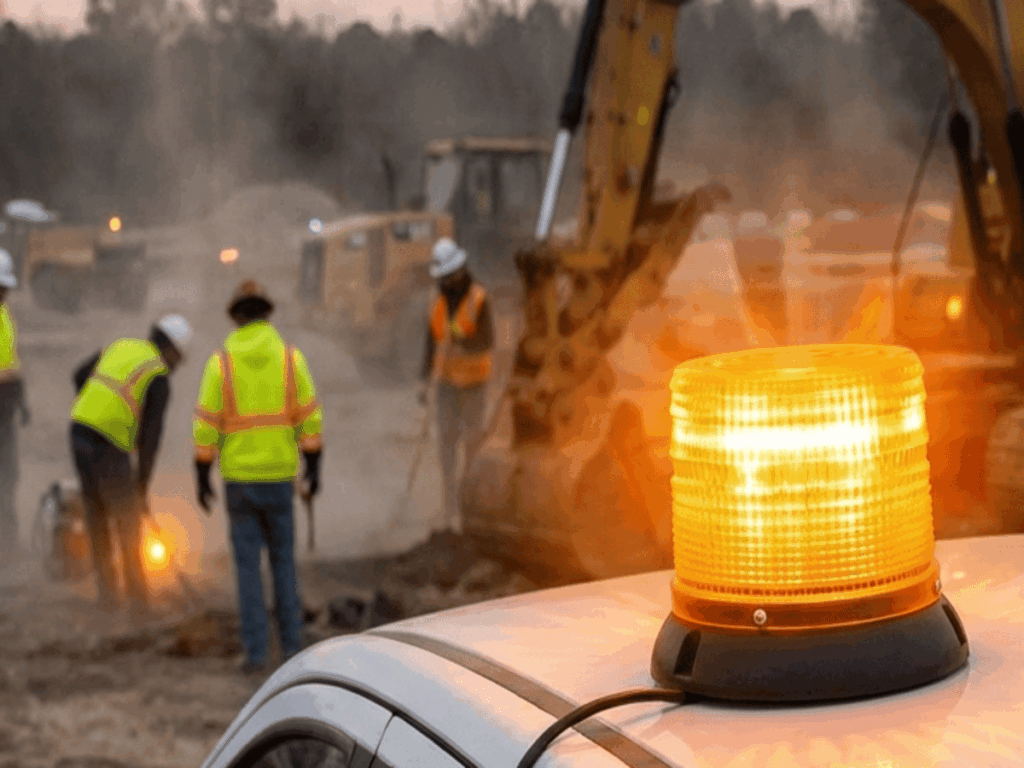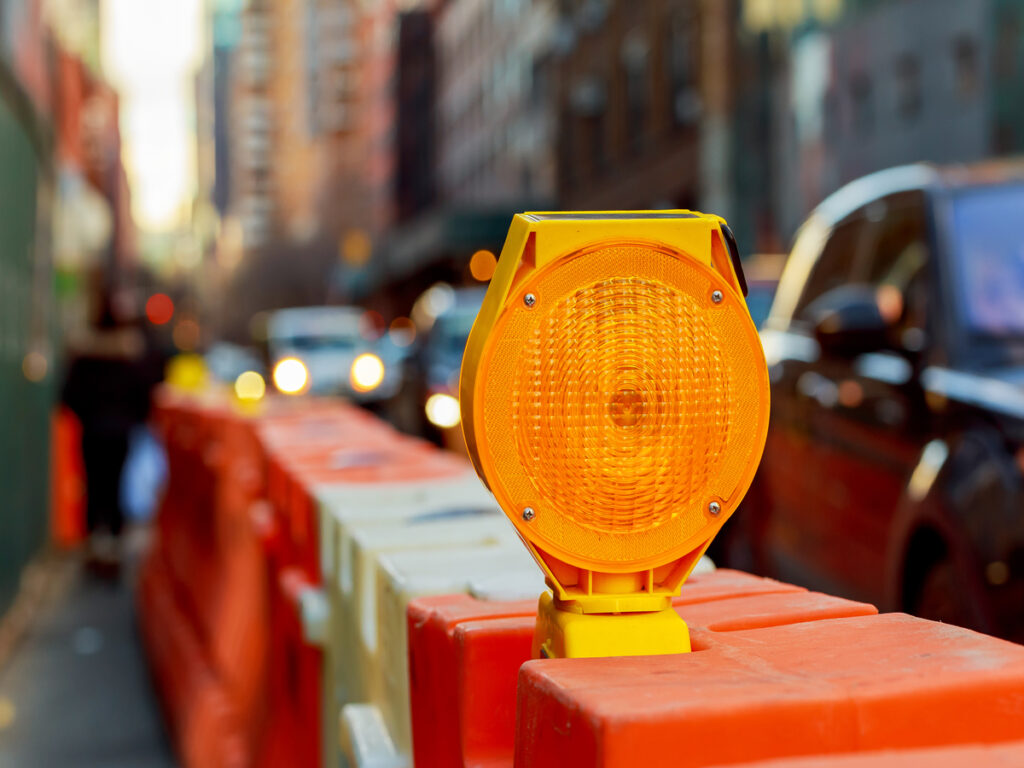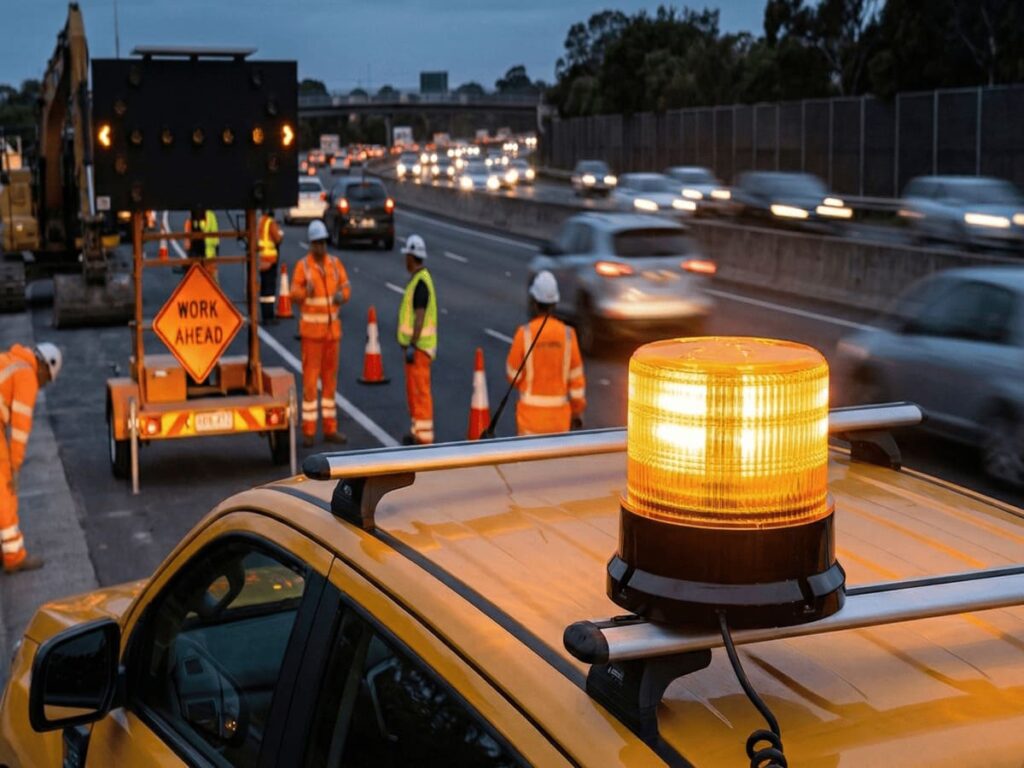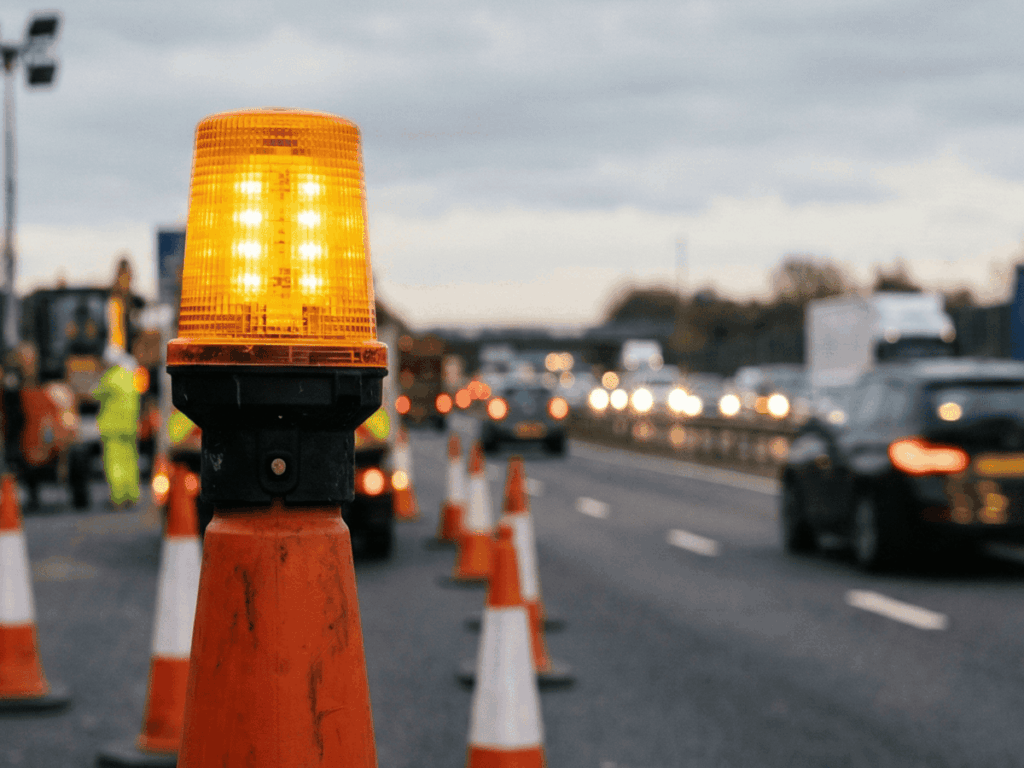
Verkehrszeichen auf der Autobahn sind für das Verkehrsmanagement von großer Bedeutung. Schilder an den richtigen Stellen helfen Autofahrern, schnell eine Entscheidung zu treffen und Unfälle zu vermeiden. Gutes Management braucht gut sichtbare und an den richtigen Stellen angebrachte Schilder. Mit intelligenten Plänen und neuen Tools machen Experten die Straßen sicherer. Untersuchungen zeigen, dass gute Straßenmarkierungen den Fahrern helfen, Dinge wahrzunehmen und Entscheidungen zu treffen, vor allem, wenn die Dinge nicht normal sind. Verkehrsmanager müssen Schilder an den richtigen Stellen anbringen, um den Fahrern zu helfen und einen reibungslosen Verkehr zu gewährleisten. Jeder Teil des Verkehrsmanagements versucht, die Straßen sicherer und besser funktionieren zu lassen.
Bei OPTRAFFIC, Wir sind spezialisiert auf die Bereitstellung hochwertige Verkehrsschilder Entwickelt, um den Sicherheits- und Verkehrsfluss zu verbessern. Unsere fortschrittlichen Produkte, einschließlich langlebiger Aluminiumschilder und reflektierender Materialien, sorgen für Sichtbarkeit und Wirksamkeit in jeder Straßenumgebung. Wir helfen Ihnen, das Verkehrsmanagement auf Ihren Straßen zu verbessern.
Key Takeaways
- Das Anbringen von Schildern an der richtigen Stelle trägt zur Sicherheit der Autofahrer bei. Es verringert auch die Zahl der Unfälle. Platzieren Sie Schilder so, dass Autofahrer sie früh genug sehen können.
- Verwenden Sie für Schilder gut erkennbare Farben und Formen. Rot zeigt Gefahr an. Grün bedeutet, dass es sicher ist. Dies hilft den Fahrern, schnell zu handeln.
- Überprüfen und reparieren Sie die Schilder häufig. Stellen Sie sicher, dass die Leute sie sehen können. Schilder sollten nicht durch Bäume oder Gebäude verdeckt werden. Das sorgt für sichere Straßen.
- Entscheiden Sie anhand von Fakten, wo Schilder angebracht werden sollen. Schauen Sie sich Verkehrsmuster und Unfallberichte an. Dies zeigt, wo Zeichen am meisten benötigt werden.
- Befolgen Sie Regeln wie die MUTCD. Dadurch ist die Platzierung der Schilder in allen Bereichen gleich und hilfreich.
Bedeutung von Straßenverkehrszeichen
Auswirkungen auf das Fahrerverhalten
Verkehrszeichen auf der Autobahn helfen Autofahrern dabei, zu wissen, was sie tun sollen. Diese Zeichen verwenden Farben, Formen, und klare Worte, um Entscheidungen zu leiten. Rot bedeutet Gefahr. Grün bedeutet, dass es sicher ist. Achtecke werden für Stoppschilder verwendet, damit Autofahrer sie schnell bemerken. Studien zeigen, dass die Herkunft einer Person und die Sprache, die sie sprechen, das Gebärdenverständnis beeinflussen können. Menschen aus verschiedenen Orten können unterschiedlich auf dasselbe Zeichen reagieren. Wie vertraut ein Zeichen aussieht und wie real es wirkt, hilft den Menschen auch dabei, es zu verstehen. Verkehrsmanagementteams nutzen diese Fakten, um Straßen sicherer zu machen. Sie platzieren Schilder so, dass Autofahrer sie frühzeitig erkennen und Zeit zum Reagieren haben. Dies trägt dazu bei, den Verkehr in Bewegung zu halten und riskante Aktionen zu verhindern.
- Farbe: Rot bedeutet Gefahr, Grün bedeutet sicher.
- Kontrast: Bei starkem Kontrast sind Schilder besser zu erkennen.
- Form: Spezielle Formen helfen Autofahrern, Schilder schnell zu erkennen.
Verwirrung und Fehler reduzieren
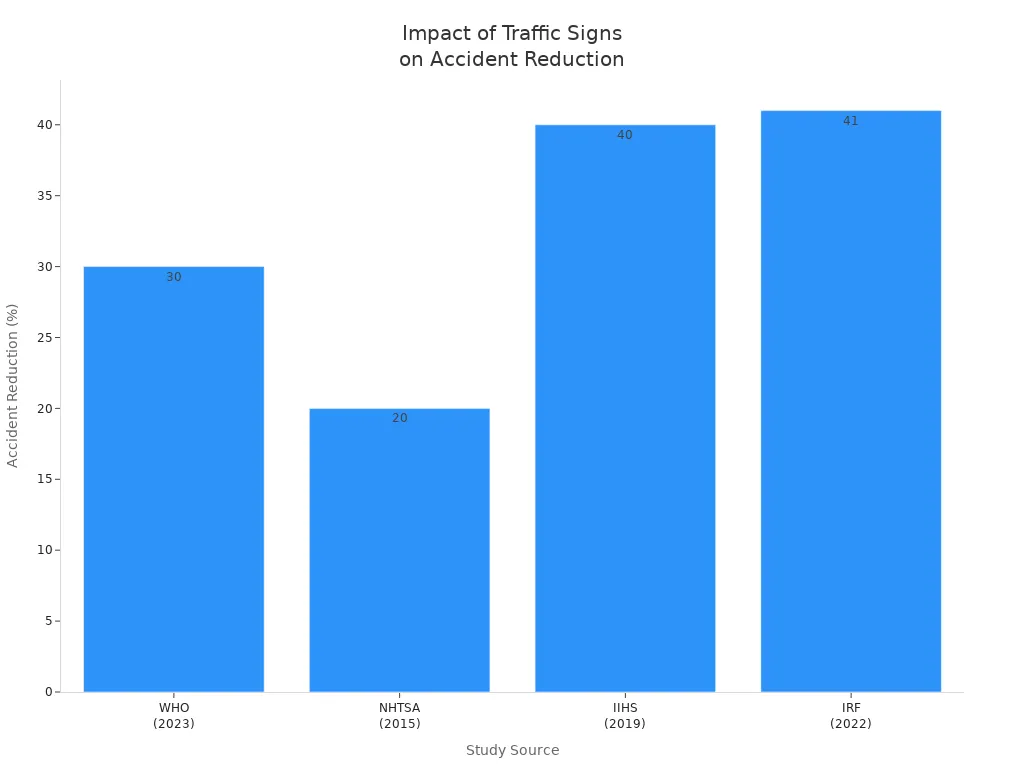
Klare Schilder helfen Autofahrern, weniger Fehler zu machen. Wenn Schilder leicht zu sehen und zu lesen sind, Fahrer entscheiden sich für bessere Maßnahmen. Verkehrsmanager nutzen Daten, um Schilder dort anzubringen, wo Fahrer verwirrt sind, wie stark befahrene Kreuzungen oder Autobahnausfahrten. Die folgende Tabelle zeigt, wie Schilder dazu beitragen, Unfälle und Fehler zu reduzieren:
| Studienquelle | Ergebnisse | Auswirkungen auf Unfälle |
|---|---|---|
| WER (2023) | Verkehrszeichen können das Unfallrisiko senken | Bis zu 30% |
| NHTSA (2015) | Geschwindigkeitsbegrenzungsschilder reduzieren Geschwindigkeitsunfälle | Bis zu 20% |
| Iihs (2019) | Stoppschilder senken Auffahrunfälle | 40% |
| IRF (2022) | Verkehrszeichen führten zu weniger Unfällen | 41% |
| Agyapong & Ojo (2018) | Verkehrsschilder tragen zur Sicherheit von Wanderern und Radfahrern bei | Ein großer Rückgang der Unfälle |
| Beanland et al. (2013) | Autofahrer, die auf Schilder achten, vermeiden Unfälle | Viele Autofahrer sind dieser Meinung |
| Wald (2021) | Die Polizei sagt, Verkehrszeichen seien sehr wichtig | Aus Sicherheitsgründen erforderlich |
Verbesserung der Verkehrssicherheit
Verkehrsmanagementteams arbeiten daran, die Sicherheit aller Menschen auf der Straße zu gewährleisten. Sie nutzen Schilder und andere Hilfsmittel, um Autofahrer vor bevorstehenden Veränderungen oder Gefahren zu warnen. Das Anbringen von Schildern an guten Stellen hilft Autofahrern, sicher zu bleiben und Unfälle zu vermeiden. Straßen werden besser, wenn die Schilder gut sichtbar und in gutem Zustand sind. Das National Cooperative Highway Research Program sagt, dass zusätzliche Straßennamenschilder an Kreuzungen zur Sicherheit der Autofahrer beitragen können. Wo die Schilder angebracht sind und wie gut sie gepflegt werden, ist entscheidend für die Funktionsfähigkeit der Wegweiser.
Das National Cooperative Highway Research Program (Nchrp) 500 In einem Serienbericht heißt es, dass zusätzliche Schilder mit Straßennamen dazu beitragen können, dass Autofahrer an Kreuzungen sicherer bleiben. Damit die Schilder gut funktionieren, müssen sie leicht zu erkennen und zu pflegen sein.
Verkehrsmanagementteams nutzen diese Ideen, um Straßen sicherer zu machen und allen dabei zu helfen, besser zu reisen.
Schlüsselfaktoren bei der Platzierung von Schildern
Straßentyp und Umgebung
Die Art der Straße und ihre Lage verändern die Art und Weise, wie Schilder angebracht werden. Autobahnen, Straßenstraßen, und Landstraßen haben alle ihre eigenen Probleme. Auf Autobahnen, Autos fahren schnell. Autofahrer brauchen mehr Zeit, um Schilder zu erkennen und Entscheidungen zu treffen. Die Schilder müssen weit genug voraus sein, damit die Fahrer sicher agieren können. In Städten, Es gibt viele Kreuzungen und Sehenswürdigkeiten. Die Schilder sollten hier leicht zu finden sein und häufig auftauchen. Auf Landstraßen, Es gibt nicht viel zu sehen. Schilder müssen schon von Weitem auffallen.
Viele Dinge ändern sich dort, wo Schilder an verschiedenen Orten angebracht sind:
- Viele Autos können dazu führen, dass Schilder schwer zu erkennen sind.
- Komplizierte Straßengestaltungen erfordern klare Beschilderungsbotschaften.
- Straßen mit drei oder mehr Fahrspuren benötigen größere Schilder.
- Kurven oder Hügel erfordern eine frühere Anbringung von Schildern.
- Viele nahe beieinander liegende Ausfahrten erfordern eine sorgfältige Planung.
- Große LKWs können kleine Schilder blockieren.
- Straßenlaternen und belebte Hintergründe können Schilder verdecken.
- Schnelle Autos brauchen frühzeitig warnende Schilder.
- Schilder an der gleichen Stelle helfen den Fahrern jedes Mal.
- Da auf dem Boden nicht viel Platz für Schilder ist, gehen diese über den Kopf.
- Wenn sich zwei Autobahnen treffen oder es eine linke Ausfahrt gibt, Schilder benötigen besondere Pflege.
Schilder müssen zum richtigen Zeitpunkt Informationen geben, damit Autofahrer sicher handeln können. Es ist wichtig, dass die Schilder gut erkennbar sind. Schilder sollten nicht durch Bäume oder Gebäude blockiert werden. Wenn die Schilder alt oder kaputt sind, Fahrer können sie möglicherweise nicht gut sehen. Auch Wetter und Pflanzen können Anzeichen verdecken oder dazu führen, dass sie nicht so lange anhalten.
Tipp: Platzieren Sie Schilder so, dass Autofahrer sie frühzeitig erkennen und sicher reagieren können. Suchen Sie nach Dingen, die die Sicht blockieren könnten, wie Äste oder neue Gebäude.
Fahrergeschwindigkeit und Reaktionszeit
Wie schnell die Fahrer fahren und wie schnell sie reagieren, ist für die Platzierung der Schilder von Bedeutung. Schnelle Autos brauchen mehr Platz, um Zeichen zu sehen und zu handeln. Auf Autobahnen, Bevor Autofahrer eine Wahl treffen müssen, müssen Schilder angebracht werden. Dies gibt den Menschen Zeit, langsamer zu werden, Wechseln Sie die Fahrspuren, oder verlassen Sie die Straße sicher.
Eine Studie untersuchte, wie Autofahrer auf Schilder reagieren:
| Fahrerkategorie | Geschwindigkeitsreduzierung (Meilen pro Stunde) | Vergleich der Reaktionszeiten |
|---|---|---|
| Schnellere Treiber | 0.7 Zu 3.0 | Habe vorhin reagiert |
| Durchschnittliche Fahrer | 1.2 Zu 3.0 | – |
| Langsamere Fahrer | – | – |
Schnelle Fahrer reagieren in der Regel früher, aber alle Fahrer kommen mit Clear besser zurecht, frühe Anzeichen. Wenn Schilder zu nahe an Ausgängen oder Gefahren stehen, Fahrer könnten Abbiegungen verpassen oder plötzlich anhalten. Dies kann unsicher sein. Die Teams nutzen diese Fakten, um anhand der Geschwindigkeit und des Verhaltens der Fahrer zu entscheiden, wie weit entfernt Schilder angebracht werden sollen.
Schildersichtbarkeit und Hindernisse
Es ist sehr wichtig, Zeichen erkennen zu können. Autofahrer müssen die Schilder schnell lesen, Auch bei schlechtem Wetter oder nachts. Dinge wie Bäume, Gebäude, oder geparkte Autos können Schilder blockieren. Auch zu viele Lichter oder Werbetafeln können dazu führen, dass Schilder schwer zu erkennen sind.
Studien zeigen, dass es mehr Ablenkungen gibt, Autofahrer sehen nur Schilder 60 Füße entfernt, nicht 110 Füße. Auch die Art der Buchstaben auf den Schildern spielt eine Rolle. Die Verwendung der Schriftart Clearview erleichtert das Lesen von Schildern 16% besser nachts. Schilder mit leuchtenden Farben und großen Buchstaben sind besser lesbar. Fluoreszierende Farben heben Schilder hervor, besonders wenn es dunkel ist.
| Beweisbeschreibung | Ergebnisse |
|---|---|
| Erkennungsentfernung mit visuellem Rauschen | Fällt ab 110 ft (geräuscharm) Zu 60 ft (hoher Lärm) |
| Auswahl der Schriftart und Lesbarkeit bei Nacht | Die Clearview-Schrift erhöht die Lesbarkeit um 16% |
| Formel für die Erkennungsentfernung | Bezieht sich auf die Leuchtdichte, Kontrast, und Buchstabenhöhe |
| Farbkombinationen und Lesbarkeit | Ein hoher Leuchtdichtekontrast verbessert die Lesbarkeit |
| Fluoreszierende Farben | Verbessern Sie die Zeichenerkennung |
Die Teams müssen die Schilderstellen häufig überprüfen. Sie sollten Pflanzen zurückschneiden, kaputte Schilder reparieren, und verwenden Sie neue Materialien, um die Sichtbarkeit der Schilder zu gewährleisten. Eine gute Sichtbarkeit der Schilder sorgt für die Sicherheit der Menschen und hilft den Fahrern, schnell zu sein, kluge Entscheidungen. Verstehen, welche Rolle verschiedene Arten von reflektierenden Folien bei der Aufrechterhaltung der Sichtbarkeit von Schildern spielen, Schauen Sie sich unseren Blog an Verständnis der verschiedenen Klassen reflektierender Folien und ihrer Anwendungen in Straßenschildern.
Sichtweite- und Platzierungsanalyse
Sichtweite verstehen
Die Sichtweite gibt an, wie weit ein Fahrer die Straße hinunter sehen kann. Eine gute Sichtweite hilft Autofahrern, Verkehrsschilder auf der Autobahn frühzeitig zu erkennen und sichere Entscheidungen zu treffen. Verkehrsbehörden empfehlen zwei Hauptarten der Sichtweite für die Schilderplatzierung:
- Sichtweite stoppen: Dies ist der Gesamtraum, den ein Auto zum Anhalten benötigt. Dazu gehört die Zeit, die ein Fahrer benötigt, um ein Schild zu sehen und zu reagieren, plus der Entfernung, die zum Anhalten des Autos erforderlich ist. Experten gehen von einer Reaktionszeit von aus 2.5 Sekunden und einer Verzögerungsrate von 11.2 Fuß pro Sekunde im Quadrat.
- Sichtweite der Kreuzung: Autofahrer benötigen an Kreuzungen eine klare Sicht. Dies hilft ihnen, andere Autos zu sehen und Unfälle zu vermeiden. Wenn die Sichtweite zur Kreuzung nicht möglich ist, Es sollte eine Bremssichtweite verwendet werden.
Der richtige Sichtabstand erhöht die Sicherheit und hilft Managementteams, Risiken auf stark befahrenen Straßen zu reduzieren.
Straßenkrümmung und -höhe
Kurven und Hügel können die Sicht des Fahrers blockieren. Diese Funktionen erzeugen tote Winkel und erschweren das Erkennen von Schildern oder anderen Fahrzeugen. Managementteams müssen vor einer Kurve oder einem Hügel Schilder anbringen, die für die Fahrer gut sichtbar sind. Sie können Schilder anbringen oder sie an bessere Orte verschieben. Reflektierende und beleuchtete Schilder funktionieren nachts oder bei schlechtem Wetter gut. Gut platzierte Schilder helfen Autofahrern, schneller zu reagieren und sorgen für die Sicherheit aller.
- Kurven und Hügel können Zeichen und Menschen verbergen.
- Das Anheben oder Verschieben von Schildern verbessert die Sichtbarkeit.
- Reflektierende Schilder helfen nachts.
- Eine gute Platzierung verbessert die Sicherheit und das Fahrerverständnis.
Berechnung der idealen Platzierung
Ingenieure nutzen Modelle und Tabellen, um für jedes Schild den besten Platz zu finden. Sie achten auf die Geschwindigkeit des Verkehrs und die Form der Straße. Die folgende Tabelle zeigt, wie sich die minimale Passierweite und der K-Wert mit der Geschwindigkeit ändern:
| Designgeschwindigkeit (Meilen pro Stunde) | Mindest-PSD für Design (ft.) | Minimaler K-Wert |
|---|---|---|
| 20 | 400 | 57 |
| 25 | 450 | 72 |
| 30 | 500 | 89 |
| 35 | 550 | 108 |
| 40 | 600 | 129 |
| 45 | 700 | 175 |
| 50 | 800 | 229 |
| 55 | 900 | 289 |
| 60 | 1000 | 357 |
| 65 | 1100 | 432 |
| 70 | 1200 | 514 |
| 75 | 1300 | 604 |
| 80 | 1400 | 700 |

Für Straßen mit Hügeln, Ingenieure verwenden spezielle Formeln, um sicherzustellen, dass Zeichen sichtbar sind. Diese Formeln helfen Managementteams, die Sicherheit hoch zu halten und sicherzustellen, dass die Fahrer genügend Zeit haben, Schilder zu erkennen und darauf zu reagieren.
Tipp: Teams sollten bei der Planung neuer Schilder stets die Sichtweite prüfen. Dies sorgt für sichere Straßen und trägt dazu bei, dass jeder mit Zuversicht reisen kann.
Best Practices für effiziente Autobahnlayouts
Vorwarnung und Entscheidungspunkte
Vorwarnschilder helfen Autofahrern, sich auf Veränderungen vorzubereiten. Diese Schilder weisen Autofahrer auf bevorstehende Kurven oder Gefahren hin. Die Teams stellen zumindest Warnschilder auf 100 Füße vor einer Kurve. Dies gibt den Fahrern Zeit, langsamer zu fahren und auf Nummer sicher zu gehen. Für Ausrichtungswarnschilder, Ingenieure verwenden einen Lesbarkeitsabstand von 180 Füße für einfache Straßen. Sie benutzen 250 Füße für härtere Straßen. Schilder mit kleinen Buchstaben oder langen Botschaften benötigen mehr Platz. Autofahrer brauchen genügend Zeit, um sich etwas anzusehen, lesen, und auf Zeichen reagieren. Die Teams prüfen, wie gut die Schilder bei unterschiedlichem Wetter und Verkehr funktionieren. Dies hilft die Sicherheit von Straßen.
- Bringen Sie Warnschilder vor Kurven oder Gefahren an.
- Ändern Sie die Platzierung für Schildgröße und Nachrichtenlänge.
- Überprüfen Sie, wie die Schilder unter allen Bedingungen funktionieren.
Schildhöhe und -positionierung
Höhe und Position der Schilder helfen Fahrern, Verkehrsschilder auf der Autobahn zu erkennen. Ein Zeichen setzen 6.5 Messgeräte sorgen dafür, dass Autofahrer aufmerksamer werden. Zu weit entfernte Schilder sind schwer zu erkennen. Nur über 25% der vertikalen Schilder werden von Autofahrern im wirklichen Leben wahrgenommen. Die folgende Tabelle zeigt, wie die Höhe und Platzierung der Schilder die Reaktion des Fahrers beeinflussen:
| Faktor | Auswirkungen auf Fahrer |
|---|---|
| Erhöhte Schildhöhe | Autofahrer schenken mehr Aufmerksamkeit |
| Seitliche Platzierung | Zeichen sind schwerer zu sehen und zu bemerken |
| Visuelle Erkennungsrate | Nur 25.06% der vertikalen Zeichen fallen auf |
Schilder mit zu vielen Informationen brauchen länger zum Lesen. Wenn ein Schild mehr als fünf oder sechs Straßennamen enthält, Autofahrer reagieren langsamer. Teams halten Nachrichten kurz und klar. Dies hilft den Fahrern, schnelle Entscheidungen zu treffen.
Minimierung der Schilderunordnung
Effiziente Autobahnlayouts erfordern nicht zu viele Schilder. Zu viele Schilder verwirren die Fahrer und verlangsamen sie. Die Teams entwerfen Schilder mit klarer Reihenfolge und verwenden Pfeile, um die Fahrer zu leiten. Studien zeigen, dass Autofahrer Schilder besser verstehen, wenn sie die Reihenfolge von unten nach oben und klare Pfeile verwenden. Durch die Angabe von Veranstaltungsinformationen vor Städtenamen können Autofahrer schneller verstehen, was passiert. Die folgende Tabelle zeigt wichtige Erkenntnisse:
| Finden | Beschreibung |
|---|---|
| Verständniseinflüsse | Eine klare Reihenfolge und Pfeile erleichtern dem Fahrer das Verständnis |
| Designhierarchie | Die Reihenfolge von unten nach oben und klare Pfeile funktionieren am besten |
| Veranstaltungsort | Veranstaltungen vor Städten helfen Autofahrern beim Verständnis |
| Pfeiltyp | Klare Pfeile funktionieren besser als einfache |
Die Teams überprüfen häufig die Platzierung der Schilder. Sie entfernen Schilder, die nicht benötigt werden. Sie aktualisieren Designs, um sie an die Straße anzupassen. Dies sorgt für klare Informationen und trägt dazu bei, dass die Straßenführung gut funktioniert.
Datengesteuerter Verkehrsmanagementplan
Ein guter Verkehrsmanagementplan nutzt Daten, um Straßen sicherer zu machen. Teams sammeln Fakten darüber, wie sich Autos bewegen, wo es zu Unfällen kommt, und wie sich Fahrer verhalten. Sie schauen sich diese Informationen an, um zu entscheiden, wo die Schilder angebracht werden sollen und wie Straßen repariert werden. Eine genaue Beobachtung der Straßen hilft den Teams, Probleme frühzeitig zu erkennen. Sie können diese Probleme beheben, bevor es zu Abstürzen kommt.
Verwendung von Verkehrsflussdaten
Verkehrsflussdaten verraten den Teams, wie sich Autos auf Straßen bewegen. Teams nutzen diese Daten, um belebte Orte zu finden, Verlangsamungen, und Orte mit vielen Unfällen. Sie können den Plan ändern und Schilder dort anbringen, wo die Fahrer sie am meisten brauchen. Zum Beispiel, Das Verkehrsministerium von North Carolina verwendet Sondengeschwindigkeitsdaten. Dies hilft ihnen, den Verkehr zu überwachen und Probleme sofort zu erkennen. Sie können die Signalzeit ändern und Schilder an bessere Orte verschieben. Durch die Überprüfung vieler Arten von Daten, Teams können kluge Entscheidungen treffen und die Straßen sicher halten.
Wichtige Schritte zur Nutzung von Verkehrsflussdaten:
- Erhalten Sie Geschwindigkeits- und Fahrzeuganzahldaten von Kameras und Sensoren.
- Sehen Sie sich die Unfallberichte an und erfahren Sie, worüber sich Autofahrer beschweren.
- Ändern Sie den Verkehrsplan, wenn neue Trends auftauchen.
- Nutzen Sie die Verkehrsauswirkungsanalyse, um abzuschätzen, wie Änderungen die Sicherheit verbessern.
Technologie und GIS-Tools
Neue Technologien erleichtern die Überwachung und Planung des Verkehrs. Geografische Informationssysteme (Gis) Helfen Sie Teams bei der Erstellung von Straßenkarten, Zeichen, und Krisenherde. Mit GIS, Teams können erkennen, wo Schilder benötigt werden und ob sie gut zu erkennen sind. Zum Beispiel, Avid4 Engineering nutzte GIS für das Signing and Delineation Project im Pennington County. Dies half ihnen, viele Daten zu verarbeiten und Geld zu sparen. Teams können GIS auch verwenden, um Karten mit Arbeitern vor Ort zu teilen. Dies beschleunigt den Bau und die Prüfung von Schildern.
Vorteile des Einsatzes von Technologie und GIS-Tools:
- Beobachten Sie den Verkehrs- und Schilderzustand in Echtzeit.
- Verwenden Sie Modelle, um riskante Orte zu finden.
- Teilen Sie Informationen ganz einfach mit allen Teammitgliedern.
- Führen Sie eine bessere Verkehrsauswirkungsanalyse für neue Projekte durch.
Ein datengesteuerter Verkehrsmanagementplan nutzt diese Tools, um Straßen sicher und Schilder hilfreich zu halten. Teams können schnell reagieren, wenn sich etwas ändert, und sicherstellen, dass jedes Zeichen den Fahrern hilft, gute Entscheidungen zu treffen.
Gesetzliche und behördliche Standards
MUTCD und nationale Richtlinien
Das Handbuch auf einheitlichen Verkehrssteuerungsvorrichtungen (MUTCD) enthält die wichtigsten Regeln für die Platzierung von Autobahnschildern in den USA. Dieser Leitfaden stellt sicher, dass Autofahrer überall die gleichen Schilder sehen. Staaten können zusätzliche Regeln erlassen, Sie müssen jedoch die MUTCD als Hauptleitfaden verwenden. Laut MUTCD müssen Schilder klar und leicht lesbar sein. Die Schilder sollten sowohl tagsüber als auch nachts gut sichtbar sein. Briefe, Symbole, und die Pfeile müssen groß genug sein, damit der Fahrer sie schnell lesen kann. Die MUTCD sagt außerdem, dass Schilder dort angebracht werden müssen, wo die Fahrer Zeit haben, zu reagieren und sicher zu bleiben.
Verkehrsmanagementteams nutzen die MUTCD, um Schilderstellen auszuwählen. Warnzeichen erfordern spezielle Mathematik, um die beste Stelle zu finden. Diese mathematischen Schritte nutzen, wie Fahrer sehen und reagieren. Laut MUTCD müssen Richtungs- und offizielle Schilder in der Nähe der Straße angebracht sein. Dies hilft Fahrern, wichtige Informationen dann zu erhalten, wenn sie sie benötigen.
| Zeichentyp | Beschreibung |
|---|---|
| Regulatorisch | Schilder informieren Autofahrer über Regeln und Gesetze. Sie gehen dorthin, wo die Regel beginnt. |
| Warnung | Für die Platzierung der Schilder ist Mathematik erforderlich. Sie nutzen die Reaktionszeiten der Fahrer. |
| Führung | Schilder geben den Autofahrern Wegbeschreibungen und hilfreiche Informationen. |
| Schule | Schilder tragen dazu bei, Kinder zu schützen und den Verkehr freizuhalten. Sie müssen gleich aussehen, um Verwechslungen zu vermeiden. |
Tipp: Der Einsatz des MUTCD hilft den Teams, die Straßen sicher zu halten und den Verkehr reibungslos zu gestalten.
Lokale Anpassungen
Staaten ändern die Zeichenregeln, um sie an ihre eigenen Bedürfnisse anzupassen. Diese Änderungen helfen beim Wetter, Sprache, und Straßenprobleme. Zum Beispiel, Kalifornien verwendet eine spezielle Schildform für Staatsstraßen. New York verwendet für die USA übliche Schildformen. Routen. Im Bundesstaat New York werden in der Nähe von Indianerreservaten zweisprachige Schilder angebracht. Florida verwendet starke Anker, damit die Schilder auch bei Hurrikanen stehen bleiben. Texas und Arizona verwenden zweisprachige Schilder und klare Symbole für alle Fahrer. Nevada bringt Schilder in der Nähe von Touristenorten an, damit die Leute sie besser sehen können.
| Zustand | Anpassungsbeschreibung |
|---|---|
| Kalifornien | Verwendet eine spezielle Schildform für Staatsstraßen. Dies hilft Autofahrern, Schilder besser zu erkennen. |
| New York | Verwendet gängige Schildformen für die USA. Routen. Das ist anders als in Kalifornien. |
| Im Norden von New York | Bringt zweisprachige Schilder in der Nähe von Indianerreservaten an. Schilder zeigen Englisch und Muttersprachen. |
| Florida | Verwendet starke Anker für Schilder. Dies trägt dazu bei, dass Schilder auch Hurrikanen standhalten. |
| Texas | Verwendet zweisprachige Schilder in Englisch und Spanisch. Das hilft vielen Menschen. |
| Arizona | Verwendet klare Symbole und Farben, um vor Staubstürmen und Hitze zu warnen. |
| Nevada | Platziert Schilder in der Nähe von Touristenorten und großen Straßen, damit die Leute sie leicht sehen können. |
Lokale Änderungen funktionieren am besten, wenn die Teams sowohl staatliche als auch nationale Regeln befolgen. Dies sorgt für sichere Straßen und hilft allen Fahrern, die Schilder zu verstehen.
Fallstudien und Beispiele in der Praxis
Platzierung von Geschwindigkeitsbegrenzungsschildern
Städte und Landgebiete nutzen unterschiedliche Methoden zur Anbringung von Geschwindigkeitsbegrenzungsschildern. Bei Dexter, Planer brachten auf beiden Seiten der F-65 Geschwindigkeitsanzeigeschilder an. Diese Schilder halfen den Autofahrern, deutlich langsamer zu fahren. Bis zu 46% weniger Autofahrer überschritten die Geschwindigkeitsbegrenzung. Die folgende Tabelle zeigt, was passiert ist:
| Stadt | Ansatz | Fahrbahn | % 10 Meilen pro Stunde über der angegebenen Geschwindigkeit | % 15 Meilen pro Stunde über der angegebenen Geschwindigkeit |
|---|---|---|---|---|
| Dexter | Westen | F-65 | -13% | -16% |
| Dexter | Ost | F-65 | -46% | 0% |
Eine Stadt hat auf ihrem Radweg Geschwindigkeitsanzeiger angebracht. Dies führte dazu, dass Autofahrer an stark befahrenen Kreuzungen langsamer fuhren. Eine andere Stadt brachte Schilder in der Nähe von Schulen und Häusern an. Die Schilder waren über geparkten Autos und Bäumen gut zu erkennen. Autofahrer bremsten ab, als sie diese Schilder sahen.
Ausgangs- und Wegweiser
Autobahnteams arbeiten hart daran, an stark befahrenen Orten Ausfahrts- und Hinweisschilder anzubringen. Studien zeigen, dass bessere Leitschilder Autofahrern dabei helfen, sicherere Entscheidungen zu treffen. Die folgende Tabelle zeigt, welche Teams gefunden wurden:
| Studienschwerpunkt | Schlüsselergebnisse |
|---|---|
| Optimierungsdesign von Leitschildern an dicht besiedelten Anschlussstellen | Verbessertes Fahrverhalten und sicherere Spurwechsel |
| Optimale Gestaltungsalternativen für Vorleitschilder | Flexible Platzierungsabstände für städtische Schnellstraßen erforderlich |
Die Teams stellen vor den Ausgangsrampen Hinweisschilder auf. Dies hilft den Fahrern, sich auf Spurwechsel vorzubereiten. Es stoppt auch Last-Minute-Umzüge.
Warnzeichen
Warnschilder sind an Orten, an denen es häufig zu Unfällen kommt, sehr wichtig. In 2022, fast 900 Menschen starben bei Unfällen in Arbeitsbereichen in den USA. Die meisten Opfer waren Fahrer oder Passagiere. Klare Warnschilder helfen Autofahrern, langsamer zu fahren und Überraschungen zu vermeiden. In Maryland, ein Vermisster “Schulter geschlossen” Das Schild sorgte für Verwirrung und einen schlimmen Unfall 2023. Die Teams haben gelernt, dass es Leben rettet, die Schilder häufig zu überprüfen und freizuhalten.
Notiz: Gutes Management bedeutet, die Schilder häufig zu überprüfen und sicherzustellen, dass die Schilder zur Straße passen.
Entwerfen optimaler Straßenlayouts
Integration der Schilderplatzierung in die Straßengestaltung
Ingenieure planen die beste Straßenführung, indem sie die Platzierung der Schilder an die Straßenform anpassen. Sie beobachten, wie Fahrer während ihrer Fahrt Schilder sehen und verwenden. Gutes Design hilft dem Fahrer, die richtige Spur zu wählen und sich sicher zu bewegen. Die Teams verwenden klare Diagrammschilder und Fahrspurlinien, um die Autos zu leiten. Einfache Schilder helfen Autofahrern, ruhig zu bleiben und sich nicht zu verwirren. Wenn Schilder und Straßenmarkierungen zusammenarbeiten, Autofahrer treffen bei schwierigen Ausfahrten bessere Entscheidungen.
| Studie | Ergebnisse |
|---|---|
| Virginia Highway Research Council | Diagrammschilder helfen Autofahrern dabei, die Fahrspur schneller zu finden. |
| Roberts- und Klipple-Studie | Weniger wilde Bewegungen durch klare Schilder und Fahrspurmarkierungen. |
| Mast- und Kolsrud-Studie | Autofahrer trafen bessere Entscheidungen, wenn sie an harten Ausfahrten gut ausgeschildert waren. |
| TTI Human Factors-Studie | Einfache Schilder helfen Ihnen, sicher zu bleiben; Zu viele Informationen verwirren die Fahrer. |
Managementteams prüfen, ob die Schilder gut zur Straße passen. Sie suchen nach Orten, an denen die Schilder höher oder näher sein sollten. Sie prüfen auch, ob die Schilder bei jedem Wetter gut zu erkennen sind. Dies hilft, den Verkehr in Bewegung zu halten und unterstützt sicheres Fahren.
Effiziente Autobahnlayouts erreichen
Bei der besten Straßenführung werden deutliche Schilder verwendet, starke Fahrbahnmarkierungen, und intelligentes Fahrspurdesign. Die Schilder müssen so angebracht sein, dass der Fahrer sie rechtzeitig sehen und verstehen kann. Wenn ein Zeichen zu früh oder zu spät kommt, Dies kann zu unsicheren Bewegungen führen. Klare Schilder tragen dazu bei, Unfälle zu verhindern und dafür zu sorgen, dass die Sicherheit an erster Stelle steht. Fahrbahnmarkierungen leiten Autofahrer, Auch in Nebel oder Dunkelheit. Helle und auffällige Markierungen helfen dem Fahrer, auf der richtigen Spur zu bleiben.
- Die Schilder müssen so angebracht werden, dass die Fahrer sie rechtzeitig sehen und verstehen können.
- Eine falsche Platzierung kann zu gefährlichen Bewegungen führen, wenn die Zeichen zu früh oder zu spät kommen.
- Deutliche Schilder sind wichtig, um Unfälle zu verhindern und die Sicherheit im Auge zu behalten.
- Fahrbahnmarkierungen helfen Autofahrern, Besonders wenn es schwer zu sehen ist, Sie müssen also hell sein und lange halten.
- Spezielle Fahrspuren für bestimmte Autos erleichtern den Verkehr und verhindern Staus.
- Ein gutes Schilderdesign vermittelt mit einfachen Bildern schnell klare Botschaften.
- Es ist wichtig, wohin die Schilder gehen; Sie müssen gut sichtbar sein und dem Fahrer Zeit zum Reagieren geben.
Managementteams nutzen diese Schritte, um die besten Straßenlayouts zu erstellen. Sie überprüfen jeden Abschnitt der Straße und aktualisieren die Schilder, wenn sich der Verkehr ändert. Diese Arbeit trägt dazu bei, dass alle sicher reisen und dass die Straßen gut funktionieren.
Für eine gute Platzierung von Autobahnschildern sind einige wichtige Schritte erforderlich. Teams verwenden große Schilder, die richtige Höhe, und leuchtende Farben, um die Sicherheit der Menschen zu gewährleisten. Sie beobachten, wie sich der Verkehr bewegt, und stellen dort Schilder auf, wo viele Autos fahren. Studien besagen, dass helle und einfache Schilder Autofahrern helfen, schneller zu handeln. Dadurch werden die Straßen sicherer und der Verkehr besser gelenkt. Neue Tools wie Intelligent Vehicle Highway Systems helfen Teams, Straßen zu verwalten und unterschiedliche Anforderungen zu erfüllen. Die Teams überprüfen und ändern häufig die Beschilderungspläne, um die Sicherheit und Funktionsfähigkeit der Straßen zu gewährleisten.
| Studie | Ergebnisse |
|---|---|
| Liu et al.. | Autofahrer erkennen Schilder schneller, was der Sicherheit und dem Verkehr dient. |
| Swift es alt. | Größere und hellere Schilder machen die Straßen sicherer und helfen den Autofahrern, besser zu fahren. |
Um die Sicherheit aller zu gewährleisten, sollten die Teams auf die Beschilderung achten und ihre Standorte ändern.
FAQ
Welche Faktoren beeinflussen die Platzierung von Autobahnschildern??
Die Teams schauen, wie viele Autos die Straße benutzen. Sie prüfen auch, um welche Art von Straße es sich handelt. Auch die Geschwindigkeit des Fahrers ist wichtig. Die Teams sorgen dafür, dass die Schilder gut erkennbar sind. Das Management nutzt diese Fakten, um die Sicherheit der Fahrer zu gewährleisten. Eine gute Schilderplatzierung trägt dazu bei, dass die Menschen verstehen und nicht verwirrt werden.
Wie stellt das Management eine angemessene Beschilderung und Sichtbarkeit sicher??
Das Management prüft, ob die Schilder durch irgendetwas blockiert werden. Sie schauen, wie gut die Schilder beleuchtet sind. Die Teams verwenden glänzende Materialien, sodass die Schilder nachts sichtbar sind. Sie reparieren und reinigen häufig Schilder. Schilder werden ausreichend hoch und im richtigen Winkel angebracht. Dies hilft allen Fahrern, sie gut zu sehen.
Warum ist ein Bauverkehrsmanagementplan wichtig??
Ein Bauverkehrsmanagementplan unterstützt die Teams bei Straßenarbeiten. Es sorgt für die Sicherheit der Arbeiter und den fließenden Verkehr. Der Plan sieht spezielle Schilder und Absperrungen vor. Sie leiten den Fahrer und schützen die Menschen im Straßenverkehr.
Wie oft sollten Teams die Platzierung der Schilder überprüfen??
Die Teams überprüfen jedes Jahr mehrmals, wo Schilder angebracht sind. Sie schauen sich die Unfallzahlen an und wie stark die Straße befahren ist. Das Management ändert die Schilder, wenn sich die Straßen ändern oder neue Gefahren auftauchen. Die Überprüfung von Schildern sorgt oft dafür, dass die Straßen sicher sind und die Schilder gut funktionieren.
Welche Rolle spielt Technologie beim Schildermanagement??
Technologie hilft Teams dabei, Schilder und Verkehr zu überwachen. GIS-Tools erstellen Karten darüber, wo sich Schilder befinden. Diese Tools zeigen, wo es Probleme gibt. Teams nutzen Live-Daten, um Schilder zu bewegen und Straßen sicherer zu machen.