Standard road signs solve most traffic management problems — but not all of them. Privatstraßen, Industrieanlagen, multilingual communities, branded campuses, and work zones with site-specific hazards all require signage beyond what catalog products can deliver. That is where custom road signs become essential.
Benutzerdefinierte Straßenschilder let buyers specify the exact message, Größe, Material, reflectivity grade, and finish for their application. Gleichzeitig, they must still meet the compliance requirements that govern traffic signage in the relevant jurisdiction. Für Einkaufsmanager, Auftragnehmer, and municipal buyers sourcing at scale, understanding what can be customized, what cannot, and how to specify correctly from the start separates a smooth bulk order from a costly rework.
OPTRAFFIC produziert custom traffic signs and safety signage for municipalities, Auftragnehmer, and large-scale infrastructure projects worldwide — with ISO 9001 Zertifizierung, MUTCD-compliant production, and bulk ordering capabilities built into every order.
Key Takeaways
- Custom road signs allow buyers to specify message, Größe, Form, Material, Reflexionsvermögen, and finish — within the compliance boundaries set by MUTCD and applicable local standards
- MUTCD Section 2A.11 governs sign colors; Section 2A.10 governs shapes; Abschnitt 2A.09 sets minimum maintained retroreflectivity levels in Table 2A-5
- Aluminum is the standard substrate for durable custom road signs; ASTM D4956 reflective sheeting grade determines night visibility and service life
- Screen printing suits simple, high-volume custom orders; digital printing handles complex graphics and lower quantities
- Bulk orders from a dedicated road signs manufacturer deliver lower unit cost, consistent quality across large batches, and faster lead times compared to retail suppliers
- Always request a digital proof and a physical sample before approving full production on any custom order
What Are Custom Road Signs?
Benutzerdefinierte Straßenschilder are traffic or facility signs manufactured to specifications that differ from standard catalog designs. The customization can involve the message, dimensions, Form, substrate, reflective sheeting grade, Farbe, logo placement, or mounting configuration.
Standard off-the-shelf signs carry pre-set text and dimensions. Benutzerdefinierte Straßenschilder, dagegen, address scenarios where standard products do not fit the physical space, the regulatory environment, or the communication need.
Wichtig, “Brauch” does not mean unregulated. Signs on public roads must comply with MUTCD regardless of whether they carry custom text or non-standard dimensions. Speziell, MUTCD governs font choice, letter height, Farbkontrast, Retrorefektivität, and placement distance — all of which directly affect whether a sign is readable at the approach speeds drivers encounter. Jedoch, signs on private property, Industriestandorte, Campus, and parking facilities face fewer mandatory design constraints. Folglich, buyers in those environments have significantly more design freedom. For a detailed breakdown of how MUTCD’s legibility requirements work in practice — including letter height tables, color contrast ratios, and retroreflective sheeting standards — see Verbesserung der Lesbarkeit von MUTCD-Verkehrszeichen: Schlüsselfaktoren und Best Practices.
Road signs manufacturers that specialize in custom production accommodate both types: MUTCD-compliant custom signs for public road applications, and fully branded, design-flexible signs for private and commercial environments.
When Do You Need Custom Road Signs?
Bau- und Arbeitszonen
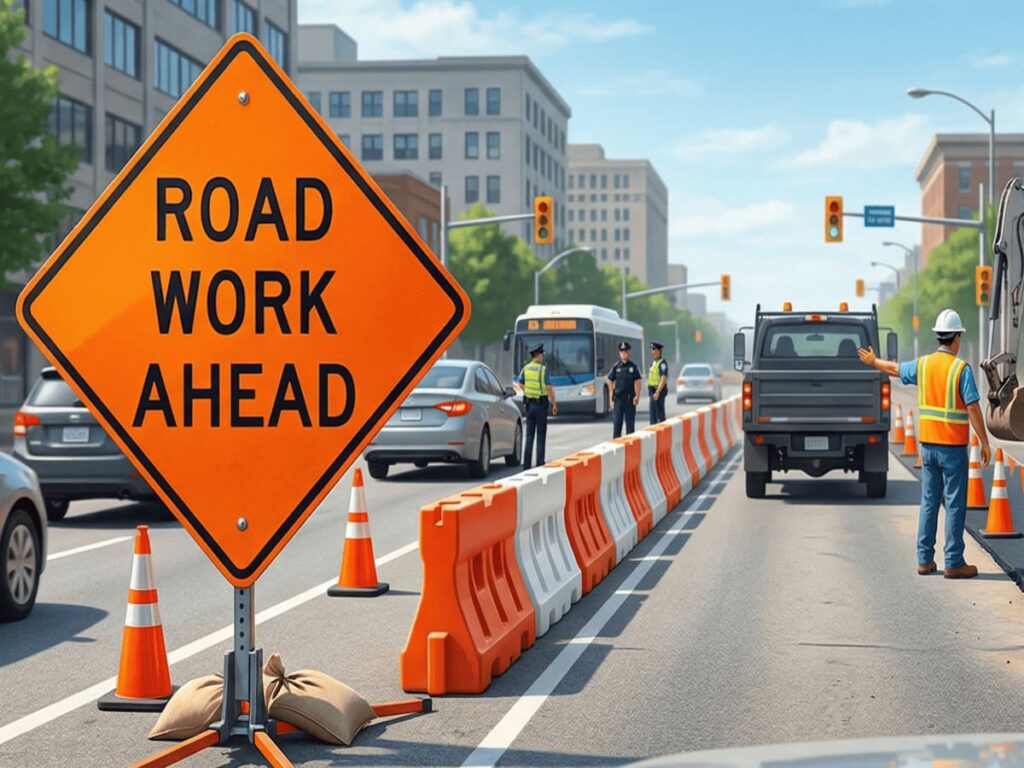
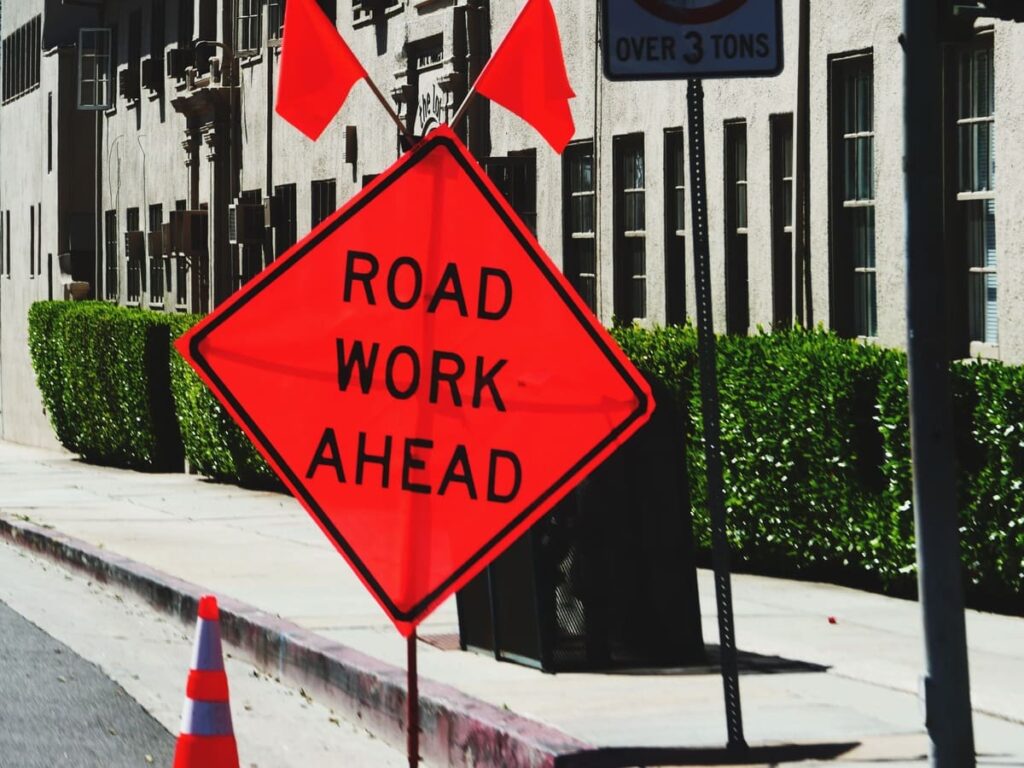
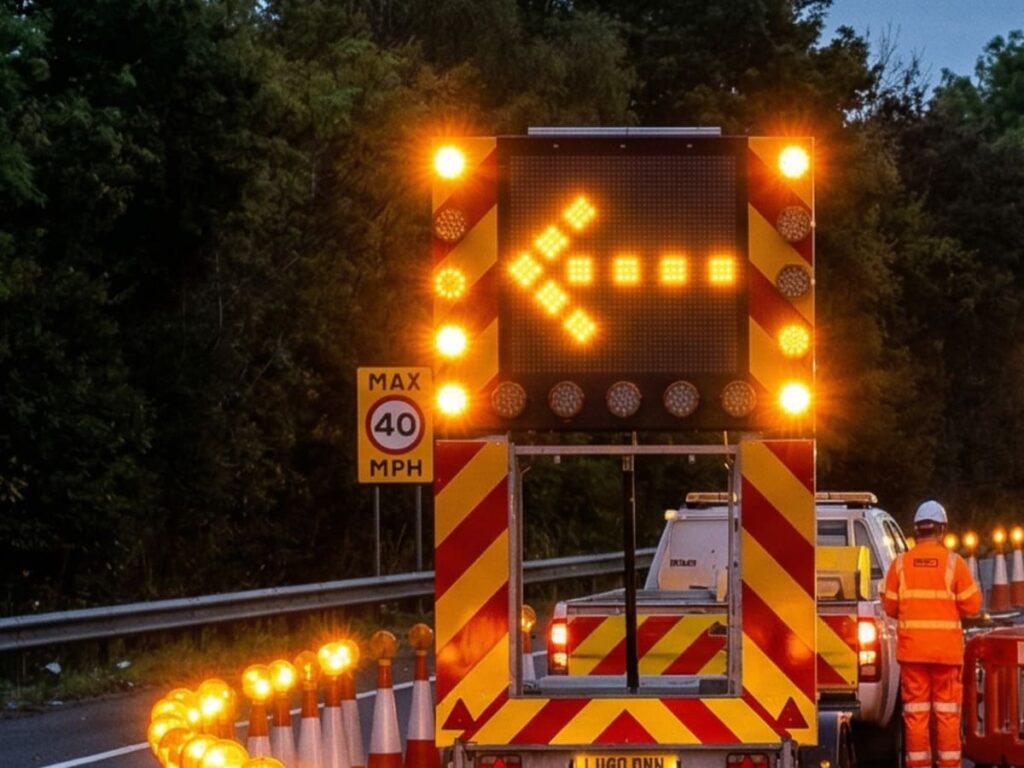
Work zones regularly require custom traffic signs beyond the standard MUTCD warning sign series. Site-specific hazards — unusual lane configurations, non-standard detour routes, specialized equipment crossings — need signs with custom text that catalog products cannot provide. Zusätzlich, contractors on branded infrastructure projects may need bilingual text or custom dimensions on orange-background warning signs.
Custom work zone signs must still comply with MUTCD Teil 6. Speziell, Farbe (orangefarbener Hintergrund, black legend), ASTM D4956 retroreflectivity grade, and placement distance are all mandatory. Within those constraints, Jedoch, message content, text size, and supplemental information panels can all be customized to the site.
Privateigentum und Wohngemeinschaften
Privatstraßen, gated communities, and residential developments frequently need custom road signs for property-specific rules. Speed limits calibrated to the road’s actual conditions, access restrictions, parking policies, and community branding are common examples. Because these signs are not on public roads, MUTCD compliance is not mandatory. Das heißt, following MUTCD design conventions for color and shape still improves driver recognition and reduces confusion.
Common examples include speed limit signs with non-standard speed values, “Private Road — No Through Traffic” signs with custom text, parking restriction signs with property-specific rules, and community entrance signs incorporating logo and branding.
Unternehmensgelände und Markeneinrichtungen
Corporate campuses, Logistikzentren, and branded facilities use custom road signs to create a consistent visual environment while managing internal traffic flow. These signs carry company logos, Markenfarben, and facility-specific directional information. Infolge, standard catalog products cannot meet the brief.
Buyers in this category should specify materials and reflective grades appropriate for long-term outdoor use — even for internal facility signs. Retroreflective aluminum outlasts PVC or corrugated plastic significantly in exposed environments, so the upfront cost difference is typically recovered within a few years.
Industriestandorte und Lagerhäuser
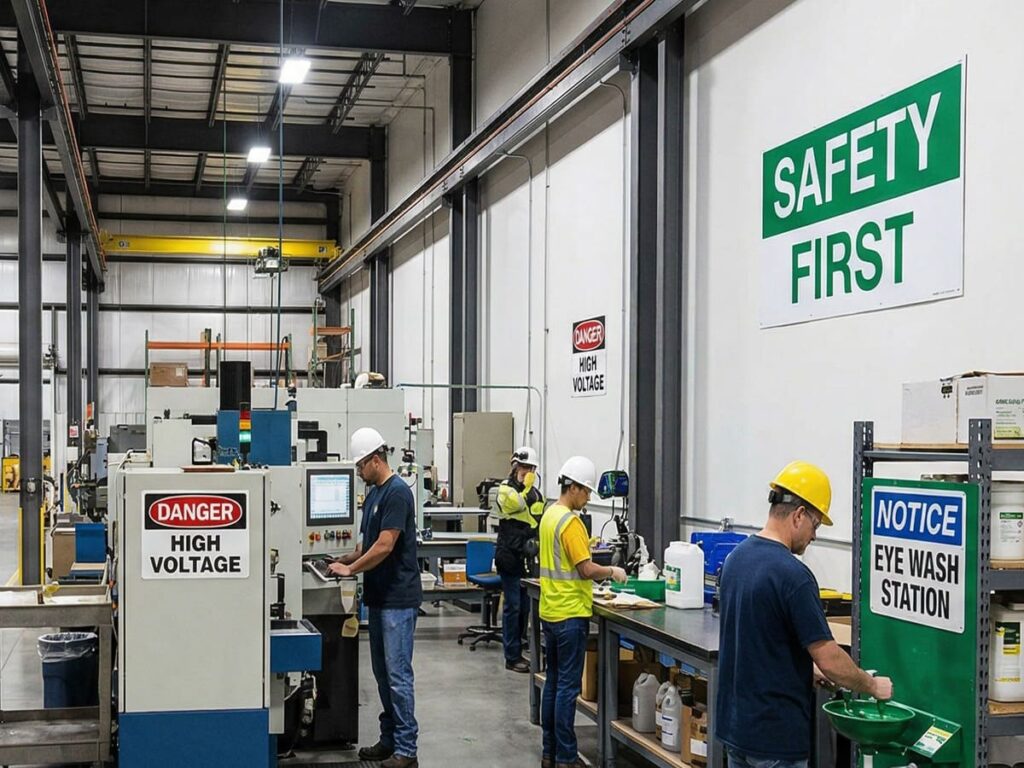
Industrial environments have traffic control needs that standard catalogs rarely address. Forklift crossing warnings, speed limits for heavy vehicle areas, hazardous material zone markings, and directional signs for large facilities all require custom text. They sometimes also require custom dimensions to be readable at the distances and vehicle speeds typical on-site.
OSHA requires that traffic control devices in construction and industrial workplaces conform to MUTCD Part 6 ggf. For private industrial sites, buyers should verify with their safety compliance officer whether OSHA’s general industry standards (29 CFR 1910) or construction standards (29 CFR 1926) govern their specific signage needs.
Multilingual and Inclusive Environments
Communities with significant non-English-speaking populations, international logistics hubs, tourist areas, and ports of entry increasingly require bilingual or multilingual custom road signs. Über 41 million people in the United States speak Spanish as their primary home language. Außerdem, many municipalities in border regions and major metro areas have adopted formal bilingual signage policies.
Custom multilingual road signs must maintain MUTCD-compliant primary text. Secondary language text must not reduce the legibility or retroreflectivity of the primary message. Buyers should specify the text hierarchy — primary language, Schriftgröße, and placement — before ordering. Font size reductions to accommodate multilingual text can cause compliance failures if the primary legend falls below MUTCD minimum letter height requirements under Section 2A.14.

Custom Road Sign Materials: What to Specify
Material selection is one of the most consequential decisions in a custom road sign order. It directly affects service life, visibility performance, und Gesamtbetriebskosten. Three variables govern material choice: the substrate, the reflective sheeting grade, and the surface treatment.
Aluminium
Aluminum is the standard substrate for durable custom road signs in both public and private applications. Most US road signs use 5052 aluminum alloy at 0.080″ thickness for standard signs and 0.125″ for larger or high-stress applications, per ASTM B209. Aluminium rostet nicht, holds retroreflective sheeting reliably over its full service life, and meets MUTCD substrate requirements.
For bulk custom orders, aluminum provides the best long-term value. Its upfront cost exceeds plastic, but the total cost is significantly lower when amortized over a 7–10+ year service life. For detailed guidance on aluminum thickness selection and MUTCD compliance, sehen Aluminum Traffic Signs Thickness: MUTCD Compliance Guide.
PVC and Corrugated Plastic
PVC and corrugated plastic (Koroplast) substrates suit short-term custom signs — construction site signs, event directionals, and temporary facility signs with an expected service life of one to two seasons. They are lighter than aluminum and cost less per unit. Infolge, they are practical for high-volume temporary deployments where longevity is not a priority.
Jedoch, plastic substrates hold retroreflective sheeting less reliably than aluminum over time. They also crack under UV exposure and cold temperatures, and they do not meet MUTCD substrate requirements for permanent public road applications. For a detailed material comparison across aluminum, Plastik, and magnetic substrates, sehen Safety Signs for Sale: Aluminium gegen Kunststoff gegen Magnetisch.
Reflective Sheeting Grades
Retroreflectivity is mandatory for any custom road sign operating in low-light conditions or at night. Mutcd Abschnitt 2A.08 requires regulatory, Warnung, and guide signs to be retroreflective or illuminated. Abschnitt 2A.09 then establishes minimum maintained retroreflectivity levels in Table 2A-5, measured in candela per lux per square meter (CD/LX/m²). ASTM D4956 defines the commercial sheeting grades that road sign manufacturers use to meet those levels:
| Grad | ASTM D4956 Typ | Beste Verwendung |
|---|---|---|
| Ingenieurqualität (Z.B) | Typ I | Private property, Bereiche mit geringer Geschwindigkeit, sheltered locations |
| Hochintensive Prismatik (HÜFTE) | Typ III / Iv | Standard public roads, Arbeitszonen |
| Diamantqualität (Dg) | Typ IX / Xi | Autobahnen, high-speed corridors, critical safety applications |
Diamond Grade sheeting reflects nearly twice as much light as High-Intensity Prismatic. Folglich, it significantly improves nighttime visibility at longer approach distances. For most custom road signs on public roads or in high-speed environments, HIP is the minimum acceptable grade. Diamond Grade is preferred for safety-critical applications. For a complete breakdown of reflective material performance by application, sehen So wählen Sie die besten reflektierenden Materialien für Verkehrszeichen aus.
MUTCD and Compliance Requirements for Custom Road Signs
Understanding which design elements are fixed by regulation — and which can be freely customized — prevents costly compliance failures and production rework.
What MUTCD Controls
For custom road signs installed on public roads in the United States, MUTCD governs the following elements:
- Farbe (Section 2A.11): Orange background for temporary work zone warning signs; white for regulatory signs; yellow for standard warning signs. These assignments are mandatory and cannot be overridden by branding preferences
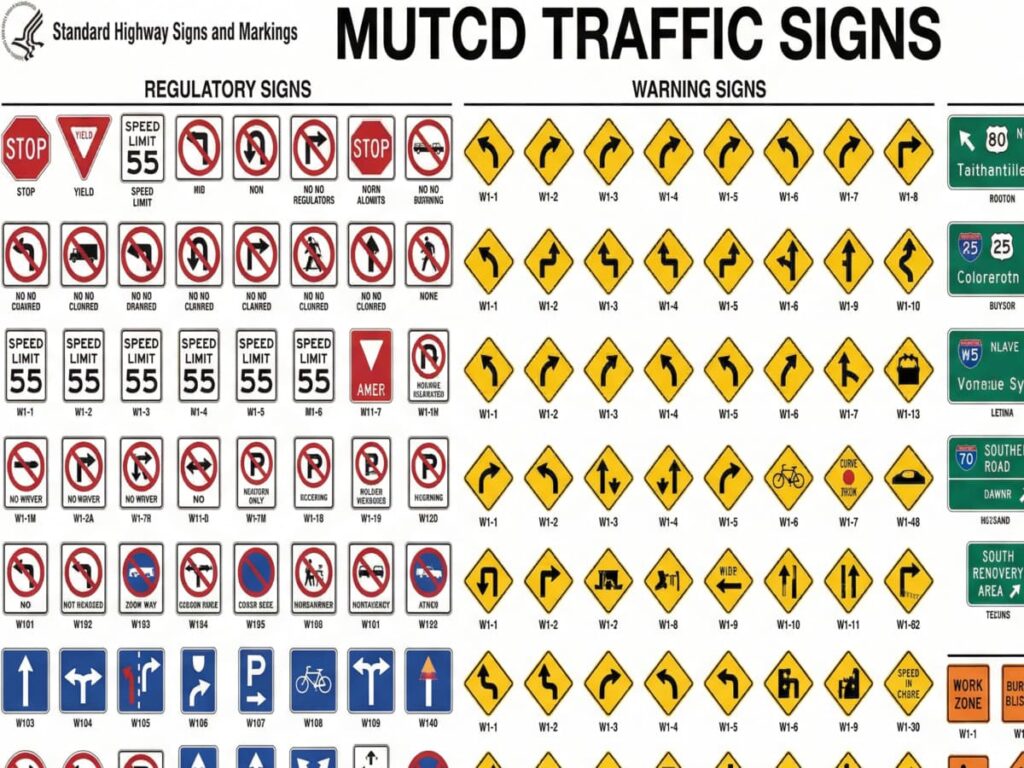
- Form (Section 2A.10): Octagon for stop signs; inverted triangle for yield signs; diamond for warning signs; rectangle for regulatory and informational signs. Custom shapes are only permitted for private property applications
- Retrorefektivität (Sections 2A.08 and 2A.09, Table 2A-5): All public road signs operating at night must meet minimum retroreflectivity levels. Agencies must implement an assessment or management method to maintain those levels over time
- Letter height and font (Section 2A.14): MUTCD specifies minimum letter heights based on road speed and sign type; Highway Gothic is the standard font for public road signs
- Größe (Section 2A.12): MUTCD provides minimum size tables by sign type and road classification; custom dimensions must meet or exceed those minimums
What Can Be Customized Within MUTCD
Within those constraints, buyers have meaningful customization options. Message content is explicitly permitted to be custom on many sign types — “Private Road — Residents Only,” site-specific speed limits on private property, custom detour text, and supplemental panels below standard signs are all examples. Zusätzlich, bilingual text is permitted as long as the primary MUTCD-compliant legend is maintained at the required size. Logo and branding are permitted on private property and facility signs, though not on public road regulatory or warning signs. Mounting configuration — custom hole patterns, frame systems, and post diameter — is freely specifiable regardless of sign type.
For a detailed overview of how MUTCD interacts with customization decisions across US, australisch, und internationalen Standards, sehen Safety Road Signs: MUTCD, ALS 1742, und Wiener Konvention.
Printing Methods for Custom Road Signs
The printing method determines how custom graphics, Text, and colors are applied to the sign substrate. Two methods dominate road sign manufacturing, each with distinct advantages depending on order volume and design complexity.
Siebdruck
Screen printing applies ink through a mesh stencil onto the sign substrate. It delivers consistent, opaque color reproduction across large production runs. It also performs well for custom signs with simple text and solid color fields. Unit cost falls significantly with volume — therefore, screen printing is the most cost-effective method for bulk custom road sign orders with consistent designs.
Screen printing is the preferred method for high-volume municipal orders, construction sign series, and any custom sign order where the same design repeats across hundreds or thousands of units.
Digitaldruck
Digital printing applies ink directly from a digital file, without physical stencils or setup costs. It handles complex gradients, detailed logos, photographic elements, and multi-color designs that screen printing cannot reproduce economically. Darüber hinaus, it is more cost-effective for smaller quantities and for orders requiring frequent design variations.
For custom road signs with complex branded graphics, facility maps, or detailed directional diagrams, digital printing provides higher design fidelity. Jedoch, buyers should specify UV-resistant inks and compatible outdoor laminates — not all digital printing setups use outdoor-grade materials by default. For a full comparison of both methods, sehen Screen vs Digital Printing for Road Signs.
How to Order Custom Road Signs at Scale
Schritt 1: Define Specifications Before Contacting Suppliers
Incomplete specifications are the most common cause of production delays and rework in custom road sign orders. Before requesting a quote, buyers should define the following:
- Sign type and intended location (public road, Privateigentum, industrial facility)
- Substrate material and thickness (aluminum 0.080″ / 0.125″, PVC, other)
- Abmessungen (width × height in inches)
- Reflektierende Foliensorte (Z.B / HÜFTE / DG per ASTM D4956)
- Message content and language(S), with exact text confirmed
- Quantity and delivery timeline
- Mounting configuration (hole pattern, frame type, post diameter if applicable)
- Applicable MUTCD compliance requirements for the installation location
Providing complete specifications upfront reduces back-and-forth, accelerates quoting, and ensures the first sample accurately represents the final product.
Schritt 2: Review Digital Proofs
Reputable road signs manufacturers provide digital proofs before production begins. Review proofs carefully for text accuracy, Schriftgröße, color match, and layout proportions. Errors caught at the proof stage cost nothing to fix. Errors caught after production means reprinting at full cost.
For MUTCD-compliant custom signs, verify that the proof reflects correct color, minimum letter height per Section 2A.14, and required retroreflectivity notation before approving production.
Schritt 3: Request a Physical Sample
For bulk orders above a threshold the buyer sets, always request a physical sample before approving the full production run. Physical samples reveal color accuracy under actual lighting conditions, reflective sheeting performance at night, substrate rigidity, edge finishing quality, and mounting hole placement — none of which are fully assessable from a digital proof alone.
Schritt 4: Confirm Lead Times and Shipping
Lead times for custom road signs vary by order volume, design complexity, and current production capacity. Standard bulk aluminum custom signs typically require 7–15 business days of production lead time. Complex multi-color or large-format orders may require more. For projects with hard deadlines, confirm lead times and factor in shipping transit time before placing the order.
Why Work with a Dedicated Road Signs Manufacturer
Retail sign suppliers and general print shops can fulfill small custom road sign orders. Jedoch, they are not the right source for bulk procurement. Dedicated road signs manufacturers offer several capabilities that general suppliers cannot match.
Production consistency at scale. A manufacturer with automated inspection systems and standardized production lines delivers consistent retroreflectivity, Farbgenauigkeit, and dimensional tolerances across thousands of units. Retail suppliers sourcing from multiple vendors cannot guarantee this consistency.
Certifications and compliance documentation. Dedicated manufacturers hold ISO 9001 Zertifizierung, Dokumentation zur MUTCD-Konformität, and CE or other international certifications. These credentials are increasingly required in procurement specifications. General print suppliers rarely carry them. For guidance on what certifications to verify before placing a custom road sign order, sehen Key Traffic Sign Standards and Certifications for Business Purchase.
Custom manufacturing capability. Non-standard dimensions, custom hole patterns, specific alloy and thickness combinations, and mixed reflective sheeting grades within a single order all require manufacturing flexibility. Only dedicated road sign production facilities can reliably provide this.
Bulk pricing and logistics. Manufacturers sell direct, eliminating distributor margins. Für große Bestellungen, they also provide consolidated shipping, customs documentation for international procurement, and door-to-door logistics.
For businesses and councils looking specifically at the design process for custom traffic signs — including font choice, color standards, and site installation guidelines — see So entwerfen Sie benutzerdefinierte Verkehrszeichen für Unternehmen und Räte.
Custom Road Sign Specification Checklist
Before placing any bulk custom road sign order, confirm the following:
| Specification Item | Confirmed |
|---|---|
| Installation location (public road / private / industriell) | ☐ |
| Applicable compliance standard (MUTCD section / local supplement) | ☐ |
| Substrate material and thickness | ☐ |
| Sign dimensions (W × H) | ☐ |
| Reflektierende Foliensorte (Z.B / HÜFTE / DG per ASTM D4956) | ☐ |
| Message text finalized and proofread | ☐ |
| Language requirements confirmed | ☐ |
| Quantity and delivery date confirmed | ☐ |
| Digital proof reviewed and approved | ☐ |
| Physical sample approved (für Großaufträge) | ☐ |
| Manufacturer certifications verified (ISO 9001, MUTCD) | ☐ |
FAQ
What is the difference between custom road signs and standard road signs?
Standard road signs carry pre-set text, dimensions, and designs from manufacturer catalogs. Custom road signs let buyers specify message content, dimensions, substrate, reflective sheeting grade, Farbe, und fertig. Both types must comply with MUTCD on public roads. Private property and facility signs, Jedoch, have significantly more design freedom.
Can custom road signs comply with MUTCD?
Ja. MUTCD governs color (Section 2A.11), Form (Section 2A.10), Retrorefektivität (Sections 2A.08–2A.09), and minimum letter height (Section 2A.14). Within those constraints, Jedoch, it explicitly permits custom text on many sign types. Bilingual text, supplemental panels, and custom mounting configurations are all achievable within MUTCD’s framework.
What materials are best for bulk custom road signs?
Aluminium (0.080″ oder 0,125″ Messgerät, 5052 alloy per ASTM B209) is the standard for durable outdoor custom road signs with a 7–10+ year service life. PVC and corrugated plastic suit short-term or indoor applications at lower cost. Reflective sheeting grade — Engineer Grade, Hochintensive Prismatik, or Diamond Grade per ASTM D4956 — should match the installation environment and nighttime visibility requirements.
How long do custom aluminum road signs last?
Custom aluminum road signs with high-intensity prismatic sheeting typically last 7–10 years in standard outdoor conditions. Diamond Grade sheeting can extend service life beyond 10 Jahre. Service life depends on UV exposure, coastal salt air, temperature cycling, and physical impact. Buyers in harsh environments should specify aluminum with additional protective coatings.
What is the minimum order quantity for custom road signs?
Minimums vary by manufacturer and sign type. Dedicated road signs manufacturers typically set minimums of 50–100 units for screen-printed custom signs and lower minimums for digitally printed orders. For large infrastructure projects, manufacturers offer volume pricing tiers that significantly reduce unit cost.
Can custom road signs include company logos?
Yes — on private property and facility signs. MUTCD does not permit commercial logos on regulatory or warning signs on public roads. For private roads, corporate campuses, Industrieanlagen, und Parkplätze, buyers can fully incorporate brand colors, Logos, and custom typography.
How do I verify a road signs manufacturer’s certifications?
Request ISO 9001 certification documentation, MUTCD compliance test reports for relevant sign types, and any regional certifications applicable to the project (CE for European projects, AS/NZS for Australian projects). Reputable manufacturers provide these on request. For a complete guide on what to verify, sehen Key Traffic Sign Standards and Certifications for Business Purchase.
How long does production take for a bulk custom road sign order?
Standard bulk aluminum custom road sign orders typically require 7–15 business days of production lead time after sample approval. Rush production is available from most manufacturers at a premium. Always confirm lead times and add shipping transit time before committing to project deadlines.
Abschluss
Custom road signs bridge the gap between what standard catalogs offer and what specific applications actually require. The fundamentals remain consistent across every project type. Specify the right material and reflectivity grade for the environment. Understand which design elements MUTCD controls — and which it does not. Confirm all specifications before production begins. Work with a manufacturer whose certifications and production capabilities match the scale of the order.
Getting these decisions right from the start prevents rework, Compliance -Probleme, and procurement delays. It also ensures the finished signs perform reliably for their full intended service life.
Explore OPTRAFFIC’s full range of custom safety signage for municipal, Konstruktion, and commercial applications, or contact the OPTRAFFIC team for bulk order pricing and specification support.