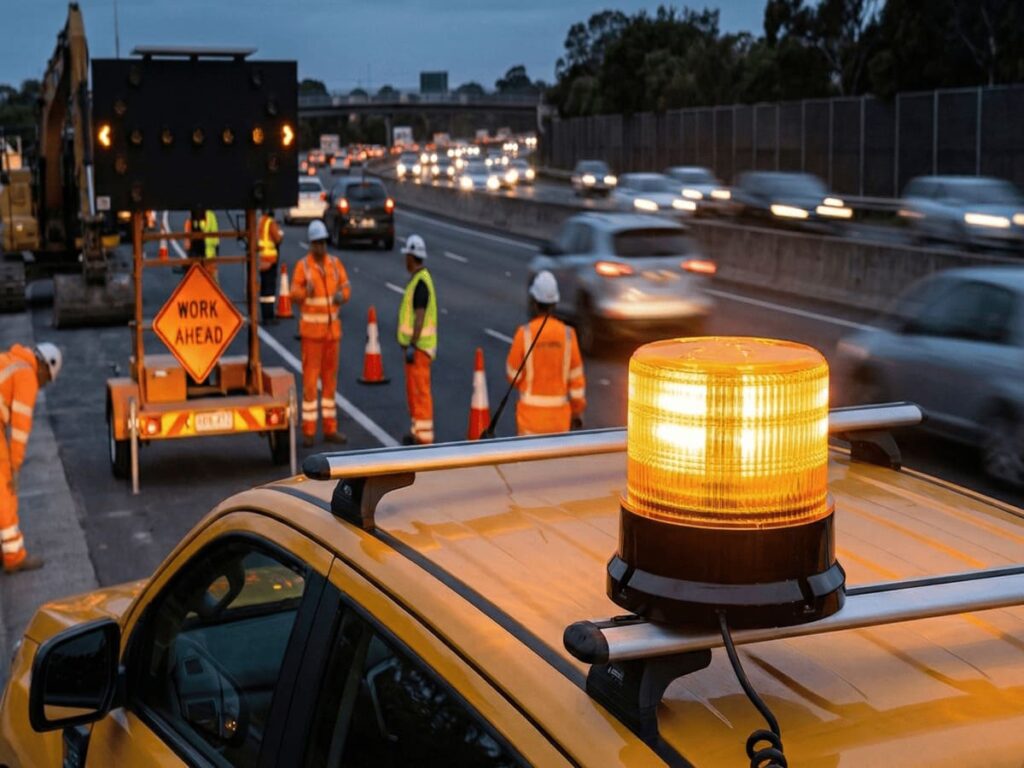
Baubeschilderung turns a chaotic work zone into a route road users can understand. It guides earlier decisions, reduces sudden braking, and protects the space crews need to work.
Work zone safety still demands serious attention. FHWA berichtete 891 work zone fatalities in 2022, and it also noted 94 highway worker occupational fatalities in roadway construction sites that year. In der Zwischenzeit, FHWA’s work zone statistics show fatalities fell 7% aus 2021 Zu 2022, yet several high-risk factors inside work zones still require tight control and consistency.
This guide explains how project teams plan and manage construction signage across the public approach, transition areas, activity zones, and internal jobsite routes. It clarifies where MUTCD governs traffic control devices, where OSHA governs on-site hazard communication, and how reflective sign visibility and routine inspections keep messages readable through daily changes and phased traffic shifts.
Why construction signage matters in work zones
Construction projects compress time and space. Drivers encounter new patterns fast. They may face narrowed lanes, Spurwechsel, Umwege, and workers close to live traffic. daher, clarity beats volume. A smaller number of well-sequenced signs often outperforms a dense wall of messages.
Poor construction signage creates three predictable failures:
- Late decisions: drivers realize the change too late, and they brake or swerve.
- Message conflict: yesterday’s sign remains, and it contradicts today’s traffic pattern.
- Hidden instructions: Ausrüstung, Fechten, or stockpiles block the sign face.
Im Gegensatz, strong construction signage reduces surprise. It also creates a consistent “story” from the first advance warning to the final confirmation.
Construction signage planning framework for every jobsite
Construction signage works best as a three-layer framework. Each layer solves a different problem, so teams can assign ownership and avoid gaps.
Construction signage compliance baseline
Public-facing traffic control devices must align with the Handbuch zu einheitlichen Verkehrskontrollgeräten (MUTCD), which FHWA maintains as the national standard. On-site hazard communication must align with OSHA construction requirements, einschließlich 29 CFR 1926 Subpart G.
This baseline answers one question: What does the controlling authority require here? It also helps resolve conflicts when multiple stakeholders influence the site.
Construction signage visibility performance
A sign can match a template and still fail in real conditions. Night glare, wet pavement reflection, Staub, and dirty sign faces can erase contrast. daher, visibility needs active management, not a one-time purchase decision.
FHWA publishes guidance on minimum sign retroreflectivity requirements and how agencies maintain retroreflectivity through management methods.
Contractors can adopt the same logic at a project level: inspect, measure when needed, and replace based on condition.
Construction signage operational control
Work zones evolve. Crews move barriers. Access points change. Traffic patterns shift by phase. Infolge, the most common signage failures come from change management, not design files.
Operational control answers: Who updates signs today, and who removes outdated messages before traffic uses the new pattern?
Construction site traffic control signage map by zone
A jobsite needs a zone map because each zone has a different decision problem. The map below gives a practical audit tool. It also prevents redundancy because teams stop placing “extra signs” and start covering “missing functions.”
| Jobsite zone | Primary audience | Primary goal | Construction signage that typically carries the load |
|---|---|---|---|
| Public approach and advance warning | Treiber | Early detection and speed adaptation | Work zone warning signs, speed messaging, Spurführung |
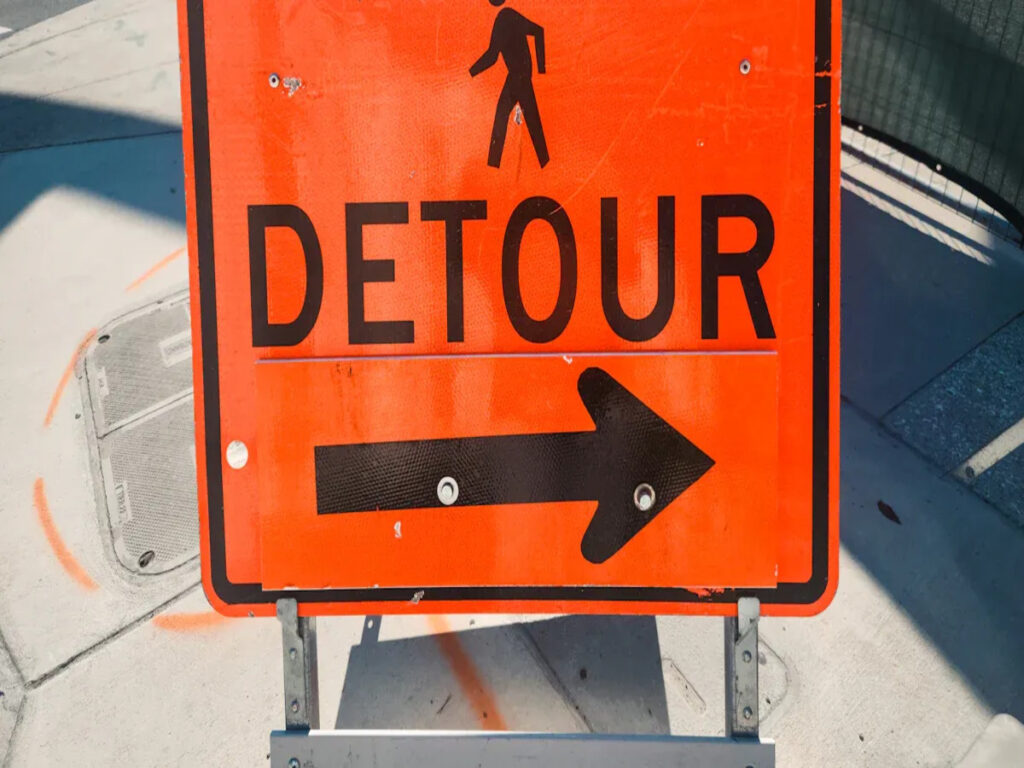
| Transition area | Treiber | Clean merges, fewer last-second moves | Merge/shift sequence signs, detour direction, confirmation signs |
| Activity area | Drivers and workers | Separation and controlled access | Truck entrance, restricted access, work area boundary messaging |
| Internal circulation | Workers and logistics | Prevent conflicts and wrong-way movement | Site directional signs, equipment route signs, pedestrian separation |
| High-risk points | Arbeiter | Hazard recognition and required action | Elektrisch, excavation, overhead lifting, PPE mandatory signs |
| Emergency and egress | Alle | Fast escape and fast response | Emergency exit, muster point, Erste Hilfe, fire equipment signs |
The key idea stays simple: place construction signage where the decision happens, and keep the sequence consistent across days. Jedoch, for infrastructure giants, the challenge extends beyond placement to long-term inventory control. Treating signs as high-value assets rather than disposable costs is the core of Beschaffung von Baubeschilderungen & Vermögensverwaltung, ensuring that every sign is tracked, maintained, and ready for redeployment across multiple project phases.
MUTCD construction signage compliance for public-facing devices
FHWA designated the 11Auflage der MUTCD (vom Dezember 2023) as the current official edition.
FHWA also published a Final Rule in the Federal Register on December 19, 2023, mit Inkrafttreten im Januar 18, 2024.
Für Auftragnehmer, the operational takeaway is not “memorize every update.” Instead, the priority is this: confirm what the controlling authority expects on the roadway you touch (state DOT, local agency, or project owner standards). Then enforce message consistency through the project lifecycle.
Common MUTCD construction signage failure points in real work zones
Teams typically fail in predictable ways:
- They keep yesterday’s sign in place after a phase change.
- They stack too many messages at one decision point.
- They place signs where objects routinely block the driver view.
- They break the sequence, so drivers lose confirmation after a maneuver.
daher, a compliance plan should include a removal plan. It should also include a “drive-through check” from the driver perspective before opening a new pattern.
OSHA construction safety signs for hazard communication on site
OSHA’s construction standards cover Sicherheitsschilder, Signale, and barricades in Subpart G, einschließlich 29 CFR 1926.200. That section includes a critical operational point: OSHA states that accident prevention tags serve as a temporary warning method and must not replace accident prevention signs.
This matters on jobsites because teams often hang tags where a durable sign should sit. Then the warning fades, Tränen, or disappears. Im Gegensatz, a stable safety sign program standardizes three things:
- Signal words and severity (so workers interpret risk consistently)
- Required actions (PS, restricted access, lockout boundaries)
- Placement at the exposure point (where people actually enter the hazard)
Entdecken Sie mehr: a dedicated compliance guide can walk through MUTCD vs OSHA boundaries, documentation expectations, and field-ready checks.
Reflective construction signs and work zone sign visibility
Visibility drives behavior. If a driver sees the message early, they can brake smoothly and merge safely. If they detect it late, they improvise. daher, reflective construction signage should link to detection distance, not only “brightness.”
FHWA provides practical guidance on minimum sign retroreflectivity requirements and examples that illustrate how sheeting selection affects performance. FHWA also explains that agencies can use different methods to maintain retroreflectivity within sign management processes.
A field-friendly visibility selection matrix for construction signage
| Zustand | What fails first | What reflective construction signage should prioritize |
|---|---|---|
| Night work on faster approaches | Detection distance | Higher retroreflective performance, larger legend, strict placement discipline |
| Heavy rain, Spray, or mist | Contrast and legibility | Starker Kontrast, Weniger Wörter, clean faces, stable sign angle |
| Complex detours and lane shifts | Driver decision load | Clear arrows, consistent sequence, remove outdated signs immediately |
| Urban pedestrian edges | Conflicts at crossings | Clear separation messaging, wayfinding at decision nodes, consistent repetition |
Zusätzlich, crews should treat sign cleanliness as performance control. Dust and road grime can reduce contrast and legibility, especially under headlights.
Temporary construction signs vs permanent construction signs
Many jobsite teams debate “temporary vs permanent” as a cost question. In the field, it is usually a change-rate question.
When temporary construction signage wins
Temporary construction signs fit projects that shift often: Dienstprogramme, Aufenthalt, short closures, rapid staging changes. They deploy fast. They also relocate easily.
Jedoch, they demand discipline. Umgang mit Schäden, Biegen, and face abrasion show up quickly. daher, inspection cadence becomes non-negotiable.
When permanent construction signage wins
Permanent construction signage fits long-duration work: multi-season projects, long detours, sustained access control at major projects. Durable substrates reduce replacement cycles. They also keep the visual language consistent across phases.
If you want a clearer way to choose between temporary and permanent signs for your specific schedule, Verkehrsbedingungen, and phase changes, lesen Vorübergehend vs. Permanente Verkehrszeichen: Welches benötigen Sie für Ihre Bauzone??
Construction sign installation and placement best practices
A strong placement plan relies on human behavior. Drivers scan and decide in sequence. Workers move through exposure points. daher, construction signage placement should follow a consistent “decision rhythm.”
Detect, entscheiden, act logic for construction site signage
- Detect: the first sign captures attention early.
- Decide: the next sign supports the lane choice or detour decision.
- Akt: a confirmation sign reassures drivers after the maneuver.
This rhythm reduces late moves. It also lowers the need for extra text.
Preventing blocked views and last-second moves
Blocked visibility is a top field failure. Stockpiles, Fechten, abgestellte Ausrüstung, and even temporary lighting towers can hide a message. daher, crews should add a daily check that answers one question: Can a driver see and read this at the intended approach?
Zusätzlich, avoid placing multiple signs where drivers cannot process them. Stattdessen, distribute messages across decision nodes.
Construction signage inspection cadence and replacement triggers
A jobsite should align inspection frequency to volatility:
- High-change zones: inspect more often, especially after every phase change.
- Stable zones: inspect on a scheduled cadence, then replace based on condition.
Replacement triggers should include:
- Faded legend or background that reduces contrast
- Face damage that affects retroreflective return
- Misalignment, Obstruktion, or wrong placement angle
- Conflicting messaging after pattern changes
Change management for construction signage
Most sites install signs. Fewer sites manage sign change. The best teams treat change management as a checklist item at every traffic pattern shift:
- Remove or cover obsolete messages.
- Confirm the full sequence from advance warning to confirmation.
- Drive the route like a first-time road user.
For step-by-step placement and setup details—mounting stability, installation height, lateral offset, and common field fixes—see Der professionelle Leitfaden für die Installation von Bauschildern.
Construction sign applications across the full jobsite
Construction signage should match real workflows. That means aligning signs with where people actually move and where hazards actually exist.
Construction signage for excavation, elektrisch, and lifting operations
High-risk operations need hazard recognition and required action. Place signage at entry points to the exposure area. Then reinforce it at the hazard boundary.
Zum Beispiel:
- Excavation areas need boundary communication and access control.
- Electrical hazards need clear warnings and action messaging near exposure points.
- Overhead lifting zones need restricted entry and “do not stand under load” reinforcement.
The goal stays consistent: prevent accidental entry and enforce predictable movement.
Construction signage for truck entrances, equipment routes, und Lieferungen
Logistics failures damage safety and productivity at the same time. Wrong gate entry triggers reversing conflicts. Equipment meets pedestrians in shared space. daher, internal construction signage should define:
- Truck entrance points and restricted entry
- One-way routing where needed
- Pedestrian separation near high-traffic corridors
- Delivery staging rules near active work areas
Construction signage for pedestrian detours and public interface zones
Pedestrians interpret space differently than drivers. They follow “desire lines.” They also respond to the most visible cue, not the most correct plan. daher, detour signage must appear at the point of choice, and it must remain consistent across the detour path.
For zone-by-zone examples and trade-specific use cases—so you can match signs to real tasks and site layouts—see Anwendungen für Bauschilder auf der gesamten Baustelle.
Construction sign costs, ROI, and risk reduction
Baubeschilderung ROI does not come from the sign itself. It comes from what the sign prevents: Verwirrung, nacharbeiten, Beinaheunfälle, and incident exposure.
What drives construction sign cost
Costs typically move with these variables:
- Material durability and substrate thickness
- Reflective performance level and service life expectations
- Sign size and legibility needs
- Mounting method and environmental exposure
- Compliance expectations and inspection discipline
daher, cost discussions should start with conditions: Nachtarbeit, speed environment, change rate, and exposure severity.
How construction signage improves ROI on active jobsites
Clear construction signage improves ROI through operational stability:
- Fewer wrong turns and fewer delivery delays
- Fewer work stoppages from near-miss events
- Less rework caused by misrouted traffic and unclear access control
- Better defensibility after incidents because the site can show a managed system
The safety context strengthens the case. NSC’s work zone crash figures for 2023 highlight how persistent the risk remains.
For a deeper look at how construction signs affect budgets beyond the upfront price—through reduced rework, fewer disruptions, and lower risk—read Finanzielle Auswirkungen von Bauschildern.
Sustainable construction signage for modern job sites
Sustainability should stay practical. Job sites care about waste, handling time, and replacement frequency. daher, sustainability often starts with Haltbarkeit.
Durability drives sustainability. High-performance signage reduces replacement cycles and prevents costly downtime from unreadable messaging. For long-term reliability, Optraffic recommends specifying Materialien für Bauschilder, die auch rauen Baustellenbedingungen standhalten—utilizing UV-resistant substrates and anti-abrasion coatings to ensure sign lifecycles align with your project’s duration.
Durability as sustainable construction signage
Longer-lasting signs reduce replacement cycles. They also reduce jobsite downtime from missing or unreadable messages. Zusätzlich, durable signs reduce scrap and handling waste over the project lifecycle.
Recyclable materials and waste reduction in construction signs
Where feasible, recyclable substrates and responsible end-of-life handling reduce environmental impact. Noch wichtiger, they support owner sustainability targets without compromising compliance or visibility performance.
For practical ways to reduce waste without sacrificing durability or compliance, sehen Beschilderung für nachhaltiges Bauen: Umweltfreundliche Lösungen für Baustellen.
OPTRAFFIC construction signage support for job sites
OPTRAFFIC unterstützt Baubeschilderung programs with a focus on consistency and field reliability. That matters when contractors run multiple active sites and need repeatable messaging, stable quality, and visibility options that match real conditions.
OPTRAFFIC can support teams that want to standardize:
- Construction signage across projects
- Reflective construction sign options aligned to night work and harsh weather
- Durable substrates for high-handling environments
- Consistent appearance across phased work, so crews recognize sign language faster
- One-stop ordering, combining standard MUTCD-style work zone signs, custom jobsite safety signs, and matching hardware so teams source, replace, and scale faster
FAQ construction signage for job sites
Does one standard cover every construction signage need?
NEIN. MUTCD governs traffic control devices for public travel contexts under FHWA. OSHA governs construction workplace signage requirements, einschließlich 29 CFR 1926 Subpart G and 1926.200. daher, sites should align both, especially at entrances and mixed-use areas.
Why do construction signs fail even when they look compliant?
Real conditions defeat “paper compliance.” Night glare, rain spray, Staub, and dirt reduce legibility. Phase changes also create message conflict. daher, inspection cadence and change management matter as much as initial selection.
What makes retroreflectivity management credible on a jobsite?
FHWA explains minimum sign retroreflectivity requirements and also describes methods agencies use to maintain retroreflectivity. A credible jobsite program documents checks, replaces signs based on condition, and keeps messages consistent through changes.
Why should contractors track the MUTCD 11th Edition?
FHWA identifies the 11th Edition (Dezember 2023) as the current edition, and the Federal Register Final Rule set an effective date of January 18, 2024. Contractors should track controlling authority expectations because state and agency adoption influences enforcement and standard plans.